
 THE LAST GENERATION – A STORY OF THE FUTURE (1908) – Written by James Elroy Flecker. A poet longs to see beyond his own era and experiences. He is visited by a time-travel phenomenon which is similar to a wind. The Time Wind transports him to various periods in the future.
First the wind takes him to future Birmingham, England, where a mad fanatic named Joshua Harris and his co-conspirators are planning to launch their coup the next day. He and his followers aren’t motivated by pure politics but by their belief that all of life is nothing but misery and can be ended only by death. They plan to seize power and set the human race on the path to extinction. Continue reading
 THE AUTOMATIC BRIDGET (1889) – Written by Howard Fielding (pen name of Charles Witherle Hooke). This was an early short story about a robot run amok.
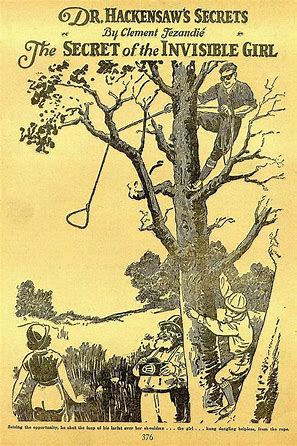 THE SECRET OF THE SUPER-TELESCOPE (August 1923) – Doctor Hackensaw’s new invention, a super-telescope, provides the most detailed looks at Earth’s moon ever seen. A secret civilization is detected and photographed. NOTE: This is the start of the first serialized Hackensaw storyline.
 DOCTOR HACKENSAW’S SECRETS – Written by Clement Fezandie. Doctor Hackensaw and his adventures were similar to Paul B’Old’s short stories about Professor Jerome Mudgewood, but with less emphasis on humor. Both figures dealt with the often destructive consequences of their own inventions or discoveries. Ferzandie’s Hackensaw tales were published in the magazine Science and Invention.
 RED STAR (1908) – Written by Alexander Malinowski under the name Alexander Bogdanov. This pro-communist science fiction novel came three years after the failed uprising of 1905 and sixteen years BEFORE Aelita: Queen of Mars, a silent sci-fi film which depicted a similar communist paradise on Mars.
 They reveal that Lenni’s brilliant paper described the concepts of nuclear fission and anti-gravity that the Martians use in their spaceships. Recognizing his superior mind they sought him out in order to take him on board their interplanetary vessel and transport him to Mars. Once there they will let him observe their culture like they secretly observed Earth culture during their stay.
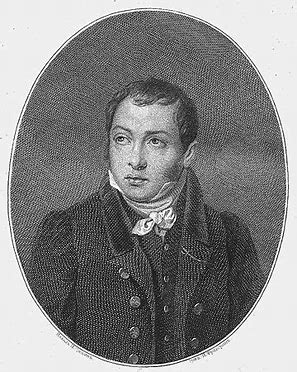 A JOURNEY IN THE TWENTY-NINTH CENTURY (1824) – Written by Faddei Bulgarin, who had served in the Polish Legion of Napoleon’s Grand Army in his youth before going on to work for the Czars of Russia. In this fascinating tale an unnamed narrator gets swept overboard in the Gulf of Finland in 1824. The cold water and another element somehow put him in suspended animation and when he comes to he is all the way over in Siberia, where his body was recovered in the waters of Cape Shelagski centuries after he was lost at sea.
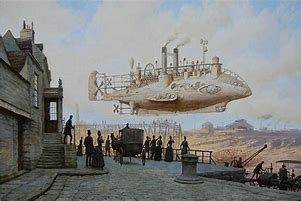 THE YEAR 4338, LETTERS FROM PETERSBURG (1835) – Written by Vladimir Fedorovich Odoevski. Set in the year 4338 A.D. this novel is told through correspondence from Hyppolitus Tsungiev, a Chinese college student in Saint Petersburg to Chinese friends in Peking. In that far future year Saint Petersburg has grown to be a megalopolis so large that it extends all the way to Moscow.
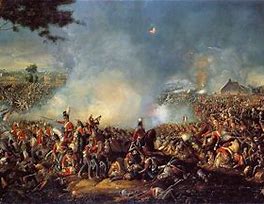 WHAT IF NAPOLEON HAD WON AT WATERLOO? (June 18th 1815) – In 1907 G.M. Trevelyan penned an essay on this topic. In Trevelyan’s take, Napoleon had been chastened by his temporary exile to Elba before escaping and regaining control of France.
 THE WRECK OF A WORLD (1889) – Written by W. Grove. (No other name available) This novel is the sequel to Grove’s A Mexican Mystery, an ahead-of-its-time work about a train engine devised to have artificial intelligence. The machine – called only The Engine in that story – rebelled and took to preying on human beings in horrific fashion. For Balladeer’s Blog’s review of that novel click
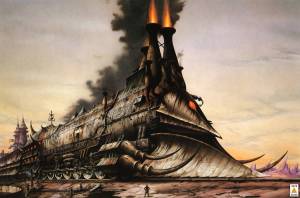 Our story begins in what was to Grove “the far future” of 1949. After a fairly superficial depiction of the world’s political and scientific situation in this imaginary future the meat of the tale begins. All in all the author did not present 1940s technology as being much more advanced than what was available in the 1880s. Grove might have done better to set his tale in 1899 or just into the 1900s to detract from his lack of vision on this particular element.
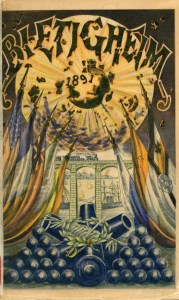 BIETIGHEIM (1886) – Published anonymously in 1886 this work of alternate history accurately predicted some of the actual results and fallout of the coming First World War (1914-1918). Bietigheim is presented as a series of John Minor lectures about world history as seen from “futuristic” 1932.

