
Last weekend’s escapist superhero post from Balladeer’s Blog looked at the earliest Dr. Doom stories and was a big hit. This time I’m looking at the earliest Red Skull stories.
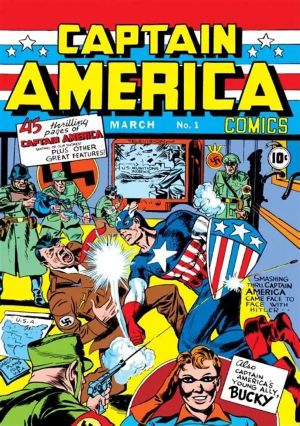 CAPTAIN AMERICA COMICS Vol 1 #1 (March 1941)
Story 5: The Riddle of the Red Skull
Synopsis: Even though America has not yet entered World War 2, Nazi agent the Red Skull has been sending his calling cards to assorted American military and intelligence figures, then inevitably ambushes and kills them shortly afterward with poison from a hypodermic needle.
Major Croy is the latest figure to receive the Red Skull’s card. Steve Rogers and J.B. Barnes try to protect him but he waves off the offer. The Red Skull shows up and kills Croy.
Captain America recognizes how deadly the Red Skull is and orders Bucky to stay out of this case. The sidekick investigates on his own and gets captured by the Red Skull and his men. Captain America shows up and frees him, but the Skull and his underlings escape.
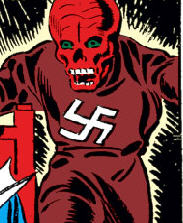 The next day at Camp Lehigh, Rogers and Barnes witness the fiery destruction of industrialist George Maxon’s latest military aircraft during a test flight. The Red Skull is behind this, too. That night the Skull shows up at the home of General Charles Manor in the Virginia suburbs and kills him.
Before he can escape, Captain America shows up. It turns out that the Red Skull has been using George Maxon as an agent and Maxon dies in the fight with Cap. The Red Skull himself is still at large and Cap discovers a note proving that the Skull answers directly to Hitler himself. Continue reading
 FANTASTIC FOUR Vol 1 #5 (July 1962)
 To save any innocent bystanders from harm, our heroes do so. They meet the armored Dr. Doom, who explains that his experiment which went awry and caused his expulsion long ago left his face scarred, so he now hides it behind a steel mask.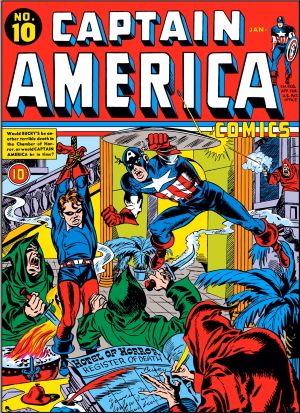
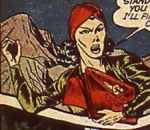 Our heroes don their costumes and as Captain America and Bucky they find Mara’s lair and defeat all her Nazi troops and her booby-traps. Then Cap defeats the countess and her purse’s weaponry – grenades, a gas-gun and a regular gun.
 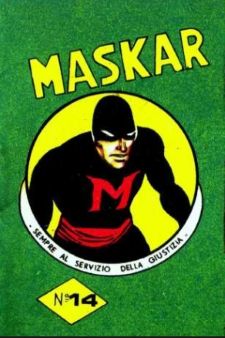 MASKAR
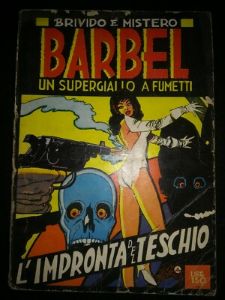 BARBEL
 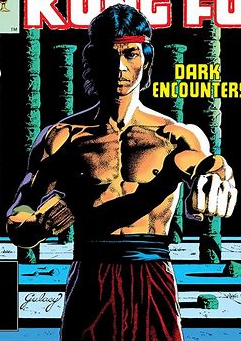 For newbies to this IP, in 1973 Marvel licensed the use of Sax Rohmer’s Fu Manchu plus other characters from the Fu Manchu tales. Rather than just churn out a Fu Manchu comic book series “the House of Ideas” instead combined it with the Kung Fu craze of the time and created Shang Chi, the son of Fu Manchu.
 Shang-Chi, Master of Kung Fu had its own inimitable style and was largely one of the most innovative comic books of the 1970s and early 1980s. “Largely” is the key word.
  MASTER OF KUNG FU Vol 1 #29 (Jun 1975)
  Our heroes take a seaplane to Velcro’s mansion in a grotto near France’s Gulf of Lions. Reston poses as a buyer of a large amount of heroin who then burns all of his purchase and an enormous amount of the drug dealer’s additional inventory of smack.
 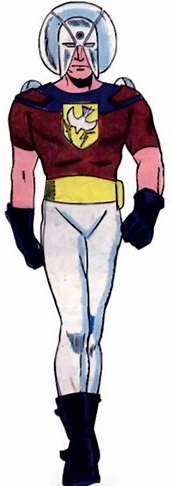 PEACEMAKER
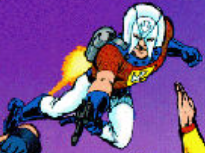 Powers: Peacemaker was in peak physical condition and was a master of armed and unarmed combat. He designed and tested his own weapons in his secret “Peace Palace” lair in the Swiss Alps. Peacemaker’s action outfit included body armor, a jetpack for flight, plus a helmet for protection AND for radio communication. This hero’s weapons included his powered laser gun and the sonic beams shot from his helmet.
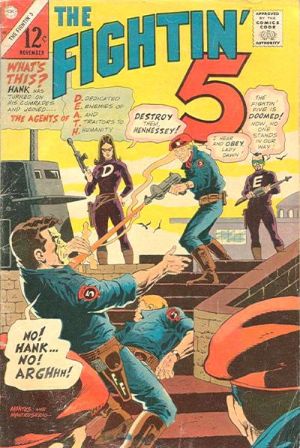 FIGHTIN’ FIVE Vol 1 #40 (Nov 1966)
 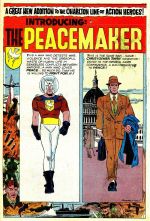 The following day Christopher attends an embassy dinner in Geneva, at which Bork and Smith needle each other. Smith dons his Peacemaker outfit and assembles his weapons, then flies out to Bork’s mansion in the Alps. Bork’s private army tries to kill Peacemaker but he outfights them all.
  WHITE THUNDER
  CANADIANA
 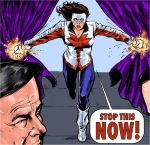 Jennifer proved strong enough to rebel against Robertson and use her powers against him and against his other female acolytes. She adopted the costumed identity Canadiana.
  CREATURES ON THE LOOSE Vol 1 #22 (Mar 1973)
  Synopsis: Thongor (at right), as always wielding his father’s god-forged sword Sarkozan, is working as a thief in the city-state of Zangabal. During one caper Thongor comes close to being captured by the authorities but is given shelter by Kaman Thuu, a Priest of the Seven Gods of Zangabal.
 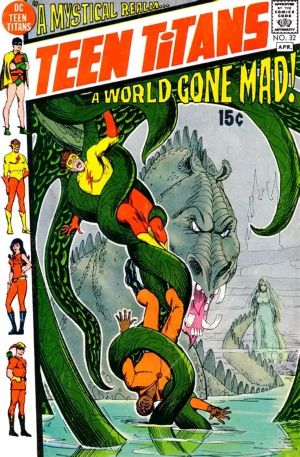 TEEN TITANS Vol 1 #32 (Apr 1971)
 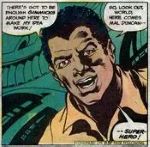 When they return to their own time period it turns out that Gnarrk’s death caused a butterfly effect and the “present” is now ruled by an evil version of Loren Jupiter called Jupiterius. He rules the world with Lilith’s (on stairs) sorcery, monsters and the evil counterparts of what would have been the other Teen Titans.
 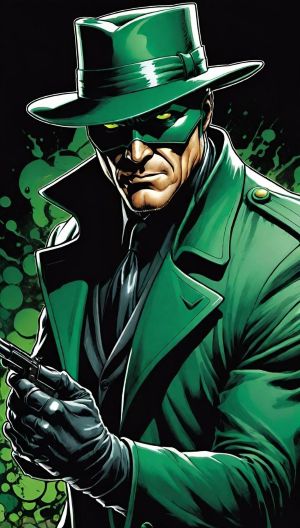 This weekend’s superhero post from Balladeer’s Blog looks at some of the earliest comic book adaptations of the iconic character the Green Hornet. That figure originated on radio in January 1936 and in a very early example of a shared universe, the Green Hornet’s secret identity was Britt Reid, grand-nephew of John Reid – the Lone Ranger.
 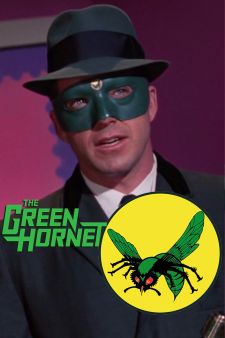 And just as the Lone Ranger show’s theme music came from classical music – the William Tell overture – the Green Hornet show’s theme came from Rimsky-Korsakov’s Flight of the Bumble Bee.
 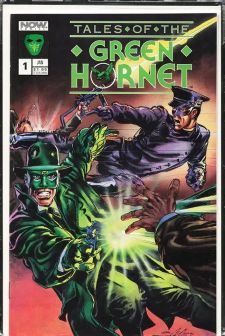 The police and even Daily Sentinel crime reporter Mike Axford (formerly of the 1932 radio series Warner Lester, Manhunter) misunderstood the Green Hornet’s vigilante activities and suspected the masked hero of being a criminal himself. The Hornet took advantage of that misperception by convincing some of his gangster foes that he was indeed an outlaw and wanted a cut of their illegal operations.
  Balladeer's Blog