
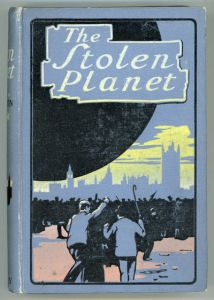
 THE STOLEN PLANET (1906) – Written by John Mastin. Jervis Meredith, a wealthy young British man and his equally wealthy friend Fraser Burnley are so brilliant they invent anti-gravity. Next the young tycoons have a spaceship built so they can use their anti-gravity device to tour outer space.
The battleship-sized craft is named The Regina and combines propellers with Meredith and Burnley’s anti-gravity invention. The friends set off with a ten-man crew and – oddly enough – they are so paranoid about people stealing their secrets they have rigged an elaborate bugging system throughout the Regina so they can know what the crew members talk about.
 The explorers make the eccentric decision to explore the region around Sirius first, rather than our own solar system. Enroute the Regina accidentally pulls an uncharted planet out of its orbit (?) and causes it to collide with another uncharted planet. This collision causes a new sun to be born. (Regular readers of Balladeer’s Blog will remember that this was apparently a big idea for a time since a lot of these old stories feature suns forming from colliding planets.)
Eventually our heroes decide to explore some planets on their way to the star Sirius. On the first planet they visit the explorers find enormous ruins obviously built by a gigantic race that is now extinct. The structures were beautiful from what can be made out and are made of materials unknown on Earth. Continue reading
 A FLIGHT TO THE MOON (1813) – Written by George Fowler. This story introduces readers to Randalthus (no last name given), an 1800s American man who has come to regard the moon with a mixture of near-pagan worship and pioneer longing.
 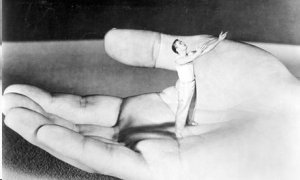 THE ADVENTURES OF A MICRO-MAN (1902) – This work of vintage or “ancient” science fiction was authored by Lancelot Bayly under the pen name Edwin Pallender. The central character of the story was Doctor Geoffrey Hassler, a wealthy eccentric scientist who has discovered “microgen” a gas which shrinks objects down to a very small size.
  Dr Hassler’s demonstrations of the procedure in a diving-bell shaped chamber convinces even the skeptics and he rakes in even more money plus scientific recognition. One day when he, his daughter Muriel, her fiancee Gerald and a family friend named Reverend Eden are all inside the chamber a fluke accident causes them all to be shrunk down to a fraction of an inch.
  A NARRATIVE OF THE TRAVELS AND ADVENTURES OF PAUL AERMONT AMONG THE PLANETS (1873) – I shortened the title when naming this blog post. Paul Aermont was the pseudonym of an unknown author, so full credit cannot be officially given.
  MEDA: A TALE OF THE FUTURE (1891) – This sci-fi tale of the year 5575 AD was first written in 1888 but read mostly among the social circle of the author. Its first official publication came in 1891.
  THE HAMPDEN-SHIRE WONDER (1911) – Written by J.D. Beresford. The story centers around Victor Stott, the remarkable son of Cricket star Ginger Stott. A news reporter who is on friendly terms with Ginger Stott meets his one year old child Victor during a train trip.
  THE ARCTIC DEATH (1927) – Written by Wilford Allen, On A Far World, covered below, was a prequel to this same tale. The Arctic Death is set in the 1930s, which was “the near future” when the story was first published.
  THE AURORAPHONE (1890) – Written by Cyrus Cole. This fun piece of vintage or “ancient” science fiction features the character Gaston Lesage, an eccentric genius who moves to the mountains of Colorado to continue his pet experiments. Lesage is obsessed with perfecting transmission and reception of radio signals, especially regarding potential contact with other planets.
 THE LAST GENERATION – A STORY OF THE FUTURE (1908) – Written by James Elroy Flecker. A poet longs to see beyond his own era and experiences. He is visited by a time-travel phenomenon which is similar to a wind. The Time Wind transports him to various periods in the future.
  THE AUTOMATIC BRIDGET (1889) – Written by Howard Fielding (pen name of Charles Witherle Hooke). This was an early short story about a robot run amok.
