Tag Archives: superheroes

SHANG-CHI, MASTER OF KUNG FU: THIRD LOOK

Back in 2021 I reviewed the first 12 1970s stories featuring Marvel’s martial arts hero Shang-Chi HERE. Then in 2024 I reviewed several stories which teamed up Shang-Chi and another 70s Marvel kung fu hero – Iron Fist, HERE.
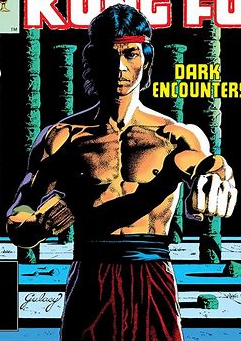
For newbies to this IP, in 1973 Marvel licensed the use of Sax Rohmer’s Fu Manchu plus other characters from the Fu Manchu tales. Rather than just churn out a Fu Manchu comic book series “the House of Ideas” instead combined it with the Kung Fu craze of the time and created Shang Chi, the son of Fu Manchu.

Shang Chi, as a surrogate Bruce Lee, and Sir Denis Nayland-Smith, as a surrogate Braithwaite from Enter: The Dragon, were the core of the new series. Shang Chi started out as an operative of his evil father Fu Manchu but realized the error of his ways and threw in with Sir Denis and his team to battle his father’s malevolent schemes.

Many of Sax Rohmer’s other characters showed up in the series, including Fah Lo Suee, the daughter of Fu Manchu. The series expanded from just Fu Manchu storylines. Writer Doug Moench and artist Paul Gulacy churned out some of the best stories in this title, with Gulacy often drawing Shang-Chi to resemble the late Bruce Lee.

Shang-Chi, Master of Kung Fu had its own inimitable style and was largely one of the most innovative comic books of the 1970s and early 1980s. “Largely” is the key word.

Idiotically, Marvel depicted Shang-Chi forever barefoot and forever wearing a goofy outfit like he was advertising a local martial arts academy. It mars the MOKF series as surely as the artwork for Ebony drags down 1940s and 1950s Spirit stories. So, when possible I will sprinkle in pics of 1970s martial arts movie star James Ryan who genuinely looked like Shang-Chi but wearing regular clothing. 

MASTER OF KUNG FU Vol 1 #29 (Jun 1975)

Title: The Crystal Connection

Villains: Velcro and Razor-Fist

Synopsis: Sir Denis Nayland Smith has Shang-Chi join him and other team members in a mission against international heroin dealer Carlton Velcro. The other team members are series regular Black Jack Tarr, former Royal Marine Commando, and semiregular Clive Reston, a walking meta reference.

NOTE: Clive Reston is a capable espionage agent whose schtick was that offhand references he makes establish something that is never specifically spelled out – his father must be James Bond and his grand-uncle must be Sherlock Holmes. It was kind of clever at first but eventually grew tiresome.

Our heroes take a seaplane to Velcro’s mansion in a grotto near France’s Gulf of Lions. Reston poses as a buyer of a large amount of heroin who then burns all of his purchase and an enormous amount of the drug dealer’s additional inventory of smack.

All this was a distraction to allow Shang-Chi and Black Jack Tarr to infiltrate the mansion. Reston ends up captured and Shang-Chi comes face to face with Velcro’s bodyguard Razor-Fist in their VERY FIRST encounter. Continue reading

14 Comments

Filed under Superheroes

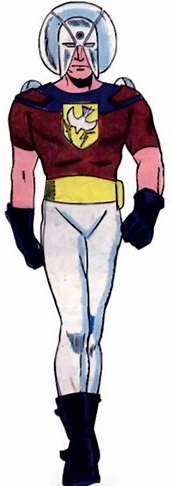
PEACEMAKER BEFORE D.C. COMICS OWNED THE CHARACTER

This weekend’s light-hearted, escapist superhero post from Balladeer’s Blog will look at the Charlton Comics hero Peacemaker BEFORE DC Comics bought him and changed him. 

PEACEMAKER

Secret Identity: Christopher Smith

First Appearance: Fightin’ 5 #40 (November 1966)

Origin: American diplomat and scientist Christopher Smith was a noted pacifist in his public persona but was secretly affiliated with the Pax Institute’s covert operations arm in Geneva, Switzerland.

When peaceful solutions to an international situation hit a dead end, Smith donned the costume of his alter ego Peacemaker, who used violence against global dictators and other aggressors to nip potentially larger conflicts in the bud. 

This hero’s adventures were every bit as focused on Cold War situations as early Marvel Comics stories were in Iron Man and the The Hulk

Powers: Peacemaker was in peak physical condition and was a master of armed and unarmed combat. He designed and tested his own weapons in his secret “Peace Palace” lair in the Swiss Alps. Peacemaker’s action outfit included body armor, a jetpack for flight, plus a helmet for protection AND for radio communication. This hero’s weapons included his powered laser gun and the sonic beams shot from his helmet.
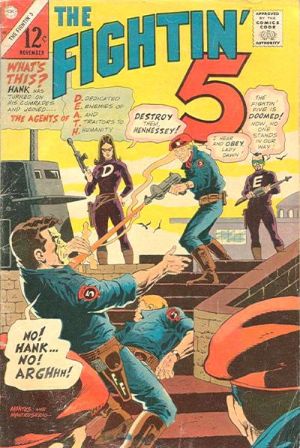
Comment: Peacemaker was the model for the Comedian in Watchmen, but the original Charlton version was neither the violent maniac of Watchmen nor the buffoonish character from recent movies and television shows.

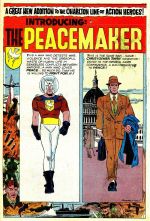
FIGHTIN’ FIVE Vol 1 #40 (Nov 1966)

Title: Introducing the Peacemaker

Villain: Emil Bork, Arms Dealer

Synopsis: Diplomat Christopher Smith is in his car in Geneva, Switzerland being briefed about international arms dealer Emil Bork by his secretary Miss Blair. The weapons merchant has agents in two fictional South American countries egging on their war so that Bork can make more and more money. Two agents of Bork try to kill Smith and Blair but fail.   

The following day Christopher attends an embassy dinner in Geneva, at which Bork and Smith needle each other. Smith dons his Peacemaker outfit and assembles his weapons, then flies out to Bork’s mansion in the Alps. Bork’s private army tries to kill Peacemaker but he outfights them all.
He then interrogates a defeated mercenary and learns that Emil has just flown off for South America to exacerbate the war between the two nations he is profiting from. Our hero flies off after Bork’s overhead jet but the villain fires a missile at him. Peacemaker damages it with his laser but the missile still goes off with him in the blast range.    Continue reading

10 Comments

Filed under Superheroes

NEGLECTED CANADIAN-MADE SUPERHEROES

This weekend’s escapist, light-hearted superhero post from Balladeer’s Blog looks at several neglected Canadian-made characters. FOR THEIR GOLDEN AGE HEROES (1941-1950) CLICK HERE.

WHITE THUNDER

Debut Year: 1982

Secret Identity: Scott Garvey

Origin: Bartender Scott Garvey was beaten nearly to death by street thugs. When his survival seemed hopeless, the hospital used experimental drugs on him. An unrelated electric shock interacted with the chemicals and healed Scott. It also granted him superpowers which he kept to himself so he could adopt the costumed identity White Thunder to get revenge on his attackers, then go on fighting crime.

Powers: This hero could fly, generate electricity and shoot electrical blasts from his hands.

CANADIANA

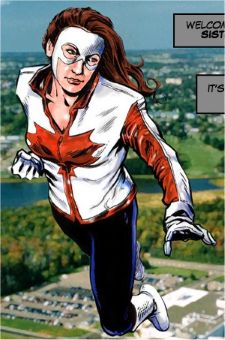
Debut Year: 2004

Secret Identity: Jennifer Neuwirth

Origin: Jennifer’s parents were flakey people who drifted to every cult that came along, taking their young daughter with them. The latest cult they became involved with was run by a charismatic but sinister man named Robertson. No first name was ever given.

      Robertson indulged in the grooming of the teenage daughters of his followers and Jennifer’s parents blithely let her become his latest victim. The cult leader tutored the young women, bringing out superpowers in them and using them as pawns in his villainous activities.

      Jennifer proved strong enough to rebel against Robertson and use her powers against him and against his other female acolytes. She adopted the costumed identity Canadiana.

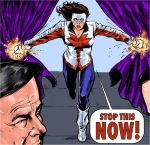
Powers: Canadiana was strong enough to easily lift a standard 4-door car and carry it with her. She could also fly at 600 kph, generate an energy force field around herself, teleport and release energy through her hands to burn or disintegrate objects with her touch. Jennifer could transform from her street clothes into her Canadiana costume and back again at will. She calls herself “the spirit of Canada.”  Continue reading

14 Comments

Filed under Superheroes

THONGOR! WARRIOR OF LOST LEMURIA (1973-1974)

This weekend’s light-hearted, escapist superhero post from Balladeer’s Blog looks at the Marvel Comics adaptation of Lin Carter’s sword and sorcery hero Thongor.

CREATURES ON THE LOOSE Vol 1 #22 (Mar 1973)

Title: Thongor! Warrior of Lost Lemuria

Villain: The Demon of Zangabal

NOTE: Pop fiction writer Lin Carter started writing stories about his character Thongor in the 1960s. He was like a cross between two Robert E. Howard creations – Conan the Barbarian and Kull the Conqueror, whose adventures were set on the ancient continent of Atlantis before it sank beneath the waves. Thongor was a sword and sorcery barbarian of sorts whose adventurers were set on ancient Lemuria, the Pacific Ocean version of Atlantis, before it sank.   

Synopsis: Thongor (at right), as always wielding his father’s god-forged sword Sarkozan, is working as a thief in the city-state of Zangabal. During one caper Thongor comes close to being captured by the authorities but is given shelter by Kaman Thuu, a Priest of the Seven Gods of Zangabal.

Kaman Thuu is a fallen priest who wants the ancient relic called the Black Mirror of Zaffar, which is currently owned by the sorcerer Athmar Phong. Zangabal’s Thieves Guild is too frightened to steal it from Athmar Phong so Kaman Thuu hires Thongor to steal it. Continue reading

8 Comments

Filed under Superheroes

TEEN TITANS (1971-1973)

This weekend’s light-hearted and escapist superhero post from Balladeer’s Blog takes a look at a particular arc of stories from DC’s original Teen Titans series.

TEEN TITANS Vol 1 #32 (Apr 1971)

Title: A Mystical Realm … A World Gone Mad

Teen Titans Roster: Robin, Kid Flash, Wonder Girl, Speedy (should be Red Arrow), Lilith (later called Omen) and Malcolm Duncan (their black member who later became Hornblower and then the new Guardian)

Villain: Jupiterius

Synopsis: Mr. Loren Jupiter, the eccentric billionaire who finances the Teen Titans, tries to experiment with time travel. He accidentally sends Mal back to prehistoric times and Kid Flash is sent back to retrieve him. The two run afoul of a teen caveman called Gnarrk (soon to join the team) and accidentally cause his death.

When they return to their own time period it turns out that Gnarrk’s death caused a butterfly effect and the “present” is now ruled by an evil version of Loren Jupiter called Jupiterius. He rules the world with Lilith’s (on stairs) sorcery, monsters and the evil counterparts of what would have been the other Teen Titans.    Continue reading

4 Comments

Filed under Superheroes

THE GREEN HORNET

This weekend’s superhero post from Balladeer’s Blog looks at some of the earliest comic book adaptations of the iconic character the Green Hornet. That figure originated on radio in January 1936 and in a very early example of a shared universe, the Green Hornet’s secret identity was Britt Reid, grand-nephew of John Reid – the Lone Ranger.

Britt’s father was the son of the Dan Reid kid that frequently interacted with his uncle the Lone Ranger from the 1933 radio show on to the Clayton Moore television series. In fact, Britt Reid’s pride in his family’s heroic forebear inspired him to don a mask and costume and fight Detroit’s racketeers like the Lone Ranger fought outlaws in the Old West.

In the radio series and screen serials the Green Hornet’s gun was loaded with knockout gas but in comic books and television his gun fired electric blasts called the Hornet’s Sting. The Hornet’s sidekick was Kato, most famously portrayed on the tv series by Bruce Lee. Kato drove the Black Beauty, the Green Hornet’s souped-up, gizmo-filled car. The Black Beauty came before the Batmobile and any of James Bond’s tricked-out vehicles.

And just as the Lone Ranger show’s theme music came from classical music – the William Tell overture – the Green Hornet show’s theme came from Rimsky-Korsakov’s Flight of the Bumble Bee.

Britt Reid’s father was the millionaire publisher of the newspaper The Daily Sentinel and he put his good-timing playboy son in charge hoping the responsibility would make him grow up and abandon his partying. Britt pretended to still be a shallow playboy to make sure his father and the public never realized he was secretly that scourge of crime the Green Hornet.   

The police and even Daily Sentinel crime reporter Mike Axford (formerly of the 1932 radio series Warner Lester, Manhunter) misunderstood the Green Hornet’s vigilante activities and suspected the masked hero of being a criminal himself. The Hornet took advantage of that misperception by convincing some of his gangster foes that he was indeed an outlaw and wanted a cut of their illegal operations.

Completing the Green Hornet program’s supporting cast was Britt Reid’s sexy secretary Lenore Case aka “Casey.” And another show in the shared Lone Ranger-Green Hornet-Manhunter universe was radio’s Sgt. Preston of the Yukon. Continue reading

8 Comments

Filed under Superheroes

MOON KNIGHT (1978-1980)

This weekend’s light-hearted, escapist superhero post from Balladeer’s Blog takes a look at the Moon Knight backup series in Hulk! For my look at earlier Moon Knight stories click HERE.

HULK! Vol 1 #11 (Oct 1978)

Title: Graven Image of Death

Villains: Joel Luxor and Fenton Crane

Synopsis: A murder investigation leads Moon Knight to a plan to steal a statue of the Egyptian god Horus from a New York museum. Our hero tries to thwart the robbery and learns from the perpetrator that amoral black market art collector Joel Luxor wanted the theft pulled off.

While Moon Knight goes off to confront Luxor he sends Marlene Fontaine, the girlfriend of his three secret identities – Mercenary Marc Spector, Millionaire Steven Grant and Cab Driver Jake Lockley – to get information from museum curator Fenton Crane. Luxor gets killed by goons working for the real brains of the operation – Fenton Crane, who captures Marlene. Continue reading

14 Comments

Filed under Superheroes

THE SUPERHERO UNCLE SAM: FIRST TWENTY STORIES

Happy Fourth of July! I’ll have my FULL Independence Day blog post later, but we’ll start the day with this look at the earliest stories of the Quality Comics superhero Uncle Sam in the 1940s. For over 20 more Quality Comics heroes click HERE.

uncle samUNCLE SAM

Secret Identity: Ezra Smith (assumed name)

First Appearance: National Comics #1 (July 1940) His final Golden Age appearance came in 1944.

Origin: During the Revolutionary War, a dying American soldier named Sam (last name unknown) felt such a fervent desire to continue fighting for the new country that he assumed supernatural status. Over the decades he incarnated as Uncle Sam whenever the United States needed him.

In 1940 he appeared to young Buddy Smith, whose father Ezra was just killed for opposing a Fascist organization called the Purple Shirts. Uncle Sam defeated that group and became Buddy’s substitute father, pretending to be his late father Ezra to legal authorities.

uncle sam againPowers: This hero had Superman-level strength and invulnerability. He could fly in a sense by making enormous Hulk-sized leaps. He had a mystic ability to know where he would be needed. Due to his supernatural nature, Uncle Sam could not be photographed or filmed.

Comment: When he was no longer needed in a given time period, this hero faded away, to once again incarnate during the next period of crisis for the country.

national comics 1NATIONAL COMICS #1 (July 1940)

Title: The Coming of Uncle Sam

Villains: The Purple Shirts

Synopsis: The origin of Uncle Sam, including his “adoption” of Buddy Smith, the scrappy kid in short pants depicted on the cover. Uncle Sam wages war on the Purple Shirts army, which is being financed by an unnamed – but obvious – foreign power.

Our hero invades the Purple Shirts’ secret stronghold at Box Valley in the southern Rocky Mountains. Uncle Sam clobbers the villains and rescues the U.S. President, whom they kidnapped earlier in a commando raid. Continue reading

14 Comments

Filed under Superheroes

THE INHUMANS (1975-1977)

This weekend’s escapist, light-hearted superhero post from Balladeer’s Blog looks at Marvel’s 2nd attempt to give the Inhumans their own spinoff series. 

INHUMANS Vol 1 #1 (Oct 1975)

Title: Spawn of Alien Heat

Villain: Blastaar

Inhumans Royal Family Roster: Black Bolt, Medusa, Gorgon, Karnak and Triton

NOTE: This series picks up after Medusa ended her temporary stint in the Fantastic Four and was back to living in Attilan, the hidden futuristic city in the Himalayas (at this time) where the thousands of Inhumans have lived for millenia. Ever since the alien Kree experimented on their caveman ancestors with the Terrigen Mists. 

Synopsis: Blastaar, a recurring foe of the Fantastic Four, is let loose from the adamantium prison in which he has been held for some time. His saviors are the Kree Empire, who once again want to try capturing those inhabitants of Attilan who have powers that would be effective in the millennia old Kree-Skrull War. 

Blastaar flies to Attilan, the Great Refuge and fights his way in past the airborne guards. In the Royal Palace, a long-buried device rises from the lowest depths below Attilan and sits, apparently waiting for a clearly missing component to complete it. Black Bolt and Triton dive into the watery depths below Attilan to see where the machine originated from.

Shortly after they depart, Blastaar bursts in and begins fighting Medusa, Gorgon and Karnak. Continue reading

12 Comments

Filed under Superheroes

FIRELORD: HIS EARLY STORIES

This weekend’s escapist, light-hearted superhero post from Balladeer’s Blog looks at the early stories of Marvel’s Firelord.

THOR Vol 1 #225 (July 1974)

Title: The Coming of Firelord

Villain: Firelord

Synopsis: Picking up from the previous issue, Thor and Hercules defeat Thor’s recurring foe the Destroyer. The spirit animating the metal creation returns to the body of Professor Clement Holmes, leaving the Destroyer’s body motionless.

Time passes as Thor hangs out with Hercules and periodically turns into his human form as Donald Blake M.D. In that form he continues to tend to the hospitalized Asgardian woman named Krista, who was injured fighting the Greco-Roman god Pluto a few issues back.

Meanwhile, a being called Firelord arrives on Earth and enters Krista’s hospital. People attack Firelord, who injures them, prompting Hercules to fight him.

Thor joins Hercules in fighting Firelord, who eventually reveals that he is the latest herald of Galactus. He summons that devourer of worlds to Earth. Continue reading

12 Comments

Filed under Superheroes