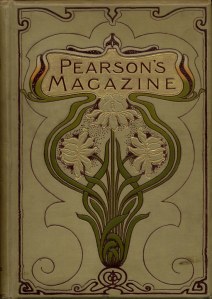
 THE DEATH-TRAP (1908) – Written by George Daulton, this story was published in the March, 1908 issue of Pearson’s Magazine. It’s once again Ancient Creature Feature time with this story about a monster from Lake Michigan which sometimes enters the Chicago sewer system to prey on unsuspecting denizens of the Windy City.
The tale’s unnamed main character leaves his Chicago gentleman’s club at 2 in the morning after a night of drinking, card-playing and cigar smoking. He refrains from taking a horse-drawn cab since he feels that walking will do him good.
 He comes to regret that decision when, on a poorly-lit street, he sees a drunken sailor get dragged down into the sewer and devoured by a slimy, half-glimpsed creature. Our hero flees for his life and doesn’t stop running until he’s reached one of Chicago’s bridges.
It is there that he encounters Hood, an eccentric but courageous Chicagoan who had his own encounter with the sewer monster weeks earlier and has been looking for it every night since. Hood spotted our main character’s headlong flight and figured he had just found another witness to the creature’s existence.
The pair decide against trying to convince the authorities about what they saw and plan to kill the beast themselves. Kolchak should have been so sensible. Continue reading →

 A FAMILY SKELETON (1885) – This short story was written by one of Balladeer’s Blog’s favorite neglected sci-fi authors – Robert Duncan Milne. This time around, Milne’s tale deals with a French nobleman and his wife, who has proven to be sterile.
  THE BARZEITSON EXPERIMENT (1888) – Written by female author Rebecca Rogers.
  THE NEW ADAM (1924) – Female author Noelle Roger (real name Helene Pittard) wrote this story in 1924. It was translated into English in 1926.
 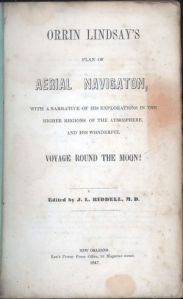 Full Title: ORRIN LINDSAY’S PLAN OF AERIAL NAVIGATION WITH A NARRATIVE OF HIS EXPLORATIONS IN THE HIGHER REGIONS OF THE ATMOSPHERE AND HIS WONDERFUL VOYAGE ROUND THE MOON (1847) – This work was written by J.L. Riddell.
 Full title: THE REV. JOHN SMITH DIED – AND WENT TO JUPITER VIA HELL (1908) – This bizarre but memorable work was published by the Juno Society of the time and was written by an anonymous author. The title clergyman passes away and finds himself in Hell – not forever, but as an ambassador to Jupiter.
  SIX THOUSAND YEARS HENCE (1891) – Written by Milton W. Ramsey. Regular readers of Balladeer’s Blog may remember that I’m usually enthusiastic about these works of “ancient” science fiction and look for any bright spots. In this novel’s case that is very, very difficult. For a book written in 1891 it seems more like an 1820s piece.
 THE AUTOMATIC MAID-OF-ALL-WORK. A POSSIBLE TALE OF THE NEAR FUTURE (1893) – Written by female author M.L. Campbell. Obviously, I shortened the title for my blog post headline. Balladeer’s Blog’s look at “ancient” science fiction continues with this 1893 robot story.
 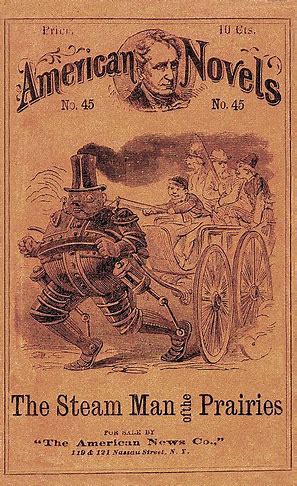 THE STEAM MAN OF THE PRAIRIES (1868) – Written by Edward Sylvester Ellis. Before the Frank Reade stories came this work that is often hailed as the first Dime Novel with a science fiction theme.
