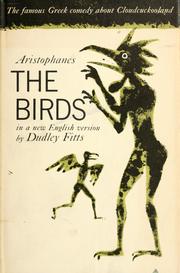
 Balladeer’s Blog presents another examination of an ancient Greek political satire. This comedy by Aristophanes was one that I was planning on covering very soon when I started posting my reviews of Attic Old Comedy years ago. For various reasons it kept falling by the wayside.
Where am I going with this? For Aristophanes’ line “In Cloud-Cuckooland things become what they are called rather than being called what they are” make it “In Ivory Towerland things become what they are called rather than being called what they are.” But I’m getting ahead of myself.
The Birds is Aristophanes’ lengthiest surviving comedy and also the most analyzed (some would say over-analyzed). So much has already been written about this particular work that I’ve decided to forego my usual intensive examination of every scene. Instead I’ll go with a brief synopsis followed by a way I feel The Birds could be adapted (as opposed to translated) for the present day.
SYNOPSIS
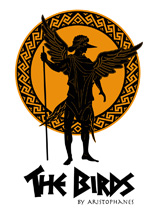 More than 2,300 years before George Orwell’s Animal Farm and 1984, Aristophanes was dealing with some of the same political themes.
Pisthetaerus and Euelpides, Athenians feeling alienated by the increasingly restrictive laws and lawsuits of their home city have left Athens behind to start over with a new society. Part of the comedy centers around the ages-old theme of how those who seek to overthrow oppression often wind up becoming the new oppressors themselves. (Think of the 1960s generation of American liberals who became just as oppressive as they claimed previous generations had been)
Another Orwellian theme finds Aristophanes satirizing the way in which the ruling class in any society uses and corrupts language to strengthen the subjugation of the populace. The Birds even features the importance of religious and historical myths in any culture as the leaders of the new civilization conjure up an all-new cosmology with “the birds” at the center to justify their own rule. Continue reading
 Anteia was written by the comic poet Philyllius. This comic poet’s career seems to have spanned approximately from the 410s BCE to 390 BCE. One of his comedies won 1st prize at a Lenaea festival in the 390s and he won 1st prize at an unknown Dionysia. His fellow comedian Strattis credited him with being the first Attic Old Comic to use real torches on stage.
 A hetaera could move from man to man or keep one man for extended periods. What they were was openly known but the hetaerae occupied the top rung in the open “sex for pay” business in ancient Greece. Political figures could be publicly known as a hetaera’s steady man and it was not a career ender, but the man would be in for a lot of ribbing in the comedies of the time, usually as the butt of jokes pointing out how such an “ugly” man could ONLY get such a beautiful sex partner by paying her.
  DEMOS-TYNDAREUS (410 BC) – Written by Polyzelus.
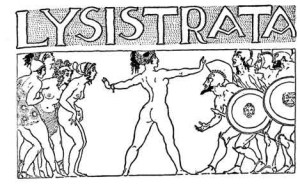
 Many of you have been kind enough to let me know that the new movie Chi-Raq, about black-on- black violence in Chicago, can be added to the long list of adaptations of Lysistrata by Aristophanes.
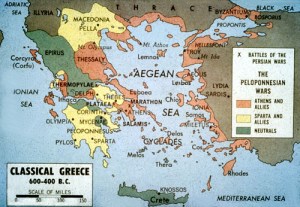
  By 411 BCE the Peloponnesian War between Athens (and its allied city-states) and Sparta (and its allied city-states) had been raging for roughly 20 years. The war provides the backdrop for many of Aristophanes’ surviving comedies and is especially apt where Lysistrata is concerned.