

This is the sixth part of Balladeer’s Blog’s look at the swashbuckling legends that surround Francois Villon (1431-1463?), remembered as one of France’s greatest poets and a notorious outlaw.
 FRANCOIS VILLON PART SIX – We pick up at the point in 1457 when the fugitive outlaw Villon found a warm and unexpected welcome in the court of Rene, Duke of Anjou. This figure was also known as “Good King Rene” because technically the crown of the Kingdom of Sicily was part of his royal inheritance.
Rene was renowned for his interest in science and literature and, despite Francois Villon’s criminal notoriety, the Duke was far more interested in the poetry Villon had churned out over the years. Some of that poetry had scandalized France, but intrigued Rene to the point where his court became a sanctuary of sorts for our man.
The Duke’s castle stood on a promontory above the confluence of the Sarth, Loir (with no e) and Mayenne Rivers, near where they poured into the Loire (with an e). The path along the land outside the castle walls was known as the Promenade of the End of the World. Continue reading
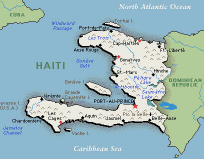 ZACA – The Voodoo god of agriculture and the harvest, making him the patron deity of farmers and fieldworkers. Zaca is the friendliest and most approachable of the gods and may be addressed as “Cousin Zaca” if spotted in the fields.
  Recently, a Balladeer’s Blog reader asked if I would compile a list of my “Best of” stories of the 1930s and 1940s pulp hero G-8 and his Battle Aces. That idea makes perfect sense considering I reviewed all 110 book-length stories of this World War One flying ace who should be as big culturally as Doc Savage, Zorro, and so many other pulp icons.
 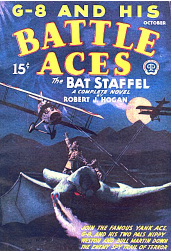 THE BAT STAFFEL (October 1933) – The very first G-8 pulp novel is at the top of my list. Not only does it nicely capture the tone and nature of the series, but it introduces the villainous mad scientist Doktor Krueger. That Teutonic terror would become the archenemy of G-8, Bull Martin and Nippy Weston as the series of novels rolled along.

 Len Kabasinski, the indie filmmaker behind such productions as Curse of the Wolf, Pact of Vengeance, Ninja: Prophecy of Death and many more, was kind enough to drop by Balladeer’s Blog and add his thoughts about the late Leo Fong.
 INSTANT CLASSIC – In this game the BRYANT & STRATTON COLLEGE (Wisconsin) BOBCATS did battle with the FORT SCOTT COLLEGE GREYHOUNDS.
  LIKE I WAS SAYING ABOVE … – At the other end of the spectrum came this very lopsided affair between the defending champions – the FLORIDA GATEWAY COLLEGE TIMBERWOLVES – and the PASCO-HERNANDEZ STATE BOBCATS.

 ACTION COMICS Vol 1 #1 (June 1938)
 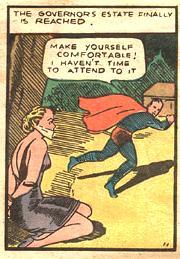 Superman takes down a wife-beater, saves Lois Lane from horny gangsters and clears a woman falsely convicted of murder by tying up the real killer – and even smashing his way into the governor’s mansion to make him call off her imminent execution.



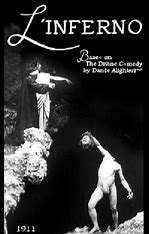 L’INFERNO (1911) – This 71-minute movie was an adaptation of Dante’s epic poem Inferno, one-third of his Divine Comedy along with Purgatorio and Paradiso. It was also Italy’s first feature-length film, beating Cabiria to theaters by three years.
 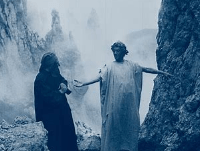 Second, L’Inferno has a certain grandeur from being filmed in Italy itself, the home of Dante Alighieri and his guide through Hell, Virgil. And third, nearly all of the footage set in the realm of the damned was filmed amid extinct and semi-extinct volcanoes in Italy, adding immeasurably to the infernal atmosphere.
  Balladeer's Blog