
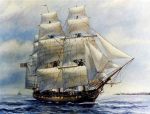
 Memorial Day Weekend rolls along with another topical post from Balladeer’s Blog. This one covers some naval actions from America’s undeclared, neither fish nor fowl, quasi-Naval War with France. Often called Stoddert’s War in reference to Benjamin Stoddert, America’s first Secretary of the Navy, this conflict was waged largely in the West Indies.
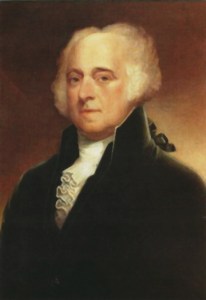
John Adams
President John Adams wanted the infant United States Navy to protect American shipping in the West Indies from French vessels seizing our ships and sailors. The French Revolutionary government had adopted this policy to (in their view) “punish” the U.S. for not declaring war on France’s side in the Wars of the French Revolution.
Thus far America had remained neutral due to divided public opinion on the matter. Some voters felt the U.S. should join the war on the side of France but others felt that the current French Revolutionary government had overthrown, imprisoned and slain virtually all of the French figures who had aided America during our war against England, therefore negating any obligation on our part. (The paranoid French government had even jailed Thomas Paine when he visited the country.)
President John Adams later took great pride in keeping America out of an all-out land war. (Sentiment against France grew so strong that 80,000 men volunteered to serve against her. And don’t forget the rallying cry of “Millions for defense but not one cent for tribute!” following the X, Y and Z Affair.) Adams chose instead to act largely on defense by protecting our coastline, safeguarding U.S. shipping and expanding our Navy from three whole vessels (WOW!) to FIFTEEN.
Here are a few of the battles from this virtually unclassifiable conflict:
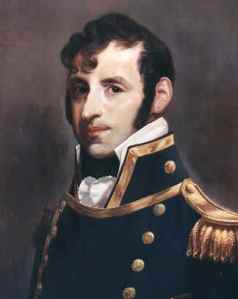
U.S. Naval hero Stephen Decatur
JULY 7th, 1798: Off the New Jersey Coast, Captain Stephen Decatur, Sr led his 20-cannon Delaware against the 10-cannon French privateer craft La Croyable. The French vessel had just plundered the American merchant ship Alexander Hamilton. After a long chase and running fight La Croyable was seized by the Delaware. The French ship was renamed Retaliation and joined the growing U.S. Navy.
NOVEMBER 20th, 1798: Off Guadeloupe, the Retaliation (commanded now by William Bainbridge) ran afoul of two French vessels: the 40-cannon L’Insurgente and the 44-cannon Volontaire. The French opened fire and soon captured Retaliation, then imprisoned the crew in the hellish Basseterre Prison on St Kitts.
FEBRUARY 9th, 1799: Nearly fifteen miles off the coast of the island of Nevis, American Captain Thomas “Terrible Tom” Truxton took his kickass nickname and his 36-cannon ship the Constellation into battle with the 40-cannon French vessel L’Insurgente. The battle began shortly after Noon and roughly two and a half hours later the French surrendered. Continue reading


 President Trump stands virtually alone – the outsider shaking up all the career criminals called Democrats and Republicans, who grow ever more frantic and irrational in their attempts to bring him down. EVERY DAY IS FUN WATCHING TRUMP INFURIATE ALL THE RIGHT CROOKS TO INFURIATE!
 The late Mary Harris Jones aka Mother Jones once again weighed in despite having been dead since 1930: “President Trump is an undeniable hero helping the working class and the poor of ALL colors every way he can while being attacked daily by America’s corrupt politicians and the bloated rich pigs who OWN those politicians.”
 FRANK C HIGH
 GEORGE W MATHEWS
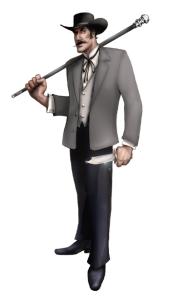 PART EIGHTEEN: In this issue the Fool Killer stated his mission in his newest incarnation (Or “regeneration” we could say with tongue in cheek.) was “the general overturning of all established institutions of every kind.” … “The Hour of Doom has struck for many of this old world’s pet institutions.” Quite a long way from his 1830s mission of driving the Devil out of the Tennessee Hills and killing fools who tried stealing the “hidden” gold of the Melungeons!
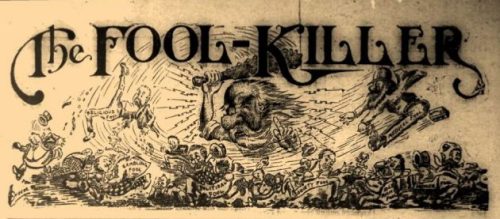 PART SEVENTEEN: Resuming my look at James Larkin Pearson’s Fool Killer (Or Fool-Killer as he wrote it). In August of 1919 Pearson brought the Fool Killer (I prefer no hyphen) out of his latest hibernation with the words “After resting for two years the Fool-Killer goes on duty again.”
 *** People still pushing Democrat President Woodrow Wilson’s claim that the World War (1914-1918) was fought to “Make the world safe for Democracy.” The Fool Killer would swing away at such people while pointing out the less-than-democratic nature of some of the Allied Powers governments from the recent conflict, especially England, Italy and Japan.
 *** A preacher who publicly said that he “almost wishes sometimes that Jesus would come already.” The Fool Killer added a joke wondering how that preacher would feel if he was on a trip and his wife said that she “almost wishes sometimes” that he would come back from his trip already. (Pearson was, sad to say, very religious and often took shots at clergy members he found insufficiently “devout.”)
 PART SIXTEEN: James Larkin Pearson, poet and newspaper man, carried on the Fool Killer tradition from 1910 to 1917, then again from 1919 to 1929. Pearson’s fellow North Carolinian Charles Napoleon Bonaparte Evans had written the Fool Killer Letters of the 19th Century so it’s appropriate that another Tar Heel continue the lore for so many years of the 20th Century.
 In August of 1917 Pearson’s nationwide publication called The Fool-Killer changed its title and format because of America’s entry into World War One four months earlier. That change from the hard-hitting satire of Fool Killing was made to show solidarity while the war raged.
 For Flashman Down Under, Flashman in the Opium War & Flashman and the Kings click
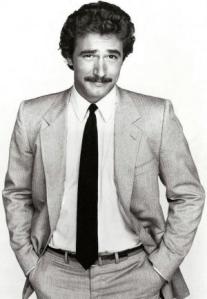
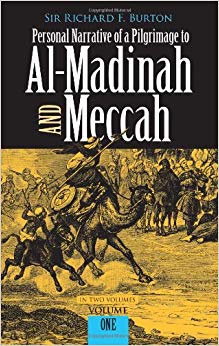 The duo enjoy diving into the darker and more forbidden side of life where sex, booze and other diversions are concerned. Flashman happens to be with Burton in Egypt in early 1853 when the famous explorer begins his journey to Medina and Mecca disguised as a Muslim.
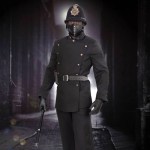 PART FOURTEEN: FACTS FOR THE FOOL-KILLER (1909) by Ridgway Hill.
 Facts For The Fool-Killer finds the fictional character operating from Buffalo, NY and vicinity. The Fool Killer now wears the blue uniform and tall helmet of a turn-of-the-century policeman and wields a police officer’s billy-club in lieu of his usual club/ walking stick/ cudgel.


