Tag Archives: book reviews

HALLOWEEN STORIES OF RALPH ADAMS CRAM

Balladeer’s Blog’s month-long celebration of Halloween continues with this look at six of the neglected horror stories written by architect Ralph Adams Cram between 1894 and 1903.

Black Spirits and whiteNUMBER 252 RUE M LE PRINCE – A haunted house at the title address in Paris turns out to be the former home of a Spanish sorcerer. The story’s narrator makes the typically stupid decision for a horror story of spending a night in the house to get to the bottom of the supernatural phenomena.

He compounds his stupidity by sleeping in the temple room in which the sorcerer performed rituals on his Black Magic altar. Overnight the foolish narrator is attacked by a blob-like, protoplasmic monster with wide, staring eyes.

THE DEAD SMILE – Lured by shrill screaming and shrieking from the family mausoleum, Sir Gabriel Ockham seeks to quiet the dead. To that end he must creep into the tomb of his evil late father and obtain a mysterious package containing an old family secret. His father’s corpse lies there outside its coffin and with its decapitated head which moves around on its own, smiling at all who enter. Continue reading
4 Comments

Filed under Halloween Season

LA MALROCHE (1833): HALLOWEEN READING

La MalrocheLA MALROCHE (1833) – By Louisa Stuart Costello. Halloween month continues here at Balladeer’s Blog with yet another look at a neglected work of Gothic Horror, this one dealing with witchcraft, a monstrous child and supernatural beasts. Louisa Costello, the female author of this eerie tale, deserves to be much better known.

La Malroche refers to a mountain in a dreaded and generally avoided area of 1830s France. At the foot of that mountain is the town of Escures, where only people too poor to have fled the area still live. Also near the foot of La Malroche is the home of the witch called La Bonne Femme (“The Good Woman”) by the local citizenry, a title bestowed on her out of fear rather than merit.   Continue reading

6 Comments

Filed under Halloween Season

LE DIABLE AMOUREUX (1772): HALLOWEEN STORY

Balladeer’s Blog’s month-long celebration of Halloween continues with this look at a neglected Gothic Horror tale.

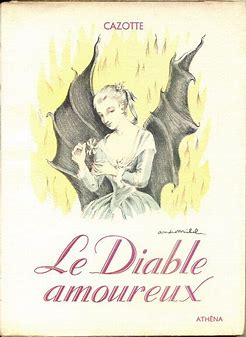
Le Diable AmoureuxLE DIABLE AMOUREUX (THE DEVIL IN LOVE) – Written in 1772 and translated into English in 1793. This story was penned by Jacques Cazotte and is a forerunner of the type of fantastic, oneiric horror stories that E.T.A. Hoffmann would specialize in.
The tale’s protagonist is Don Alvaro, a Spanish military officer serving in the army of the King of Naples in the 1750s. Don Alvaro is a swashbuckling young man with a cavalier irreverence toward organized religion and a fascination with the forbidden thrills of occultism.

Some of our hero’s fellow officers grow annoyed with his lack of piety and resolve to teach him a lesson in the dangers that can be unleashed by diabolism. They provide him with a Black Magic spell and tell him that if he wants a real-life experience with the supernatural he must go to creepy, neglected ruins in the countryside and recite the spell. Continue reading

22 Comments

Filed under Halloween Season

KILLRAVEN TEN: THE DEATH BREEDERS

FOR PART ONE OF BALLADEER’S BLOG’S EXAMINATION OF THIS OLD, OLD MARVEL COMICS STORYLINE CLICK HERE  The revisions I would make are scattered throughout the synopsis below.

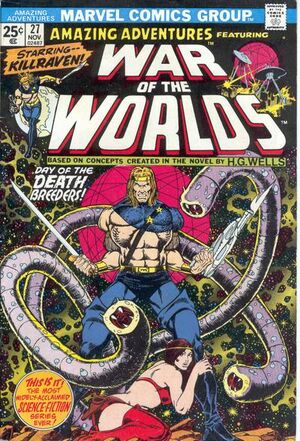
Death BreedersAMAZING ADVENTURES Vol 2 #27 (November 1974)
Title: The Death Breeders

Synopsis: The narrative tells us it is now March of 2019 (lol) but you can just tell yourself that it’s March of 45 years from now, as it would have been to readers in 1974.

Since their clash with the Survivalists of Battle Creek, MI Killraven and his Freemen at some point commandeered an abandoned ice-ship. This craft is basically a traditional ship complete with sails but with runners on the bottom like a sleigh. The wind in the sails lets the ship “skate” across frozen Lake Erie on its ski-like runners.

Up in the ship’s crow’s nest the Native American Freeman called Hawk warns his comrades on the deck below (Killraven, M’Shulla, Old Skull, Carmilla Frost and Carmilla’s creation Grok) that a pair of gigantic lampreys have sensed their vessel and have burst through the ice to attack them.

The lampreys are nearly Kaiju-sized, having been mutated over the years by pollution (the 1970s go-to explanation) and presumably the widespread after-effects of the biological warfare agents unleashed during the war against the Martian invaders.

REVISIONS: As always, I would have eliminated the tenuous connection to War of the Worlds and just had Earth’s conquerors be regular aliens, preferrably from Zeta Reticuli. In addition I would still have it be Deathlok as a Freeman instead of Grok. See previous installments for my justification.

Returning to the story, the Freemen battle the attacking lampreys – Killraven with his sword, photonuclear pistol and explosive star-grenades, M’Shulla with his crossbow and indestructible bolts, Hawk with his photonuclear rifle and Old Skull with his brute strength. Continue reading

20 Comments

Filed under Superheroes

THE WOLF IN THE GARDEN: WEREWOLF STORY FOR HALLOWEEN

Balladeer’s Blog’s month-long celebration of Halloween continues:

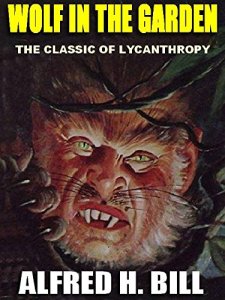
Wolf in the GardenTHE WOLF IN THE GARDEN (1931) – Written by Alfred Hoyt Bill. This neglected novel is ideal for people who go in for horror tales set long ago. In this case the 1790s.

New Dordrecht, a town in New York’s Hudson Valley, becomes the home of the fallen Count de Saint Loup, a French aristocrat fleeing the guillotine during the French Revolution. Anyone who remembers that “loup” is French for wolf will immediately know that this figure will be our title werewolf. (Though his deadly hound DeRetz is a red herring at first.)  

The Count transferred much of his wealth before fleeing his homeland so he is initially welcomed as a prominent new citizen in New Dordrecht. Unfortunately Count de Saint Loup soon displays the overbearing, snobbish airs that drove the French underclasses to overthrow the aristocrats in the first place.

People who get on the wrong side of the former “aristo” start to turn up dead after getting attacked by a monstrous wolf-like creature. Continue reading

28 Comments

Filed under Halloween Season

THE AUTOMATIC MAID (1893): ANCIENT SCIENCE FICTION

primitive robotTHE AUTOMATIC MAID-OF-ALL-WORK. A POSSIBLE TALE OF THE NEAR FUTURE (1893) – Written by female author M.L. Campbell. Obviously I shortened the title for my blog post headline. Balladeer’s Blog’s look at “ancient” science fiction continues with this 1893 robot story.
Well-to-do John Matheson and his wife are having a hard time keeping a maid. To satisfy his hard to please wife, the inventor works away in his laboratory/ workshop to perfect his new idea: a mechanized “Maid-Of-All-Work” hoping this will solve the domestic staff issue. Continue reading

14 Comments

Filed under Ancient Science Fiction

POLEIS (CITIES): ANCIENT GREEK COMEDY

Balladeer’s Blog resumes its examination of ancient Greek comedies. 

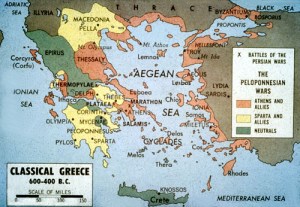
classical greecePOLEIS – In this post I’m looking at Poleis (Cities), written by Eupolis, one of the Big Three of Ancient Greek Comedy along with Aristophanes and Cratinus. This satirical comedy is dated from approximately 422 B.C. to 419 B.C.  Like so many other such comedies it has survived only in fragmentary form.
The title refers to the all-important Chorus in ancient Greek comedies. In this case the chorus consisted of actors costumed to represent some of the city-states which were under the influence of Athens at the time.

As for how people can be “costumed” as cities, picture how it would be done with American cities. The chorus member representing New York might be depicted as the Statue of Liberty, Saint Louis as the Arch, Pittsburgh as a steel worker, Los Angeles as a brain-dead movie star and so on.

Part of the political satire dealt with the love-hate relationship that many subject- states had with Athens. Being the combination Paris/ Tokyo/ New York City of its time, Athens had a lot to offer its allied polities, but a certain air of tension always existed because of what some of those locations felt were Athens’ high-handed ways of dealing with them.

Eupolis depicted the personified subject-states/ allied states as workers with a not altogether beloved “boss,” Athens. Continue reading

20 Comments

Filed under Ancient Greek Comedy

MESSAGES FROM MARS (1892): ANCIENT SCIENCE FICTION

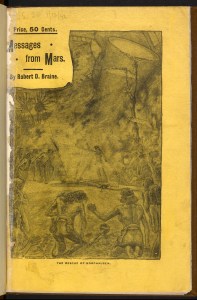
Messages from Mars 2MESSAGES FROM MARS BY THE AID OF THE TELESCOPE PLANT (1892) – Written by Robert D Braine. I shortened the title for the blog post headline. The main character of this novel is a sailor named Nordhausen. After leaving Madagascar our hero winds up shipwrecked on an uncharted island.

While roaming this island Nordhausen finds plants with thick transparent leaves which refract light like lenses do. The sailor breaks off one of the leaves to study it more closely, only to be seized by the island’s native inhabitants, who have been watching him from hiding.

Messages from MarsThe natives take him through a cave entrance to their hidden village which is a blend of the primitive and the futuristic. For the “sacrilege” of damaging one of the telescope plants Nordhausen is to be executed. The means? A device formed from several of the lens-like leaves which magnify the sunlight into a makeshift heat-ray, like holding a magnifying glass over a piece of paper to catch it on fire. 

Our hero is saved at the last minute by a beautiful woman named Raimonda, who wants him spared. When her own words are not sufficient to stay the execution she enlists the King of Mars to persuade the natives to spare Nordhausen. Continue reading

10 Comments

Filed under Ancient Science Fiction

FOOL KILLER PART TWENTY-NINE: FEBRUARY 1921

Balladeer’s Blog continues its examination of the many facets of Fool Killer lore. FOR PART ONE, INCLUDING THE HISTORICAL CONTEXT, CLICK HERE

Matthew as the Fool Killer would be perfectPART TWENTY-NINE – As always part of the fun comes from the way the Fool Killer’s opinions are a mix of today’s left-wing and right-wing attitudes. Some you’ll agree with, others you won’t but it’s always interesting. 
Here is a look at some of the Fool Killer’s targets from James L Pearson’s February of 1921 issue of The Fool-Killer.

** People who were fine with spending $23 million apiece on warships but who penny-pinched on contributions to feed starving children in Europe. Ironically given our 21st Century view of him, future president Herbert Hoover was working with the Literary Digest to raise money to send food to Europeans but came up with only $10 million – less than half their stated goal.

** Criminals who were using the military training they received in World War One to efficiently rob banks and armored cars. Continue reading

10 Comments

Filed under Mythology, Neglected History

DOCTOR MENSANA: AUSTRALIAN SUPERHERO

One of Balladeer’s Blog’s biggest hits was my examination of Australian-made comic book heroes like Dark Nebula, Vixen, Crimson Comet, Niteside and the super-team called the Southern Squadron. Here’s another, and for my full look at Aussie super-types click HERE

Doctor Mensana

Dr Mensana in one of his two super-powered forms.

DOCTOR MENSANA 

Debut Year: 1941 

Secret Identity: None. He openly used his real name, but the public often tagged him with nicknames like “the Samson of science” or “the man of Mind Plus.”

Origin: Sporting both an MD and a PhD the good Doctor Mensana used his unrivaled genius to create pills which could make him super-strong AND endow him with telepathic powers in addition to even greater intelligence than he already possessed. 

Powers: When our hero swallowed one of his M-Plus (M+) or Mind-Plus pills his already formidable brilliance was multiplied many times over. His cranium would grow and he would also boast telepathic and psionic powers. When Dr Mensana swallowed one of his S-Plus (S+) or Strength-Plus pills he would instantly bulk up with muscles and possess incredible super-strength. Continue reading

2 Comments

Filed under Superheroes