
Balladeer’s Blog’s readers have made it clear they love these light-hearted superhero posts on weekends, so here we go with the first twenty stories of the MLJ character the Shield.
 THE SHIELD
Secret Identity: Doctor Joe Higgins, a chemist.
Origin: On his deathbed Joe’s father Tom revealed to him the secret of a chemical formula he had been working on. That formula could bestow superpowers on a normal human being. As Joe grew older he got his PhD in chemistry, finished his father’s formula and used it on himself, gaining superpowers. He devised a special costume and fought the forces of evil as the Shield, a super-powered operative of the FBI.
First Appearance: Pep Comics #1 (January 1940). His final Golden Age appearance came in late 1945.
 Powers: The chemical formula that the Shield rubbed onto his skin followed by bombardment with flouroscopic rays endowed him with massive super-strength plus invulnerability and the ability to leap enormous distances. His name came from an acronym for the areas of the human anatomy affected by his chemical formula: S – Sacrum H – Heart I – Innervation E – Eyes L – Lungs D – Derma. The Shield also wore an indestructible costume which encased his torso like a shield.
Comment: The Shield was America’s first star-spangled superhero, beating Captain America into print by more than a year. He eventually had a youthful sidekick called Dusty and a private detective sweetheart named Betty Warren. His archenemy was the Vulture. His adventures continued until December of 1945. Only J Edgar Hoover knew the Shield’s secret identity. Yes, J Edgar Hoover was the head of the FBI, proving that even back then the FBI was a crooked and politically corrupt organization.
 PEP COMICS #1 (January 1940)
Title: The Shield, G-Man Extraordinary
Villains: A Stokian spy ring
Synopsis: The Shield is given his first assignment. He must destroy a spy ring from the fictional nation of Stokia after the ring blows up a munitions factory, sabotages commercial shipping and assassinates U.S. military personnel. Our hero defeats all of the villains and survives their explosion of the Hotel Braganza.
NOTE: This is the first time readers see the Shield attach wires from his earpieces to telephone wires so that his enhanced hearing can “bug” the room of his targets. Continue reading
 THE CAVERN OF FIRE (1888) – Written by Francis W Doughty. This novel was originally serialized in The Boys of New York from September 15th to November 3rd of 1888. The main character is Professor Hardcastle, head of Merton College in Illinois. Hardcastle’s pet theory over the years has been that America’s mound builders were really from ancient Greece.
  PART FIFTY-FIVE – Here is a look at some of the Fool Killer’s targets in the April of 1912 edition of James Larkin Pearson’s version of the character:
  *** Judges and other high officials who betrayed their public trusts. He favored the recall process for judges as well as others.
 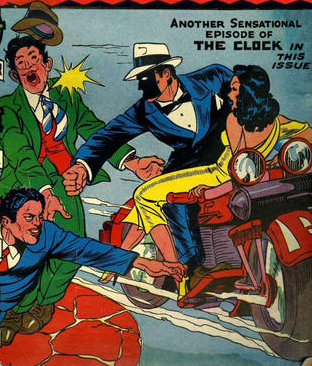 Before Batman, before Captain America and even before Superman himself, came the Clock, written and drawn by George E Brenner. The Clock was the first masked crimefighter in comic books, debuting in 1936, while the much more popular Batman didn’t come along until 1939. I’m not pointing that out to diss Batman, but to point out what a shame it is that the Clock seems to have been forgotten by most of the world. The figure is pretty much the middle character between Pulp heroes like the Shadow and the Moon Man and comic book superheroes. The Clock’s influence on Will Eisner’s iconic character the Spirit is obvious.
 THE CLOCK
 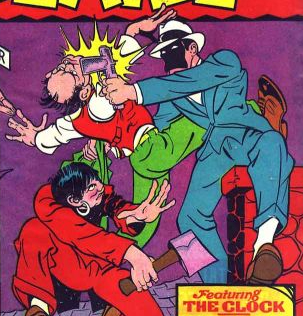 Powers: The Clock was the prototype for the countless non-powered costumed crimefighters to come. He was in peak physical condition and was a master of unarmed combat. He possessed the agility of an Olympic gymnast and was a marksman with the handgun he carried into action with him. In addition he was a master detective and investigator whose knowledge of the law helped him compile evidence against his foes.
 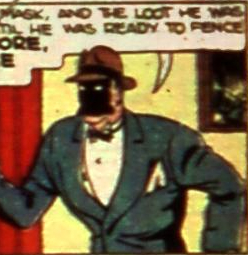 1. FUNNY PAGES Vol 1 #6 (November 1936) – #9 (March 1937)
  ARE THE PLANETS INHABITED? (1913) – Written by Edward Walter Maunder, this book began with ridicule of the outdated belief that the sun and moon might be inhabited, but it doesn’t exactly embody scientific accuracy itself. Therefore I’m classifying it as science fiction even though in 1913 it was considered to be a series of observations adhering to rigid scientific principles.
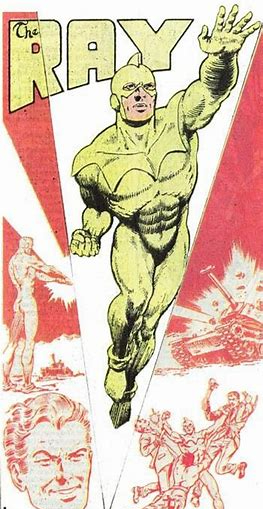 THE RAY
 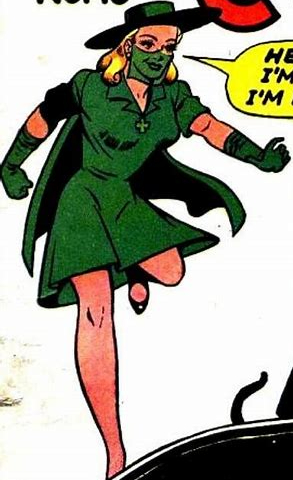 LADY LUCK
  Thank you to those Balladeer’s Blog readers who reminded me that I hadn’t provided a post with the links to ALL my reviews of the episodes of The Rivals of Sherlock Holmes. That was a 1971-1973 British television series which adapted Victorian Age and Edwardian Age stories about detectives other than Sherlock Holmes.
 A MESSAGE FROM THE DEEP SEA – R Austin Freeman’s police surgeon detective Doctor John Evelyn Thorndyke (created in 1907) uses his unique talents to investigate the murder of a London prostitute. Click
 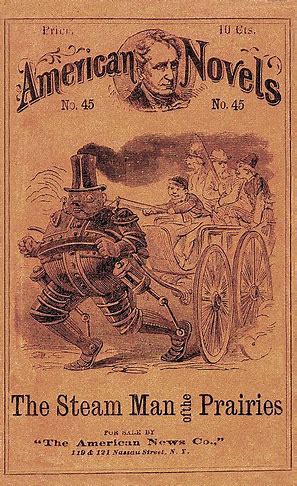 THE STEAM MAN OF THE PRAIRIES (1868) – Written by Edward Sylvester Ellis. Before the Frank Reade stories came this work that is often hailed as the first Dime Novel with a science fiction theme.
  GARRISON TALES FROM TONQUIN (Tonkin): AN AMERICAN’S STORIES OF THE FRENCH FOREIGN LEGION IN VIETNAM IN THE 1890s (1895) – Written by James O’Neill. Seven years ago here at Balladeer’s Blog I examined Washington Irving’s 1809 work
  In a similar spirit, I am now examining Garrison Tales From Tonquin, published in 1895 and written by American James O’Neill, who had served in the French Foreign Legion during the 1880s and early 1890s. Just as Washington Irving was ahead of his time with his sentiments in The Men of the Moon, James O’Neill was ahead of his time in regard to his observations on the French occupation of Vietnam during and after the Sino-French War. Readers in 1895 who were expecting Kipling would have found O’Neill to be virtually his polar opposite.
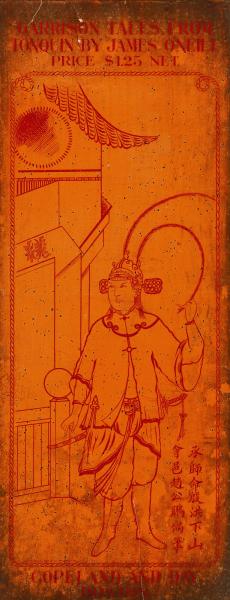 I found it staggering to read 1890s accounts written by an American fighting man in Vietnam reflecting on the ugliness and ultimate futility of the military situation. So much of O’Neill’s fictionalized accounts of his real-life experiences in Vietnam read like something from an author in the late 1960s or later using such a tableau as an allegory for America’s involvement in Indochina.
  Pop culture at the moment remains superhero-crazed, and Balladeer’s Blog’s readers always want more articles about them. Here is a look at the early adventures of Tigra the Werewoman from the 1970s.
 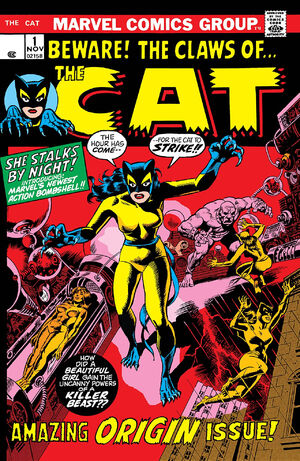 THE CAT Vol 1 #1 (November 1972)
  Balladeer's Blog