Balladeer’s Blog’s End of Year Retrospective Continues with this look at The Best of April.
 FREE SPEECH, LIBERALS AND CONSERVATIVES – Neither end of the political spectrum seems interested in defending freedom of expression except when their own point of view is in danger of being silenced.
Here at Balladeer’s Blog I deal with these issues all the time. Easily offended people from the political left to the political right are often outraged by what I write. CLICK HERE
 WITHIN AN ACE OF THE END OF THE WORLD (1900) – My review of this work of “ancient” science fiction was a hit with readers.
Robert Barr was the name of the author of this neglected item that dealt with apocalyptic concerns. What Barr’s previous work The Doom of London did for that city Within An Ace of the End of the World did for the entire planet. CLICK HERE
 POLO: 2018 U.S. OPEN, GAMES ONE AND TWO – Balladeer’s Blog’s annual coverage of the U.S. Open in Polo attracted its usual share of attention.
Instead of the title game, like previous years, this year the most hits went to the opening two games pitting the Aviators against the Red Sleeves and the Valiants against the Association. CLICK HERE
 TRUMP-HATERS: FASCISTS AND BUFFOONS – After two pieces of garbage like Barack Obama and George W Bush we got a de facto Third Party President in Donald Trump.
This post infuriated the stuffy, blustering fools who hate President Trump, the new FDR. That seems to be because they hate the working class and the poor whom Trump has helped and when they trash the Donald they are really expressing their resentment of the needy people that Trump has benefited. CLICK HERE
 NEGLECTED DETECTIVES WHO SOLVED REAL-LIFE MYSTERIES – This item looked at a pair of baffling real-life mysteries that were solved decades ago by eccentric detectives as colorful as any in fiction.
Ellis Parker tackled a puzzling murder and bank robbery in 1920, while Edward O Heinrich solved four murders that took place during a botched train robbery. Heinrich’s case happened in 1923. CLICK HERE
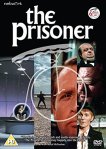 THE PRISONER: MORE RELEVANT THAN EVER BEFORE – This item kicked off my review of the 1967 science fiction/ existential drama The Prisoner.
This series has become more timely than ever here in the 21st Century. Part Orwell, part Kafka, part Pirandello and part Alphaville, The Prisoner paved the way for ground-breaking shows like Twin Peaks, The X-Files and Lost. CLICK HERE
 POLITICAL FORTUNE COOKIES – This was a popular one-shot item in which I took shots at Congressional Republicans, Barack Obama and many, many more.
To enjoy them, just CLICK HERE
 MICHAEL MOORE: FAKE FRIEND TO THE WORKING CLASS – Pathetic, outdated Michael Moore STILL refuses to give away all but two million dollars of his bloated fortune to prove that he really cares about the 99 percent like he claims he does.
Moore is a whiny, hypocritical hatemonger and is despised by the working class that he claims to champion. CLICK HERE Continue reading →

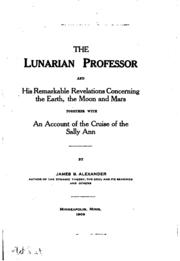 THE LUNARIAN PROFESSOR AND HIS REMARKABLE REVELATIONS CONCERNING THE EARTH, THE MOON AND MARS TOGETHER WITH AN ACCOUNT OF THE CRUISE OF THE SALLY ANN (1909) – Written by James B Alexander back in the glory days of titles so long they might not fit in a 140 character limit.
  IN SEARCH OF THE UNKNOWN (1904) by Robert W Chambers. Previously Balladeer’s Blog examined Chambers’ underrated horror classic The King in Yellow. The work we’re looking at this time around is a collection of short stories about Francis Gilland the Zoologist. Gilland was a forerunner of the real-life Frank “Bring ’em Back Alive” Buck and the fictional Indiana Jones.
  I. THE HARBOR MASTER – Gilland is sent north to Hudson Bay where a Harbor Master has reported capturing a pair of Great Auks, flightless birds which went extinct in the mid-1800s. The two-fisted scholar finds the Great Auks are for real but the Harbor Master harbors (see what I did there) a sinister secret.
  II. IN QUEST OF THE DINGUE – The Graham Glacier melts, unleashing a number of animals from species that were long thought extinct. Among the crowd of academics converging on the unexplored area are Gilland and Professor Smawl. The Professor is a sexy, strong-willed female scholar that our hero has been forced to accompany into the region.
  PSI CASSIOPEIA, or STAR: A MARVELOUS HISTORY OF WORLDS IN OUTER SPACE (1854) – Written by Dr Charlemagne Ischer Defontenay, a French M.D. and author. Long before J.R.R. Tolkien churned out obsessive amounts of fine detail about his fictional Middle Earth, Defontenay produced this volume of history, poetry and drama from his fictional planets in the star system Psi Cassiopeia.
 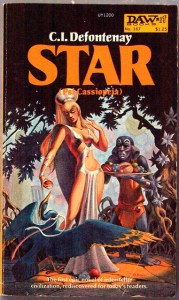 The system where that planet is located is a three-star system. Ruliel is the large, white star at the center, around which orbit the two lesser stars Altether (green) and Erragror (blue). The planet called Star is orbited by large planetoids/ moons named Tassul, Lessur, Rudar and Elier. Throwing all science to the winds the planet is also orbited by a small red star called Urrias.
  THE WRECK OF A WORLD (1889) – Written by W. Grove. (No other name available) This novel is the sequel to Grove’s A Mexican Mystery, an ahead-of-its-time work about a train engine devised to have artificial intelligence. The machine – called only The Engine in that story – rebelled and took to preying on human beings in horrific fashion. For Balladeer’s Blog’s review of that novel click
 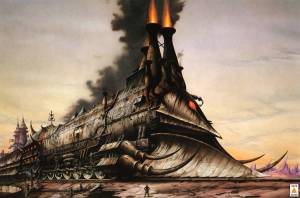 Our story begins in what was to Grove “the far future” of 1949. After a fairly superficial depiction of the world’s political and scientific situation in this imaginary future the meat of the tale begins. All in all the author did not present 1940s technology as being much more advanced than what was available in the 1880s. Grove might have done better to set his tale in 1899 or just into the 1900s to detract from his lack of vision on this particular element.
  THE HAMPDENSHIRE WONDER (1911) – Written by J.D. Berresford. The story centers around Victor Stott, the remarkable son of Cricket star Ginger Stott. A news reporter who is on friendly terms with Ginger Stott meets his one year old child Victor during a train trip.
  WITHIN AN ACE OF THE END OF THE WORLD (1900) – Written by Robert Barr. No doubt about it, Barr was obsessed with the notion of humanity possibly bringing on its own demise through ill-considered scientific tampering. Recently Balladeer’s Blog reviewed another of his stories, The Doom of London, which mined the same creative territory.
 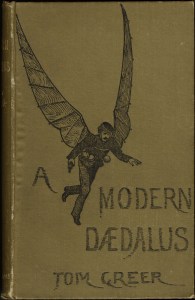 A MODERN DAEDALUS (1887) – By Tom Greer. No, the title’s not referring to James Joyce’s character Stephen Dedalus (sic) but this tale IS about Ireland. The main character is a young man named Jack O’Halloran, a recent college graduate who returns to his native Ireland.
 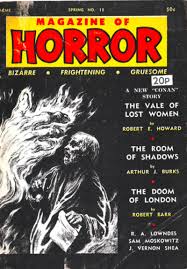 THE DOOM OF LONDON (1892) – Written by Robert Barr. In the “far future” of the mid-Twentieth Century the narrator of this tale looks back at the catastrophe that hit London in the 1890s.
  THE ARCTIC DEATH (1927) – Written by Wilford Allen, On A Far World, covered below, was a prequel to this same tale. The Arctic Death is set in the 1930s, which was “the near future” when the story was first published.
  Balladeer's Blog