 BIETIGHEIM (1886) – Published anonymously in 1886 this work of alternate history accurately predicted some of the actual results and fallout of the coming First World War (1914-1918). Bietigheim is presented as a series of John Minor lectures about world history as seen from “futuristic” 1932.
First off, a summary of the book’s accurate predictions:
a) Tensions between Germany and assorted other nations cause a war that sweeps up many of the Great Powers as well as several other countries.
b) American entry into the war proves decisive.
c) The German side loses the war.
d) The old European monarchies fall.
e) In the wake of Germany’s defeat a popular figure arises and rallies millions to him with his plans for the future of Europe and Russia.
Just before the 1890 outbreak of the war Germany and France are pushing their claims to Alsace-Lorraine, Italy is demanding Austria turn over portions of northern Italy, Great Britain and Russia are clashing over preeminence in India and Afghanistan, plus the Slavic nations are feuding with the Ottoman Muslim Turks over their own future and control of the Dardanelles. Continue reading →

 THE AUTOMATIC MAID-OF-ALL-WORK. A POSSIBLE TALE OF THE NEAR FUTURE (1893) – Written by female author M.L. Campbell. Obviously I shortened the title for my blog post headline. Balladeer’s Blog’s look at “ancient” science fiction continues with this 1893 robot story.
 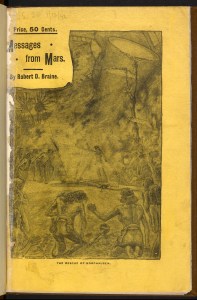 MESSAGES FROM MARS BY THE AID OF THE TELESCOPE PLANT (1892) – Written by Robert D Braine. I shortened the title for the blog post headline. The main character of this novel is a sailor named Nordhausen. After leaving Madagascar our hero winds up shipwrecked on an uncharted island.
 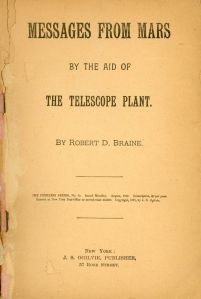 The natives take him through a cave entrance to their hidden village which is a blend of the primitive and the futuristic. For the “sacrilege” of damaging one of the telescope plants Nordhausen is to be executed. The means? A device formed from several of the lens-like leaves which magnify the sunlight into a makeshift heat-ray, like holding a magnifying glass over a piece of paper to catch it on fire.
  THE QUEEN OF APPALACHIA (1901) – Written by Joe H. Borders. This novel features Paul Thornton, a merchant in Kentucky, and his Lost World adventures. While hiking in the wilderness Paul saves a beautiful woman from drowning. The woman is, coincidentally enough, utterly identical to Paul’s girlfriend May Arnold.
 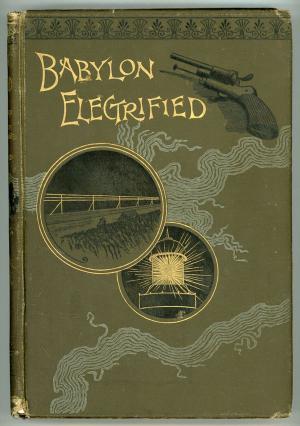 BABYLON ELECTRIFIED (1888) – Written by Albert Bleunard. In the tradition of his fellow Frenchman, Jules Verne, Bleunard crafted this work of science fiction with an international cast.
 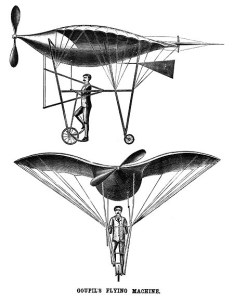 LOOKING FORWARD: A DREAM OF THE UNITED STATES IN 1999 (1899) – Written by Arthur Bird. This is speculative science fiction looking at world events and scientific advances from 1899 to 1999. Since the U.S. was coming off the 1898 war with Spain that accounts for the way Spain is presented as the major villain on the global scene.
  THE STRANGE MANUSCRIPT BY _________ M.D. (1881) -Written by Alexander Pitts Bettersworth. The mock author, an M.D. who remains anonymous, upon learning that a comet will strike the Earth in 1883, stores supplies in Mammoth Cave with the help of his black servant Josh. With most of humanity dismissing the threat as a hoax or a mistake, the only other people who join them in the cave are a young woman named Ida and her black servant Chloe.
  FARMING IN THE YEAR 2000 A.D. (1890) – Written by Edward Berwick. Just when you thought it was safe to read speculative science fiction about life in the future without Edward Bellamy’s Looking Backward being referenced, along comes this entry from the Overland Monthly‘s Twentieth Century special.
 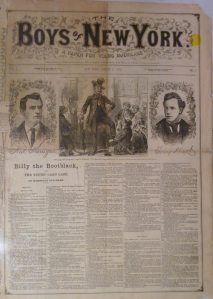 3,000 MILES THROUGH THE CLOUDS (1892) – Written by Francis W Doughty under a house pseudonym for The Boys of New York magazine, serialized from February 13th to April 2nd.
  THE LUNARIAN PROFESSOR AND HIS REMARKABLE REVELATIONS CONCERNING THE EARTH, THE MOON AND MARS TOGETHER WITH AN ACCOUNT OF THE CRUISE OF THE SALLY ANN (1909) – Written by James B Alexander back in the glory days of titles so long they might not fit in a 140 character limit.
