This weekend’s escapist, lighthearted superhero post from Balladeer’s Blog will take a look at the 30th Century Legion of Superheroes. DC fans are still saying I don’t cover enough DC characters, so here we go.
 LEGION OF SUPERHEROES (Superboy starring the …) Vol 1 #203 (August 1974)
Title: Massacre by Remote Control
Legion Roster: Sun Boy, Phantom Girl, Invisible Kid, Superboy, Saturn Girl, Lightning Lad, Mon-El, Brainiac 5, Dream Girl, Karate Kid and Element Lad
Villain: Validus
Synopsis: Mon-El, the current leader of the Legion, is outraged that Invisible Kid has been letting his relationship with a woman from the invisible dimension – Myla – interfere with his obligations to the team.
 Eventually, Dream Girl has a dream foretelling an imminent attack by Validus – the huge, mindless monster who is strong enough to take on entire teams of Legionnaires at once. Because Validus is usually harmless unless controlled psychically by its fellow Fatal Five member Tharok, the Legion makes sure that the cyborg Tharok is still safely incarcerated at Space Prison Complex X33.
Not only is the villain still in custody, but he has been undergoing repairs to some of the cybernetic devices in his brain, meaning he cannot be mentally controlling Validus at all.
 When Validus ultimately attacks Legion headquarters in future Metropolis, he is routing the heroes while withstanding all their counterattacks. Invisible Kid at first seems to have abandoned his post to dally with Myla but it turns out he actually solved the problem at hand.
In the Legion trophy room, the Kid has deduced that components of Tharok’s brain that are on display (These are the good guys, right?) have activated themselves and THEY have summoned Validus to attack them. Continue reading →

 THE PURPLE DEATH (1895) – Written by William Livingston Alden. Presented in the first person this story is narrated by a British gentleman staying in Italy. He becomes friendly with his neighbor, a German M.D. and bacteriologist named Dr Schmidt.

 FIVE TOMORROWS – On February 5th 1970, Kurt Vonnegut Jr. hosted an NET Playhouse presentation of five short films which presented grim visions of the future. Vonnegut was interviewed and offered comments on the international shorts from the high flux beam reactor in Brookhaven (NY) National Laboratories’ center for advanced experimental research.
 BAD MOVIES: There was
  ANCIENT SCIENCE FICTION: I reviewed
  COMEDIES: MODERN PARODY HALL OF FAME: The full breakdown
  NEGLECTED GUNSLINGERS:
  MARCH 1st – British troops led by Major John Maitland landed and took Cockspur Island at the mouth of the Savannah River in Georgia. The Redcoats clashed with American Militiamen and drove them off. Both sides were left with wounded men following the exchange of gunfire, but no fatalities are known.
  Four British warships, along with multiple smaller vessels, launched a joint land and sea effort to seize American rice ships in the area in order to feed the British forces. Over 300 British infantrymen took part in commandeering the rice boats by surprise overnight.
  THE MYSTERY OF THE LEAPING FISH (1916) – Regular readers of Balladeer’s Blog may remember that I’m a geek for Silent Movies. Last week’s look at
 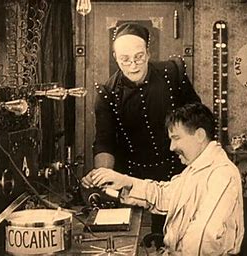 The short’s comedic approach to cocaine, opium and more demonstrates the “anything goes” attitude before film codes were implemented to ban certain content from the big screen. In the pre-internet years, The Mystery of the Leaping Fish was a film that people refused to believe existed until you had them sit down and watch it with you.
 THE DON’T MISS EDITION, as



 DISCOVERIES IN THE MOON (1835) – The full title of this work is Discoveries in the Moon Lately Made at the Cape of Good Hope by Sir John Herschel. Originally published as a series of “real” scientific articles in the newspaper the New York Sun, this hoax was the written-word equivalent of the War of the Worlds radio broadcast of a century later. The series of fraudulent articles caused a sensation and increased the newspaper’s circulation exponentially before the Sun revealed it was all a work of fiction.

 Balladeer's Blog