
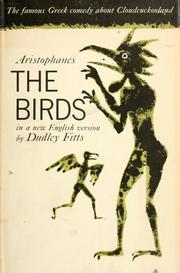
 Balladeer’s Blog presents another examination of an ancient Greek political satire. This comedy by Aristophanes was one that I was planning on covering very soon when I started posting my reviews of Attic Old Comedy years ago. For various reasons it kept falling by the wayside.
Where am I going with this? For Aristophanes’ line “In Cloud-Cuckooland things become what they are called rather than being called what they are” make it “In Ivory Towerland things become what they are called rather than being called what they are.” But I’m getting ahead of myself.
The Birds is Aristophanes’ lengthiest surviving comedy and also the most analyzed (some would say over-analyzed). So much has already been written about this particular work that I’ve decided to forego my usual intensive examination of every scene. Instead I’ll go with a brief synopsis followed by a way I feel The Birds could be adapted (as opposed to translated) for the present day.
SYNOPSIS
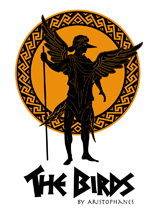 More than 2,300 years before George Orwell’s Animal Farm and 1984, Aristophanes was dealing with some of the same political themes.
Pisthetaerus and Euelpides, Athenians feeling alienated by the increasingly restrictive laws and lawsuits of their home city have left Athens behind to start over with a new society. Part of the comedy centers around the ages-old theme of how those who seek to overthrow oppression often wind up becoming the new oppressors themselves. (Think of the 1960s generation of American leftists who became just as oppressive as they claimed previous generations had been)
Another Orwellian theme finds Aristophanes satirizing the way in which the ruling class in any society uses and corrupts language to strengthen the subjugation of the populace. The Birds even features the importance of religious and historical myths in any culture as the leaders of the new civilization conjure up an all-new cosmology with “the birds” at the center to justify their own rule. Continue reading
 THANK YOU once again to all of you readers for making Balladeer’s Blog so enjoyable to write. As I always say the unusual and controversial items I sometimes churn out here mean that readers have to be open-minded and very secure in their own beliefs not to just take offense and leave.
 FIRST AND SECOND BATTLES OF MACHIAS – Revolutionary War history about the two separate battles in Machias, Maine. CLICK
 THE MONKS OF MONK HALL – This neglected American horror classic was the country’s best-selling novel prior to Uncle Tom’s Cabin. CLICK
 HAPPY FATHER’S DAY FROM BALLADEER’S BLOG! Over the years my review of the 2011 horror film Father’s Day has been the most controversial. Reader reaction has been split between requests that I run the review every single Father’s Day and requests that I never run it again.
 Balladeer’s Blog continues its examination of another neglected pulp hero – in this case Northwest Smith. Created by the female author C.L. Moore in the 1930′s Northwest Smith was a ruthless outer-space smuggler and mercenary decades before Han Solo. With his Venusian partner Yarol at his side and armed with a trusty blaster Smith roamed our solar system in his deceptively fast spaceship The Maid. For more on Northwest Smith and other neglected pulp heroes click here:
 The story opens in Jirel’s time. She is leading her obedient band of male outlaws in an assault on the castle of a sorceror named Franga. Our sword-wielding heroine battles her way through to Franga’s chamber where she seizes a mystic gem called the Star Stone. That jewel is so powerful but so unfathomable that even Franga was still trying to discover how to harness its arcane energies. Jirel defeats Franga and forces him to flee between dimensions, but as he leaves he promises Jirel that he’ll return to get revenge on her and get the Star Stone back – just as soon as he finds a champion capable of matching Jirel’s courage, cunning and force of will. “No matter what world or what time I find them in” he adds, letting the reader know what’s coming up.
 ATOMAN
 GOLDEN LAD
 PART FORTY-SIX – Items of note in the May of 1911 issue of James Larkin Pearson’s version of The Fool-Killer:



 For Balladeer’s Blog’s review of the first episode of this 1971-1973 series about London by Gaslight detectives from both the Victorian and Edwardian Ages you can simply click
 Episode: THE CASE OF THE MIRROR OF PORTUGAL (October 25th, 1971)
 The story begins with Horace in the middle of one of his typical scams. He’s been hired by an insurance company to recover a stolen painting after his Scotland Yard rival Inspector Brent (Lloyd Lamble) failed to do so.

