
Balladeer’s Blog resumes its examination of ancient Greek comedies.
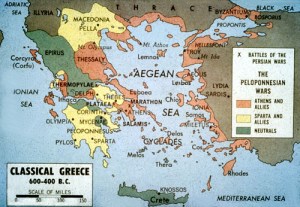 POLEIS – In this post I’m looking at Poleis (Cities), written by Eupolis, one of the Big Three of Ancient Greek Comedy along with Aristophanes and Cratinus. This satirical comedy is dated from approximately 422 B.C. to 419 B.C. Like so many other such comedies it has survived only in fragmentary form.
The title refers to the all-important Chorus in ancient Greek comedies. In this case the chorus consisted of actors costumed to represent some of the city-states which were under the influence of Athens at the time.
 As for how people can be “costumed” as cities, picture how it would be done with American cities. The chorus member representing New York might be depicted as the Statue of Liberty, Saint Louis as the Arch, Pittsburgh as a steel worker, Los Angeles as a brain-dead movie star and so on.
Part of the political satire dealt with the love-hate relationship that many subject- states had with Athens. Being the combination Paris/ Tokyo/ New York City of its time, Athens had a lot to offer its allied polities, but a certain air of tension always existed because of what some of those locations felt were Athens’ high-handed ways of dealing with them.
Eupolis depicted the personified subject-states/ allied states as workers with a not altogether beloved “boss,” Athens. Continue reading
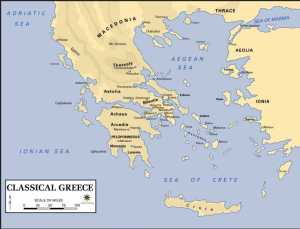 By reader request here is a blog post featuring a brief synopsis of the subject matter to each of the dozens of reviews I’ve written of ancient Greek comedies. Some of you indicated that you don’t like clicking on one with no idea what it will be about, so here we go.
  ASK BALLADEER: Who is your favorite Attic Old Comedian outside of Aristophanes?
  Anteia was written by the comic poet Philyllius. This comic poet’s career seems to have spanned approximately from the 410s BCE to 390 BCE. One of his comedies won 1st prize at a Lenaea festival in the 390s and he won 1st prize at an unknown Dionysia. His fellow comedian Strattis credited him with being the first Attic Old Comic to use real torches on stage.
 Balladeer’s Blog frequently examines ancient Greek comedies written by Aristophanes, Cratinus, Eupolis and others. Recently I was put in mind of the way those comedians often satirized the “professional accusers” in the political and legal forums of ancient Athens.
  Demagogues like Cleon and Hyperbolus and others often used “professional accusers” against their political opponents. These figures – called sycophantes by the ancient Athenians – are often termed “informers” in many translations of Greek comedies but I feel the word accuser is more accurate.
  Here at Balladeer’s Blog I’ve been reviewing ancient Greek comedies for years and a fair amount of people have recently asked me why I didn’t take the traditional view of Aristophanes’ comedy The Birds. That traditional view claims that The Birds was written at least partially as a commentary on the failed military expedition to Sicily.
