
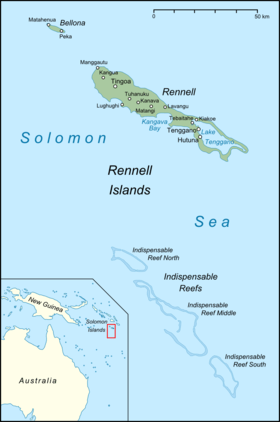
 In the style of Balladeer’s Blog’s separate examinations of Hawaiian and Samoan myths as a subset of Polynesian Mythology comes this look at the deities worshipped on the Polynesian outliers Bellona Island and Rennell Island. Despite its much smaller size Bellona had a larger population for much of their history.
NGE’OBIONGO – The goddess of the stone ovens used by the people of Rennell and Bellona. The ovens were shown such reverence that it was forbidden to eat near them or to scatter firewood or even to speak in raised voices in their vicinity. Nge’obiongo would punish anyone who violated those taboos, just as she punished women who were bad or lazy cooks or who prepared meals without first properly cleaning their hands.
Undercooking the food would also invite this deity’s wrath. On rare occassions some of the prepared food would be left in the ovens as an offering to Nge’obiongo.
 MAHUIKE – The earthquake god of Bellona and Rennell Islands (henceforth Bel-Ren). Like his counterparts in Hawaii and Samoa, Mahuike lived far underground and caused earthquakes by pushing at the earth with both of his arms.
Once, after a particularly destructive earthquake, the god Tehu’aingabenga fought Mahuike for injuring his worshippers and broke off one of the earthquake god’s arms. Continue reading
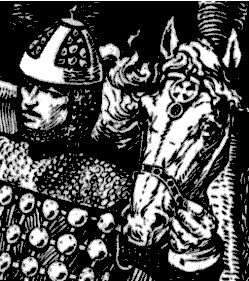 REINOLD, MAUGRIS THE MAGICIAN AND THE ENCHANTED HORSE BAYARD – Reinold was another of Charlemagne’s nephews, like the Paladin Roland. Reinold, also called Rinaldo, was the son of the Emperor’s sister Aya and her husband, Duke Aymon of Ardennes. Reinold’s sister Bradamante, covered previously at Balladeer’s Blog, was the white-armored Paladin in Charlemagne’s court, making her literally a “white knight.”
 Once, while riding outside Paris, Reinold was presented with a magnificent suit of armor by Maugris the magician, the younger, more active counterpart to Merlin from Arthurian lore. (In some versions Maugris – aka Malagigi – also gives Reinold a horse, but since this tale centers around Reinold’s taming of the mount Bayard I’m omitting that to keep the story stream-lined.)
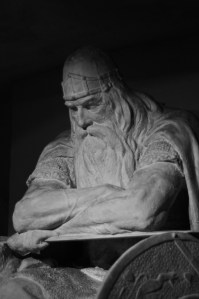
 I. A 14 ft tall giant named Ferragus was preying upon Charlemagne’s subjects, carrying them away at will and devouring them in his cave. When the Emperor was made aware of this situation by the inhabitants of the affected region he called for a volunteer from among his Paladins to kill the giant.
 POLEIS (CITIES) 422-419 B.C. – A look at the ancient Greek political comedy written by Eupolis. CLICK
 ANCIENT SCIENCE FICTION – Messages From Mars (1892)
 ISAIAH WASHINGTON – And yet another Martin Luther King Person of Courage to profile – CLICK
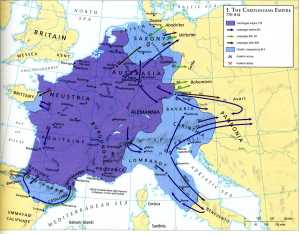 Our previous installment ended with the army of Charlemagne besieging the Muslim Saracen army which had taken Rome after forcing them to withdraw inside the city following their defeat in battle. Roland, Ogier and others had been knighted by Charlemagne himself after distinguishing themselves in combat.
 Though Charlemagne was a real historical figure, a body of folkore has risen around him and his Paladins (knights). Part of that folklore was that the Pope crowned Charlemagne as the new Holy Roman Emperor on Christmas Day, even though the crowning really took place the following February. Since the story of Charlemagne’s crowning as Emperor was told as a Christmas story for centuries I always use Christmas time to examine him and his Paladins.
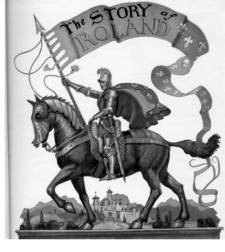 HOW ROLAND AND OGIER BECAME PALADINS – The Emperor could not expect his nephew to immediately step into service as a Paladin, since he had a great deal to learn. Charlemagne placed him as a Page in the household of Duke Namo of Bavaria, where Roland began his career alongside many other young nobles.
 As always part of the fun comes from the way the Fool Killer – in this case James Larkin Pearson’s version in his monthly publication – took aim at politicians from both parties and at other “fools” of the day. March of 1921’s targets:
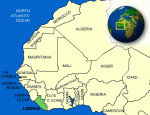 Balladeer’s Blog presents another neglected epic myth from around the world. In this case, Liberia’s Woi Epic of the Kpelle people.

