THE CAVERN OF FIRE (1888) – Written by Francis W Doughty. This novel was originally serialized in The Boys of New York from September 15th to November 3rd of 1888. The main character is Professor Hardcastle, head of Merton College in Illinois. Hardcastle’s pet theory over the years has been that America’s mound builders were really from ancient Greece.
At long last he gets some proof of his belief when a tornado not only slams Merton College but also tears open one of the aged mounds in question. Hardcastle, his student Jack Merton and their Chinese aide John Foo discover an iron chest in the opened mound. The chest contains leather pages which, when translated by the professor, are revealed to feature the account of an ancient Greek adventurer named Polyxaphanes.
Polyxaphanes explored far northern caverns leading deep into the Earth, past the realm of the Hyperboreans and ultimately surfacing amid the Toltecs of what is now Mexico. From there the resourceful Greek eventually found his way to America. Hardcastle, Merton and Foo set off in a lighter than air balloon to search for the Mexican end of the vast subterranean cavern system described by Polyxaphanes. Continue reading
 ARE THE PLANETS INHABITED? (1913) – Written by Edward Walter Maunder, this book began with ridicule of the outdated belief that the sun and moon might be inhabited, but it doesn’t exactly embody scientific accuracy itself. Therefore I’m classifying it as science fiction even though in 1913 it was considered to be a series of observations adhering to rigid scientific principles.
 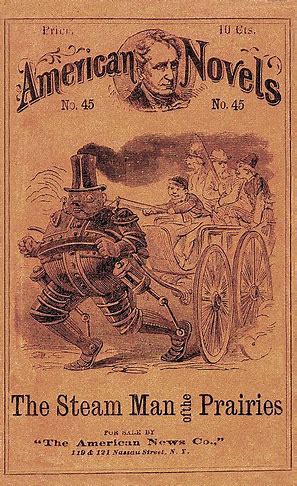 THE STEAM MAN OF THE PRAIRIES (1868) – Written by Edward Sylvester Ellis. Before the Frank Reade stories came this work that is often hailed as the first Dime Novel with a science fiction theme.
  THE NEW HUMANS (1909) – Written by B Vallance. No other name has come to light for the author of this thought-provoking work. Explorer Montgomery Merrick is roaming around the wilds of 1909 Uganda when he falls down a mountainside and into a concealed valley.
  MY COUSIN’S AIRSHIP, A TALE OF 1950 (1902) – Written by W.F. Alexander. Though written in 1902 this story is set in a fictional 1950 which has seen incredible scientific advances.
  INSPECTOR LIPINZKI: RIVALS OF SHERLOCK HOLMES (1973) – The best episode of Season Two involved this detective investigating the spectacular theft of a huge diamond. Click
  THE FIRST TWENTY CAPTAIN AMERICA STORIES OF THE 1940s – The Golden Age adventures of the red white and blue superhero. Click
 VICTIMS OF THE DEMOCRAT RIOTERS SPEAK OUT – The victims of color who suffered through the Democrat riots this year were ignored by the Democrats’ media outlets. Click
  LADY MOLLY: DETECTIVE – Baroness Orczy’s female detective from 1910, solving a murder mystery involving a woman in a “big hat.” Click
  TWIN PEAKS IN POLAND: THE MAGICAL WORLD OF ANIA – The disappearance of a troubled young woman leads to a series of nightmarish goings-on. Click
  CONSOLATIONS IN TRAVEL (1830) ANCIENT SCIENCE FICTION – A trip to assorted planets in our solar system. Click
 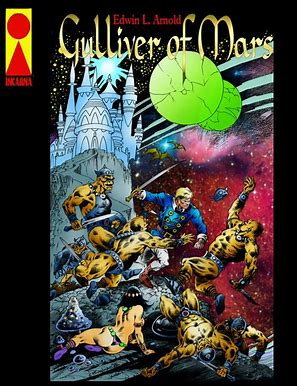 GULLIVAR JONES ON MARS (1905) – Written by Edwin L Arnold. In
 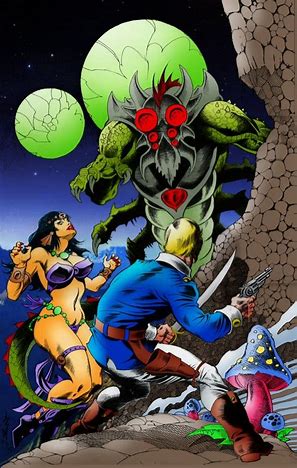 Gullivar Jones on Mars starts out in the late 1860s or early 1870s with U.S. Navy Lieutenant Gullivar Jones, a veteran of the Union forces in the Civil War, in New York City on shore leave. He comes into possession of a Turkish rug with unexplained mystical powers. While standing on the unrolled rug he wishes he was on Mars and the flying carpet transports him there. (?)
  GULLIVAR JONES ON MARS (1905) – Written by Edwin L Arnold, this novel was originally published under the title Lieut. Gullivar Jones: His Vacation. Years later, with the spelling of the lead character’s first name altered, it was published as Gulliver of Mars. Over the years it was revived under a variety of titles. I’m using the title that I prefer – Gullivar Jones On Mars.
  If Arnold had written this story decades later it could have been said that he was intentionally subverting the tropes of heroic sword & science epics. Unfortunately, this novel instead seems to be the victim of ineptitude on the author’s part.