
 Steven Spielberg’s sister Anne got her start as a producer for many of the cheapjack science fiction films of Robert Emenegger and Allan Sandler. She had worked with them – and Cameron Mitchell – as far back as 1975’s Death: The Ultimate Mystery. With apologies to fans of the original Doctor Who series, to me “E-Space” will always mean EMENEGGER SPACE, as in the Emenegger-verse of his series of movies in 1980 and 1981.
Emenegger Space is full of Grade Z special effects, bad acting, a few good ideas and an overall feel of striving for Alien and Star Trek levels but falling far, far short.
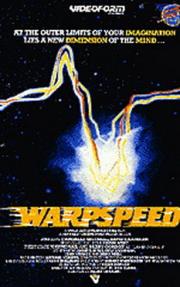 WARP SPEED (1981) – Set in the far-off year 2013 (!) this movie features the crew of a spaceship sent to determine what happened to the vanished crew of a multi-year mission to Saturn. The organization they serve is called Starfleet, which serves as a reminder that by 1981 there was just the original Star Trek series, its cartoon version and one movie, not the enormous universe of spin-offs that we have today. Point being that the term Starfleet was apparently open for use by other creators. Starfleet features in another Spielberg/ Emenegger/ Sandler joint, too.
Adam West plays Captain Lofton, the leader of the now-lost mission, and has assorted offspring of Cameron Mitchell backing him up in this movie. One such Mitchell, Camille, stars as Dr Janet Trask, a psychic who is sent into the abandoned Atlas vessel to investigate the cause of the crew’s disappearance.
Trask is outfitted with tech which sends back images of the psychic visions she receives of past events on the ghost-ship. Amid assorted David Lynch-style psychosexual interludes we see disaster strike the Atlas, followed by an aborted mission and ultimately a mutiny as the crew try to get the damaged craft back to the Earth. Continue reading
 OBJECT Z (1965) – Directed by Daphne Shadwell and written by Christopher McMaster, this was one of the many six-episode science fiction serials from British television of the 1950s and 1960s. The Quatermass serials are among the best remembered of those programs but there were also items like The Trollenberg Terror, a serial later adapted into the B-Movie The Crawling Eye.
  ISLAND OF THE LOST (1967) – Directed by John Florea and written by Richard Carlson and Ivan Tors, this family adventure movie starred Richard Greene, known for playing Robin Hood in the 1950s television series and for playing Sir Denis Nayland Smith in a few of the Fu Manchu movies from the 1960s.
  Richard Greene AND Richard Carlson? You know that with a couple of Dicks like them around we are in for some campiness and lame special effects that might have been acceptable in the 1950s … in black & white, not color.
 MY COUSIN’S AIRSHIP, A TALE OF 1950 (1902) – Written by W.F. Alexander. Though written in 1902 this story is set in a fictional 1950 which has seen incredible scientific advances.
 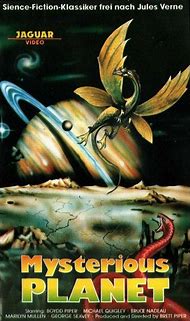 MYSTERIOUS PLANET (1982) – Written, produced and directed by Brett Piper, this was his first film ever and it manages to be bad in every conceivable way, running the gamut from fun-bad to boring-bad to incomprehensibly bad and even rising to “how could you NOT be ashamed to release this under your real name” bad at times.
  As the story opens, some kind of space fleet is informing all of its ships that no take-offs will be permitted until an “asteroid storm” passes through. Most of the captains are content to obey, but not Commander Rogan (Paula Taupier), the combined captain and science officer of the medical transport ship. (If you can make out the name of the vessel you’ve got me beaten, and I replayed most of the dialogue several times to pick out what nuggets of information I could.)
  SIX-HUNDRED & SIXTY SIX (1972) – Directed by Tom Doades and written by Marshall Riggan, this film is a very unusual blend of science fiction, horror, post-apocalypse drama and religious message. Cult actor Joe Turkel, perhaps best known as the ghostly Lloyd the Bartender in The Shining, stars as Colonel John Ferguson.
  Obviously, a post-Omen film would not blow their story’s final reveal in the title, like we get with Six-Hundred & Sixty Six.
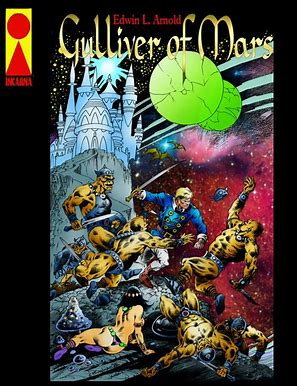 GULLIVAR JONES ON MARS (1905) – Written by Edwin L Arnold. In
 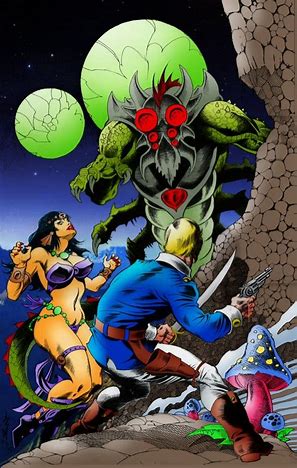 Gullivar Jones on Mars starts out in the late 1860s or early 1870s with U.S. Navy Lieutenant Gullivar Jones, a veteran of the Union forces in the Civil War, in New York City on shore leave. He comes into possession of a Turkish rug with unexplained mystical powers. While standing on the unrolled rug he wishes he was on Mars and the flying carpet transports him there. (?)
  GULLIVAR JONES ON MARS (1905) – Written by Edwin L Arnold, this novel was originally published under the title Lieut. Gullivar Jones: His Vacation. Years later, with the spelling of the lead character’s first name altered, it was published as Gulliver of Mars. Over the years it was revived under a variety of titles. I’m using the title that I prefer – Gullivar Jones On Mars.
  If Arnold had written this story decades later it could have been said that he was intentionally subverting the tropes of heroic sword & science epics. Unfortunately, this novel instead seems to be the victim of ineptitude on the author’s part.
 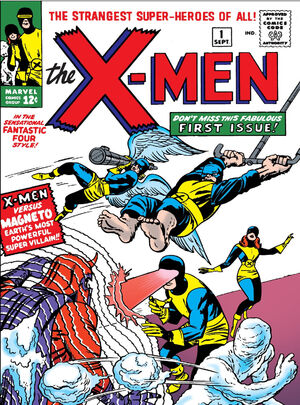 THE X-MEN Vol 1 #1 (September 1963)
  Balladeer's Blog