 We all know today’s date, so let’s examine the notoriously bad Italian ripoff of Star Wars. I know many people consider Star Crash to be the worst of the Italo-Ripoffs but I’ve always gotten more laughs out of The Humanoid.
The many, many ways this movie steals from Star Wars will become clear as we go along. Let’s deal with first things first:
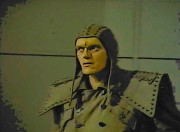 Richard Kiel plays the title figure. His real name is Golob but the Darth Vaderish bad guy arranges for Golob to be the guinea pig for a treatment that transforms ordinary people into powerful “Humanoids”. As a Humanoid Golob loses his beard for some reason but – even more comically – the beard suddenly reappears when he is returned to normal late in the movie.
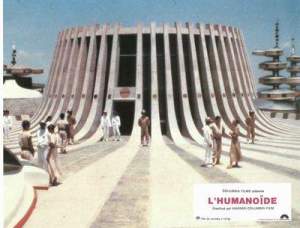 Golob in his amped-up Humanoid form has super-strength, is invulnerable to harm and can deflect energy blasts that the Rebel Alliance-style good guys shoot at him. The bad guys plan to use a warhead to expose every man, woman and child on Earth to the bio-treatment, thus creating an instant army of billions of super-powered Humanoids like Richard Kiel. (Good luck controlling them since the treatment will reduce them to mindless animals like Golob.)
 Corinne Clery portrays Barbara Gibson, the spunky Princess Leia pastiche. Barbara is a prominent scientist of Metropolis, which is what the entire Earth has been renamed now that it is just one big planet-wide city in the far future setting of The Humanoid. Barbara studies a gifted Asian lad who controls
 the Force uh, I mean some kind of psychic or magical energy field.
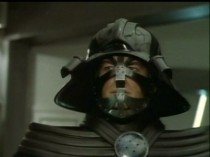 Ivan Rassimov plays the main villain Lord Graal, whose entire army dresses exactly like Darth Vader. He does, too, but to stand out from his underlings HIS black helmet and mask have cutouts that let his eyes, mouth and cheeks show. Lord Graal wants to create the aforementioned Humanoid army so he can conquer the entire Milky Way galaxy. He has magical powers like the Asian boy. Continue reading →

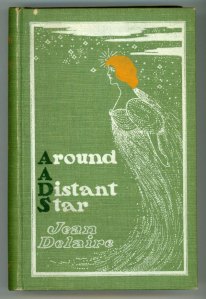 AROUND A DISTANT STAR (1904) – Written by Mrs Muirson Blake under the alias Jean Delaire.
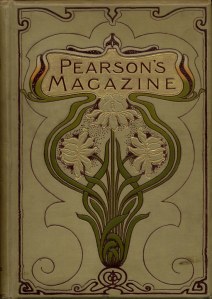 THE DEATH-TRAP (1908) – Written by George Daulton, this story was published in the March, 1908 issue of Pearson’s Magazine. It’s once again Ancient Creature Feature time with this story about a monster from Lake Michigan which sometimes enters the Chicago sewer system to prey on unsuspecting denizens of the Windy City.
  He comes to regret that decision when, on a poorly-lit street, he sees a drunken sailor get dragged down into the sewer and devoured by a slimy, half-glimpsed creature. Our hero flees for his life and doesn’t stop running until he’s reached one of Chicago’s bridges.
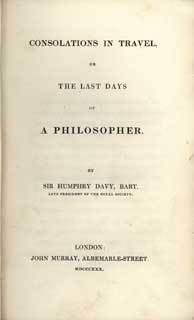 CONSOLATIONS IN TRAVEL or THE LAST DAYS OF A PHILOSOPHER (1830) – Written by THE Sir Humphrey Davy, this is largely a work of philosophical discourse but with one section devoted to a science fiction tale: The Vision.
  The first planet they travel to is Saturn, where Davy is awestruck by the alien landscape. Strange clouds fill the skies and among the oddest planetary features are large columns of liquid which flow from the ground upward. Saturn is inhabited by intelligent beings with three pairs of wings and organs like elephant trunks dangling from their bodies.
  THE Nth MAN (1920?)
  A MEXICAN MYSTERY (1888)
 THE MONSTER OF LAKE LA METRIE (1899) – This short story was written by Wardon Allan Curtis and was first published in the August of 1899 issue of Pearson’s Magazine.
  The pair of researchers begin to theorize that the lake reaches down to the Earth’s “hollow interior.” (Yes, it’s one of THOSE notions again.) They suspect that plant and animal species long extinct on the surface are still alive deep within the planet and occasionally wash up in the lake’s waters.
 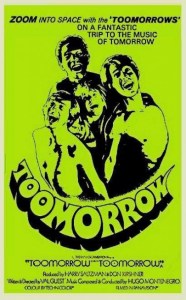 TOOMORROW (1970) – What is one part Monkees episode, one part Frankie & Annette Beach Movie, one part Help!, one part Donny & Marie in Goin’ Coconuts, one part KISS Meets The Phantom of the Park and one part Beyond the Valley of the Dolls? The answer is Toomorrow, the infamous Don Kirshner/ Val Guest cult movie with a then-unknown Olivia Newton-John in a starring role.
  We’re told that Vic’s Tonalizer is what gives Toomorrow its special “sound.” How special is that sound? So special that its unique vibrations can revive the stagnant culture of an alien race that’s facing decay and collapse. It seems the aliens’ own musical output has grown stale because they have long since progressed beyond the troublesome “emotions” and “heart” that Toomorrow’s members pour into their songs.
 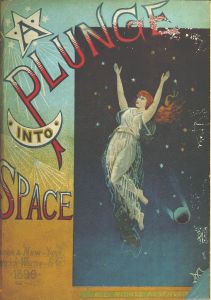 A PLUNGE INTO SPACE (1890) – Written by THE Robert Cromie, later editions of this novel came with a preface by Jules Verne himself. Scientist Henry Barnett, after 20 years of labor, has mastered “the ethereal force which permeates all things,” a combination of electricity and gravity. This mastery will allow for interplanetary space travel.
 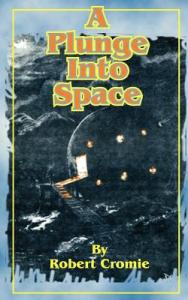 In anticipation of encounters with hostile life-forms on other planets, the clique has also manufactured disintegrator weapons, with which they fight off curious parties of indigenous tribes in order to preserve their secret.
  UTOPIA or THE HISTORY OF AN EXTINCT PLANET, PSYCHOMETRICALLY OBTAINED (1884) – Written by Alfred Denton Cridge. An unnamed narrator comes across the remains of a meteor that entered Earth’s atmosphere. This narrator has the gift of psychometry (the author’s uncle was THE William Denton) and after he picks up the tangerine-sized chunk of black rock from another planet he begins getting impressions from it.
  The planet was just 2,500 miles across and was home to a race of roughly 5 1/2 feet tall humanoids, some with yellow skin, some with brown skin and others with gray skin. All the races had long, black hair. Utopia sported Earthlike plains, mountains, lakes and rivers with just one huge ocean.
