Tag Archives: Science fiction

ANCIENT SCIENCE FICTION: THE UNPRETENTIOUS PHILOSOPHER (1775)

The spacecraft departs from Mercury.

The spacecraft departs from Mercury.

THE UNPRETENTIOUS PHILOSOPHER (1775) – By Louis-Guillaume de La Follie. The original French title of this work of proto-science fiction was Le Philosophe sans Pretention ou l’Homme Rare, but in the 21st Century it’s more generally known by the slightly shorter title. 

One of the central characters of this story is an Earth scholar named Nadir, and I have no idea if it’s a coincidence or if the people behind the 1960s film Frankenstein Meets The Space Monster were paying sly homage to de La Follie by naming one of the characters Nadir. At any rate Nadir is visited by Ormisais, a space traveler from the planet Mercury.

Ormisais regales Nadir with details about life on Mercury and also informs him that he has crash-landed on Earth and needs rare elements to repair his electrically -powered craft so that he can return to his home planet. The Mercurians had a planetary version of the British Royal Society and the French Academy, but it had a much more limited membership. Continue reading

8 Comments

Filed under Ancient Science Fiction

TEN EXAMPLES OF “ANCIENT” SCIENCE FICTION: 1634 – 1909

Forget the stories written by the usual science fiction pioneers like Jules Verne and H.G. Wells. This list will examine some of the nascent works of science fiction going back to before the world at large even used those words to describe this emerging genre. Though technically this examination could begin as far back as 150 C.E. with the Greek philosopher Lucian’s works like Icaromenippus and True History – both involving journeys to the moon via man-made craft – I will instead begin in the 1600s and move on to the early 20th Century.
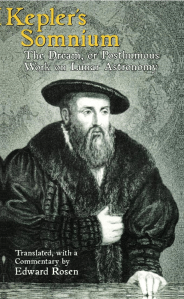
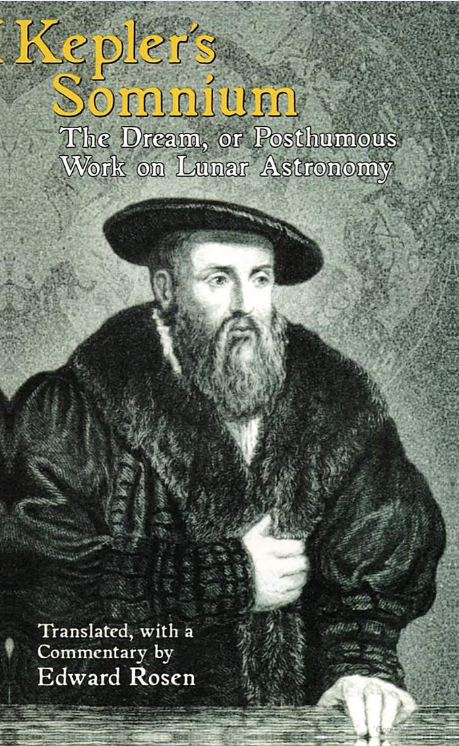
Somnium10. SOMNIUM (1634) – Written by Johannes Kepler. Yes, this is THE Johannes Kepler the famed astronomer so this may be the earliest work of proto-science fiction written by a figure with a grounding in something approaching our own notions of rational science.

Somnium depicted a fictional visit to the moon with story details based very loosely on observations Kepler had made while observing Earth’s natural satellite through a telescope – a fairly new device at the time.  

Kepler’s work depicted the moon as a celestial body of extremes which was bisected into two regions of blazing heat and freezing cold. Nights on the moon were very mild on the side facing Earth because of the amount of reflected sunlight that our planet sends its way. Believe it or not life existed in this world of extremes – reptilian creatures which lived in caves and breathed in the lunar atmosphere. Kepler also depicted plant life – cone-shaped vegetation which went through its entire life-cycle within two weeks.

Fearing the type of persecution that Galileo had faced Kepler never published Somnium during his lifetime and even wrote it in Latin accompanied by copious technical footnotes, possibly to try to disguise it as a thesis. Even though Kepler’s story came out posthumously he might have been spared any persecution for his Copernican views even if he had published it earlier since he took the precaution of explaining the lunar journey away as a mere dream (the meaning of the word “somnium”).   
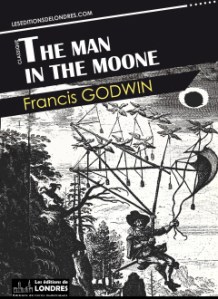
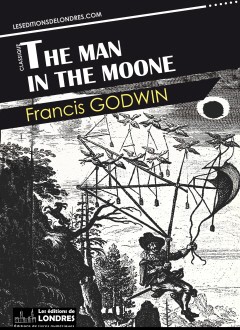
Man in the Moone9. THE MAN IN THE MOONE (1638) – Written by Bishop Francis Godwin. The Man in the Moone depicted Godwin’s fictional hero Domingo Gonsales who trained a huge flock of specially-bred swans to transport him to the moon. The book was written in the style of the accounts that the great nautical explorers of the age wrote of their travels and is often considered the first science fiction story written in English. 

Despite the tale’s thoroughly unscientific method of reaching the moon Gonsales dealt with sensations of weightlessness on his space journey in a nicely prescient bit. Godwin came very close to stating a theory of gravity even before Isaac Newton! In a nod to Dante’s Divine Comedy from centuries earlier the story also featured some of the spirits of deceased humans inhabiting the space between worlds.

Godwin depicted the moon itself as fairly Earth-like and inhabited by a race of Continue reading

20 Comments

Filed under Ancient Science Fiction, Neglected History

WAR OF THE WORLDS (1988-1990)

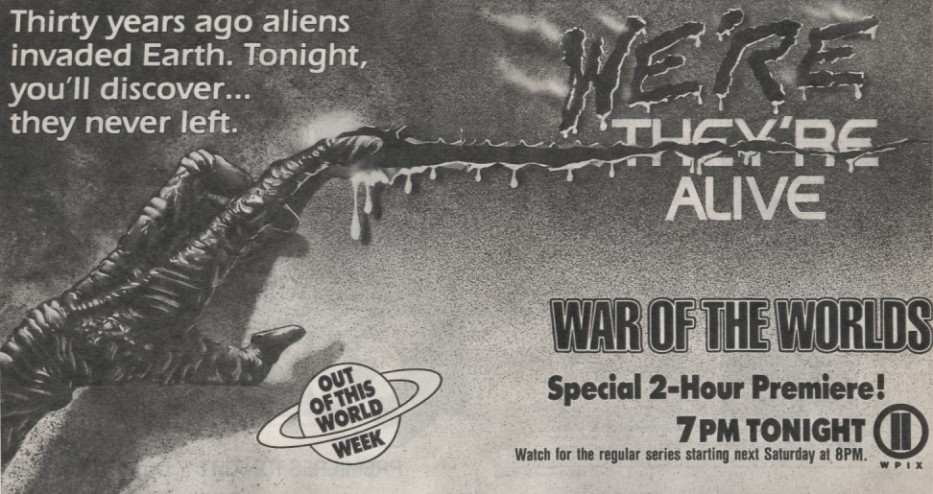
War of the Worlds tv guideWar of the Worlds posterWAR OF THE WORLDS (Television Series) – This short-lived series proceeded from a fun premise. In this program’s world the Martian invasions depicted occurring in 1901 ( 1897 novel), 1938 (Orson Welles radio version) and 1953 (first film version) were really three separate real-world attempts by extra-terrestrials (NOT Martians, however) to conquer the Earth. In an “X-Files before The X-Files existed” sort of way the world’s governments collaborated in an extensive – and successful – coverup to pass those invasions off as fiction.

The faux-Martian craft were presented as the explanation behind the first UFO sightings and their damaged spaceships and presumably dead bodies were being kept in hiding at various bases around the world for reverse-engineering and other studies. The leftover bodies from the 1953 invasion were really just dormant, thanks to the aliens’ latest attempts at immunizing themselves against the Earthly illnesses that were always their undoing in the past.    

War of the Worlds castThose dormant aliens are now emerging from their sleep and attempting once again to conquer the Earth, this time by taking over the bodies of human beings thereby giving themselves full immunity. Human scientists, military and governmental forces battle the aliens. 

Though all of that sounds derivative War of the Worlds actually managed to make it all seem fresh through quality scripting, fleshed-out characters and a capable cast led by Jared “Fantastic Voyage” Martin, Ann Robinson, Ilse Von Glatz and Richard Chaves. An added element of suspense lay in the fact that the aliens sometimes WON so viewers felt genuine tension. Pacing was a problem, however, and I would say the show’s episodes would have benefited from a half-hour run time instead of an hour-long format.   Continue reading

18 Comments

Filed under Forgotten Television

FOOLKILLER: DEFENDERS NUMBER 79

Foolkiller in swamp in Man Thing

Foolkiller

Summer means superhero movies, so Balladeer’s Blog’s “Script Doctoring” of Marvel’s handling of Foolkiller continues with Part Five. FOR PART ONE OF THIS ARTICLE CLICK  HERE

More hints about my backstory for Foolkiller’s Purification Gun as I outline this alternate version of Defenders # 79as the team continues fighting Mandrill, Fem-Force and Mutant Force.

DEFENDERS Vol 1: Number 79 – Chains of Love (Jan 1980)

Since having Hulk on the cover was always crucial for sales during this struggling period for The Defenders the cover featured Hulk, Dr Strange and Sub-Mariner in their dull Tunnelworld adventure. It’s more imitation Tolkien as the trio battle the Unnameable, a boring villain from the Unreadable (Ed Hannigan).   

Back on Earth the other contingent of Defenders (Valkyrie, Yellowjacket, Hellcat, Foolkiller and the Wasp) are where we left them last time. Yellowjacket has already been captured and the others are surrounded by Fem-Force, the Mandrill’s all-female army, because Ruth and Amber – under the Mandrill’s pheremone-fueled control – betrayed them.   Continue reading

6 Comments

Filed under Superheroes

WAVELENGTH (1983): MICRO-REVIEW

WavelengthWAVELENGTH (1983) – This is an unjustly neglected science fiction film that stars Robert Carradine, Cherie Currie and Keenan Wynn in a very unconventional love triangle: both Carradine and Currie are fighting over Wynn. (I’m kidding!)

Robert Carradine plays a moody musician suffering a career lull, Cherie Currie portrays a groupie who becomes a bona fide romantic partner for him and Keenan Wynn barks and snarls in his usual “grouch with a heart of gold” manner. Cherie’s sensitive mind is open to alien brain-waves calling to her from a nearby (seemingly) abandoned government installation. Carradine and his neighbor Wynn help her try to find out what’s going on. Continue reading

10 Comments

Filed under Bad and weird movies

THE MEN OF THE MOON (1809): ANCIENT SCIENCE FICTION

Washington Irving giving us his sexiest come-hither stare.

Washington Irving giving us his sexiest come-hither stare.

THE MEN OF THE MOON (1809) – Several decades before H.G. Wells would use his fictional invasion from Mars in War of the Worlds as an allegorical condemnation of colonialism the American author Washington Irving beat him to it. In Irving’s work The Men of the Moon a technologically advanced race from the moon conquered the Earth and treated its inhabitants the way that European and Muslim colonialists treated the indigenous inhabitants of the areas they subjugated.

Irving tongue-in- cheekly called his invaders from the moon “Lunatics” and depicted them as green-skinned humanoids with tails and one eye each instead of two. Their most bizarre feature is the fact that they carry their detached heads tucked under one arm with a spinal column “cord” attaching the head to the body. For refreshment the moon men drink liquid nitrous oxide.  Continue reading

6 Comments

Filed under Ancient Science Fiction

EDISON’S CONQUEST OF MARS (1898): THE CONCLUSION

MARSBalladeer’s Blog concludes its examination of Garrett P Serviss’ odd sequel to Fighters From Mars, his blatant imitation of War of the Worlds.

PART TWELVE

Soon the freed Earthwoman Aina (ah-EEE-nuh) was fluent enough in English and the High Command of the Terran fleet were well-versed enough in the ancient tongue of Aina’s people AND the Martians’ own language. In the present state of affairs Aina could understand and be understood enough that Edison, Serviss, Colonel Smith and the others could make clear to the former slave-girl their strategic needs.

When Aina gave the Earthmen a breakdown on all that she and her people had learned during their servitude on the Red Planet a plan came to mind. Thomas Edison’s strategy took the shape of the soon-to-be- formula “unstoppable army who can be defeated by a single quick blow inflicted at a ridiculously obvious point of weakness.” Continue reading

4 Comments

Filed under Ancient Science Fiction

EDISON’S CONQUEST OF MARS (1898): PART ELEVEN

The Martian moon Deimos

The Martian moon Deimos

Balladeer’s Blog continues its examination of Garrett P Serviss’ odd sequel to Fighters From Mars, his blatant imitation of War of the Worlds.

PART ELEVEN

The 20 spaceships in the detachment commanded by Garrett Serviss and Colonel Alonzo Jefferson Smith rejoined the main fleet commanded by Thomas Edison. That main fleet was continuing its bombardment of the Martian forts and cities below with their disintegrator guns while trying to remain just outside of the range of the Martians’ lightning cannons. (I know “cannon” can also be plural but many people don’t so to avoid confusion I use “cannons” instead) 

Serviss and Smith informed Edison about the success of their raid to obtain supplies for the entire fleet and then revealed the other find from their raid: the captive Earth woman whom the Martians had been using as a slave. 

With the dire supply problem solved Edison decided to have the Terran fleet withdraw to the Martian moon of Deimos. The remaining 60-plus Earth ships landed on the side of that moon that was always faced away from the Red Planet. Patrols in camouflaged space suits were posted on the far horizon to keep a watch on Mars with telescopes to prevent any surprise attacks.     Continue reading

13 Comments

Filed under Ancient Science Fiction

EDISON’S CONQUEST OF MARS (1898): PART TEN

Edison's Conquest of MarsBalladeer’s Blog continues its examination of Garrett P Serviss’ odd sequel to Fighters From Mars, his blatant imitation of War of the Worlds.

PART TEN

The Earth fleet remained far enough away from the Red Planet to be out of the range of the Martians’ heat rays and lightning cannons. Just over 60 spaceships were left of the 100 that had set out from Earth.

The Terrans regrouped after their defeat at the Battle of the Lake of the Sun. Because of the earlier disaster regarding their food and water barely 9 days’ worth of provisions remained to them and that was not even enough to last for the long trip back to Earth.  Continue reading

4 Comments

Filed under Ancient Science Fiction

EDISON’S CONQUEST OF MARS (1898): PART NINE

Edison's Conquest of Mars 8Balladeer’s Blog continues its examination of Garrett P Serviss’ odd sequel to Fighters From Mars, his blatant imitation of War of the Worlds.

PART NINE

As the black chemical cloud succeeded in hiding the entire surface of Mars from the Earth fleet’s view the men on board the spaceships began choking and suffocating as the strange fumes somehow slipped through microscopic pores on the hulls. 

Thomas Edison ordered the fleet to pull far enough away from the Red Planet that they would all be safe from the chemical smoke, which was limited to the Martian atmosphere. While the various commanders tried to plot a new attack strategy it was discovered that most of the food supplies on each of the Earth ships had been destroyed by leaks.

The fleet only had enough provisions left for 10 days, which was not even long enough for the return trip to Earth. The Terran forces now had no choice: they must somehow acquire food and water from the planet below or die. Continue reading

2 Comments

Filed under Ancient Science Fiction