
 THE BLACK ABBOT (1897) – Balladeer’s Blog’s month-long celebration of Halloween continues with another neglected work of horror – this one penned by Robert W Chambers, author of The King in Yellow, which I reviewed HERE
The story – also known as The Black Priest or The Messenger – is set in 1896 in the mysterious Brittany region of northwest France. Richard Darrel, a wealthy American knickerbocker (upstate New York gentry) has bought a Breton estate with assorted household staff. He lives there with his beautiful (of course) wife Lys, a native of Brittany.
Landscaping work near Richard’s estate has uncovered thirty-eight skeletons: men killed in a battle between English invaders and Breton defenders back in 1760. A bronze cylinder in the mass grave holds a delicate parchment with a message written in human blood at the time of the burial. The writing is in the ancient language of Brittany, which only the clergy of the 1760 time period were literate in.
Our American hero senses that the local authorities are withholding vital information from him. He is also intrigued by the revelation that there were thirty-nine men buried in the pit but only thirty-eight skeletons have been found.
The story gets even more intriguing from there, in typical R.W. Chambers style. The skull of the missing dead man is found. It belonged to Abbe Sorgue, a Breton priest who supposedly betrayed the nearby fort to the British attackers. Legend held that for his treachery the priest was branded on the forehead all the way through to his skull. A skull has been found with an arrow-shaped burn on the forehead, obviously the dead traitor.
That skull keeps mysteriously showing up, no matter how many times it seems to have been disposed of. Eventually the Mayor of Saint Gildas confides in Richard that part of the scroll made reference to a link between the Black Abbot and the American’s wife.
Very soon the workmen involved in disturbing the Black Abbot’s remains start turning up dead and Richard finds a superabundance of coincidences tying his wife’s Breton family to the Black Abbot. When that undead villain begins terrorizing the American’s now-pregnant wife he researches what history can be learned about Abbe Sorgue, the Black Abbot himself. Continue reading
 It’s another October 1st and as all readers of Balladeer’s Blog know that means 31 days of obscure and/or forgotten horror films and stories mixed in with all of my usual topics.
 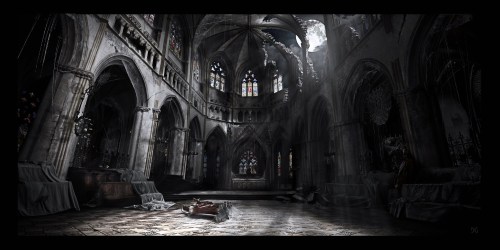 ALL HALLOWS (1926) – Written by Walter de la Mare. In recent decades Walter de la Mare’s horror stories have begun to get as much attention as his poetry. This particular tale is about a haunted cathedral but there is also a blatant subtext.
  Appropriately for a horror story our protagonist has arrived as the sun is going down. The odd, perhaps half-crazed Verger (Anglican Church Caretaker) impatiently leads the new arrival on a tour of the degenerating interior. Almost like a Halloween Funhouse host the Verger emphasizes the creepy lore about All Hallows.
  ROSAURA (1817) – Written by Friedrich Fouque. Halloween Month 2017 is dying quickly. Here is another neglected story from the late Gothic Horror period. Rosaura has a fairly unique supernatural premise so that alone should have earned it a wider following by now.
  BEATRICE RAPPACCINI
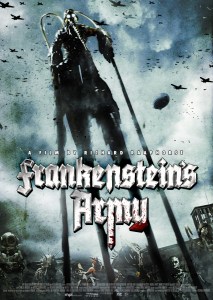 FRANKENSTEIN’S ARMY (2013) – Halloween Month continues here at Balladeer’s Blog with this odd mish-mash of a film. Frankenstein’s Army is one of those horror movies which is presented as Found Footage for no reason and even though it’s set during World War 2 it’s being filmed in color for no reason at all and it’s being filmed by a Russian film crew for ABSOLUTELY no reason at all.
  Dr Frankenstein has been doing experiments for the Germans, working on those Top Secret “wonder weapons” that Hitler and his propagandists kept reassuring the suffering German civilians about. Stalin wants our heroes to determine the nature of Frankenstein’s creations and take him into custody to continue his work for the blood-soaked Soviet dictator.
  Balladeer's Blog