
 THE WRECK OF A WORLD (1889) – Written by W. Grove. (No other name available) This novel is the sequel to Grove’s A Mexican Mystery, an ahead-of-its-time work about a train engine devised to have artificial intelligence. The machine – called only The Engine in that story – rebelled and took to preying on human beings in horrific fashion. For Balladeer’s Blog’s review of that novel click HERE
The Wreck of a World is not a direct sequel to A Mexican Mystery but does use one of that novel’s elements as its springboard: the deliciously frightening notion that the Engine’s artificial intelligence might have included the capacity to design and build others of its kind. Though A Mexican Mystery never explored that concept, Grove deals with it in much more detail in this second novel.
 Our story begins in what was to Grove “the far future” of 1949. After a fairly superficial depiction of the world’s political and scientific situation in this imaginary future the meat of the tale begins. All in all the author did not present 1940s technology as being much more advanced than what was available in the 1880s. Grove might have done better to set his tale in 1899 or just into the 1900s to detract from his lack of vision on this particular element.
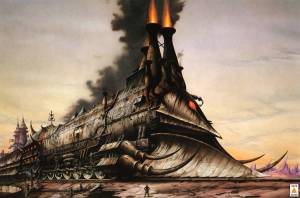
The revolt of the machines begins with train engines, presumably as a nod to the memorably malevolent Engine from Grove’s previous novel. The engines begin constructing others of their kind with the same robotic arms and with each new edition flaunting deadlier and deadlier weaponry to boot.
The engines soon modify themselves beyond the need for train tracks and become more like tanks, so kudos to this neglected author for nicely predicting the advent of such mobile death-machines. Continue reading
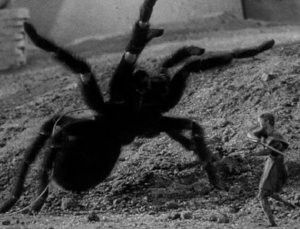 THE ULTIMATE INHERITORS (1914) – Written by Berg Bellair. This is a very entertaining work of vintage or “ancient” science fiction and is especially noteworthy for the way it anticipates the many “big bug” movies of the 1950s and later.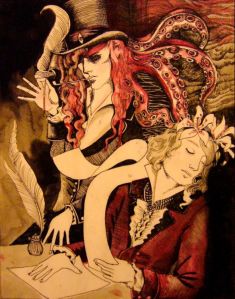
 Fifth Canto, Stanza 1: BETWEEN YOUR LITERATURE AND MINE – Maldoror goes meta, addressing the reader directly for daring to condemn him while still continuing to read about his nightmarish activities. He recommends a recipe for preparing the flesh of one’s mother after killing her, and otherwise seems to presage many modern-day serial killers. CLICK
  IN SEARCH OF THE UNKNOWN (1904) by Robert W Chambers. Previously Balladeer’s Blog examined Chambers’ underrated horror classic The King in Yellow. The work we’re looking at this time around is a collection of short stories about Francis Gilland the Zoologist. Gilland was a forerunner of the real-life Frank “Bring ’em Back Alive” Buck and the fictional Indiana Jones.
  I. THE HARBOR MASTER – Gilland is sent north to Hudson Bay where a Harbor Master has reported capturing a pair of Great Auks, flightless birds which went extinct in the mid-1800s. The two-fisted scholar finds the Great Auks are for real but the Harbor Master harbors (see what I did there) a sinister secret.
 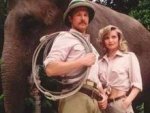 II. IN QUEST OF THE DINGUE – The Graham Glacier melts, unleashing a number of animals from species that were long thought extinct. Among the crowd of academics converging on the unexplored area are Gilland and Professor Smawl. The Professor is a sexy, strong-willed female scholar that our hero has been forced to accompany into the region.
 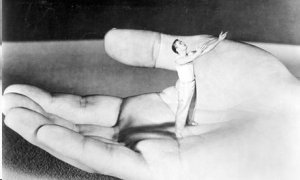 THE ADVENTURES OF A MICRO-MAN (1902) – This work of vintage or “ancient” science fiction was authored by Lancelot Bayly under the pen name Edwin Pallender. The central character of the story was Doctor Geoffrey Hassler, a wealthy eccentric scientist who has discovered “microgen” a gas which shrinks objects down to a very small size.
 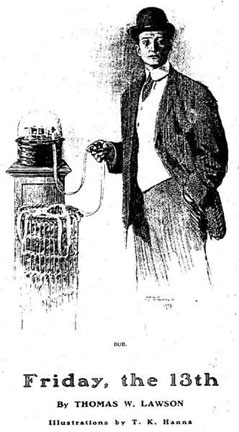 FRIDAY THE THIRTEENTH (1907) – Written by Thomas William Lawson, a writer and stock manipulator who made a fortune from shady stock deals … in between advocating for cleaning up Wall Street to shut down those fleece jobs. The reforms Lawson campaigned for were taken up decades later when Franklin Roosevelt appointed future Supreme Court Justice William O Douglas to head the Securities Exchange Commission.
 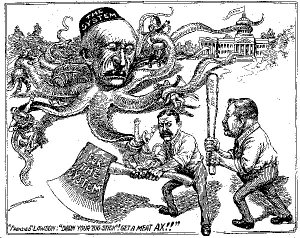 Jim Randolph, one of the novel’s main characters, is in the T.R. mold: he may be a bloated rich pig but at least he’s a bloated rich pig with a sense of noblesse oblige. Jim shares Teddy Roosevelt’s disdain for the Trusts and for con men who use the stock market to rip off their clients.
