
Balladeer’s Blog continues its examination of the many facets of Fool Killer lore. FOR PART ONE, INCLUDING THE HISTORICAL CONTEXT, CLICK HERE
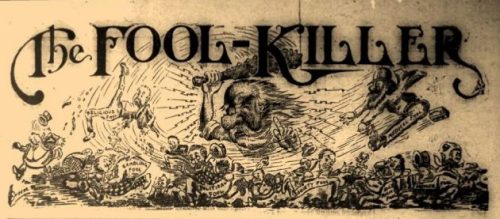 PART SEVENTEEN: Resuming my look at James Larkin Pearson’s Fool Killer (Or Fool-Killer as he wrote it). In August of 1919 Pearson brought the Fool Killer (I prefer no hyphen) out of his latest hibernation with the words “After resting for two years the Fool-Killer goes on duty again.”
This time around the figure had nationwide exposure and with the enormous number of railroads criss-crossing the country by now he could get around more quickly than ever.
In the previous installment I provided the background information on Pearson and his Fool Killer. This time around we can jump right into the “fools” who were the fictional figure’s August 1919 targets:
 *** People still pushing Democrat President Woodrow Wilson’s claim that the World War (1914-1918) was fought to “Make the world safe for Democracy.” The Fool Killer would swing away at such people while pointing out the less-than-democratic nature of some of the Allied Powers governments from the recent conflict, especially England, Italy and Japan.
*** Bloated rich pigs – “plutes” as this Fool Killer called them, short for plutocrats – who try to blame the “class consciousness” of American laborers wanting better working conditions on the fairly new Bolshevik government in the emerging Soviet Union. (An especially idiotic claim by the plutocrats, since American workers had been striking, etc, for decades before the Bolsheviks took power.)
 *** A preacher who publicly said that he “almost wishes sometimes that Jesus would come already.” The Fool Killer added a joke wondering how that preacher would feel if he was on a trip and his wife said that she “almost wishes sometimes” that he would come back from his trip already. (Pearson was, sad to say, very religious and often took shots at clergy members he found insufficiently “devout.”)
*** White Russians (The fallen Russian aristocrats and their supporters).
*** Mossbacks (Narrow-minded conservatives. Think of the clueless, stuffy white guys in suits at National Review for just one example.) Continue reading
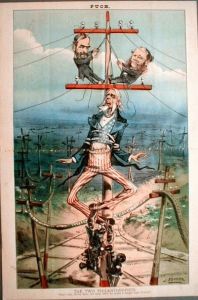 Puck magazine (1871-1918), the well-known political humor magazine, was at its height under original founder and creative director cartoonist Joseph Keppler. Here is a February 23rd, 1881 Keppler political cartoon depicting Jay Gould, the telegraph monopolist, and Cornelius Vanderbilt the railroad baron.
  This is similar to the way the Silicon Valley and Social Media Robber Barons of today cloak themselves in “socially conscious” public images while in reality clutching the United States and all its institutions by the throat.
  AT THE END OF THE RIVER – More Weirdness at the End of the World, this time with an adventure featuring Spain’s answer to Mad Max: Hombre himself. This character was created by Antonio Segura and Jose Ortiz in 1981 in the Spanish publication Cimoc. Hombre went on to appear in notably “adult” comic books and magazines around the world, including reprints in Heavy Metal here in America.
 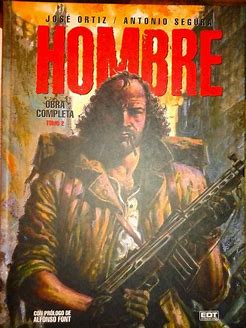 The title character Hombre roams our post-apocalypse planet armed to the teeth and ready to kill or be killed on a daily basis. His first-person narration echoes the best aspects of hard-boiled Film Noir detective stories while the action and mis en scene combine the best elements of Spaghetti Westerns, Post-Apocalypse movies and Martial Arts flicks. Think Six-String Samurai but without the rock and roll samurai.
 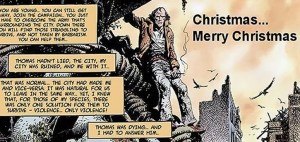 Segura mostly avoided easy narratives and my least favorite storyline involved Atila, the badass woman warrior. The character was great, but the tale seemed very UN-Segura-like to me. I probably would have liked her in her own spin-off story but having two such nigh-indestructible figures in one tale put things too far into the realm of upbeat fictional tropes to me. I’m virtually alone on that, by the way, since most fans LOVE the Atila story.
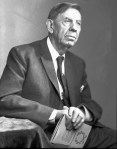
 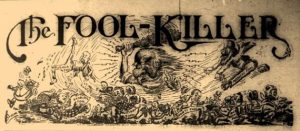 PART SIXTEEN: James Larkin Pearson, poet and newspaper man, carried on the Fool Killer tradition from 1910 to 1917, then again from 1919 to 1929. Pearson’s fellow North Carolinian Charles Napoleon Bonaparte Evans had written the Fool Killer Letters of the 19th Century so it’s appropriate that another Tar Heel continue the lore for so many years of the 20th Century.
  In August of 1917 Pearson’s nationwide publication called The Fool-Killer changed its title and format because of America’s entry into World War One four months earlier. That change from the hard-hitting satire of Fool Killing was made to show solidarity while the war raged.
  For Flashman Down Under, Flashman in the Opium War & Flashman and the Kings click
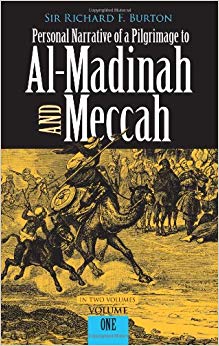 The duo enjoy diving into the darker and more forbidden side of life where sex, booze and other diversions are concerned. Flashman happens to be with Burton in Egypt in early 1853 when the famous explorer begins his journey to Medina and Mecca disguised as a Muslim.
  PART FIFTEEN: Last time around I examined Joel Chandler Harris’ 1902 story Flingin’ Jim And His Fool-Killer, set in Georgia in October of 1872, plus Ridgway Hill’s Facts For The Fool-Killer, set in and around Buffalo, NY in 1909.
  Thank you to readers who reminded me that I did not follow up my examination of the World War Two-era Justice Society of America stories with my usual collection of links. I always did that after similar items like The Celestial Madonna Saga, Panther’s Rage, The Kree-Skrull War and most recently Adam Warlock’s encounter with the Magus, Thanos and Gamora.
 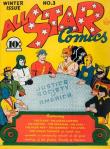 THE FIRST MEETING OF THE JUSTICE SOCIETY OF AMERICA (December 1940)
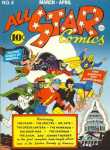 FOR AMERICA AND DEMOCRACY (March 1941)
 THE MYSTERIOUS MISTER X (June 1941)
  PART FOURTEEN: FACTS FOR THE FOOL-KILLER (1909) by Ridgway Hill.
  Facts For The Fool-Killer finds the fictional character operating from Buffalo, NY and vicinity. The Fool Killer now wears the blue uniform and tall helmet of a turn-of-the-century policeman and wields a police officer’s billy-club in lieu of his usual club/ walking stick/ cudgel.
  PART THIRTEEN: FABLES IN SLANG (1899)
 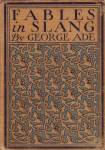 “The written word equivalent of political cartoons” might be another way of describing the fables. In any event Ade did accompany the fables with assorted illustrations.
  PART TWELVE
  Now we’re in the 1880s and 1890s. The Fool Killer lore of the Melungeon people was absorbing traces of Mormon influence from the wider culture. The Melungeons were NOT Mormons but their Fool Killer tales took on pseudo-religious elements from Mormon lore, like the notion that the Melungeons may be even older than the previously held legends about pre-Columbian Portuguese explorers or ancient Phoenicians.
  Balladeer's Blog