
 In the realm of pop culture it continues to be Marvel Comics’ world! Over the past few years Balladeer’s Blog has been reviewing some old, old, OLD Marvel stories from decades ago. From the research I’ve done, I feel the late 1960s through mid-1970s were Marvel’s creative height, with only the Uncanny X-Men title retaining consistent art and story-telling quality beyond that time period.
I’ve covered The Celestial Madonna Saga (1973-1975), which also contained The Avengers/ Defenders War and the original Thanos War within its own storyline. I’ve examined the 13-part Black Panther story titled Panther’s Rage (1973-1975), the original Kree-Skrull War (1970-1971) and, most recently, the 7-part Adam Warlock tale The Magus (1975-1976).
Readers requested more Marvel, so, since these are fun and light time-passers, here comes Killraven, the Warrior of the Worlds.
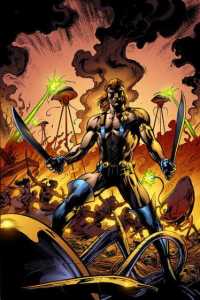 WAR OF THE WORLDS/ WARRIOR OF THE WORLDS/ KILLRAVEN: In the early 1970s Marvel was experimenting with hybrid titles combining the old and the new by fusing licensed properties with unique Marvel twists.
The most famous and longest-lasting example was Shang Chi, Master of Kung Fu. In 1973 Marvel licensed the use of Sax Rohmer’s Fu Manchu plus other characters from the Fu Manchu tales. Rather than just churn out a Fu Manchu comic book series “the House of Ideas” instead combined it with the Kung Fu craze of the time and created Shang Chi, the son of Fu Manchu.
Shang Chi, as a surrogate Bruce Lee, and Sir Denis Nayland-Smith, as a surrogate Braithwaite from Enter: The Dragon, were the core of the new series. Shang Chi started out as an operative of his evil father Fu Manchu, but realized the error of his ways and threw in with Sir Denis and his team to battle his father’s malevolent schemes.
In 1976 Marvel licensed the rights to do a comic book tie-in series with 2001: A Space Odyssey and ultimately incorporated their most popular character from that series – Mister Machine aka Machine Man – into the mainstream Marvel Universe.
The same year as Shang Chi – 1973 (so BEFORE Star Wars) – Marvel had worked similar “synergy” by taking their license to do a comic book series based on H.G. Wells’ War of the Worlds and combining it with sci-fi post-apocalypse action. The main character was Jonathan Raven, aka Killraven, a charismatic rebel leading an uprising against Earth’s 21st Century Martian conquerors.
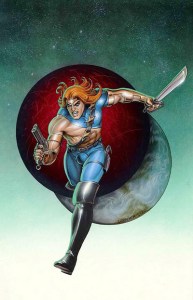 Killraven’s use of a sword AND futuristic firearms in action set against a post-apocalyptic backdrop also brought a little John Carter of Mars appeal into the series. By 1976 the promising saga was canceled due to poor sales but gained a cult following in the decades since then.
Killraven’s influence could be seen in the original 1980s mini-series V, especially the element of humans being used as food by our alien overlords and the sentimental “heroic freedom fighters versus evil tyrants” appeal. Killraven writer Don McGregor incorporated similarly themed stories and characters into Sabre, his other post-apocalypse comic book series.
Even Star Wars reflected some aspects of Killraven’s tales: the Rebel Alliance against the bad guys, the armored badass (The High Overlord in Killraven’s case) and, of course, the way Killraven wielded enigmatic, more than human abilities called simply “the Power” in K.R.’s series. (PLEASE NOTE: Killraven’s use of The Power came years before Star Wars and The Force.) The young sword-wielding hero was slowly mastering the Power as the series went along, but cancellation cut short his development of his paranormal gifts.
 And yes, I know that both Killraven and Star Wars drew on the same vast inheritance of sci-fi tropes but the close proximity of K.R. (1973-1976) to Luke Skywalker (1977 onward) makes the comparisons inevitable.
About fifteen years back, Tom Cruise was set to star as Killraven but eventually all K.R. elements were dropped from the project and Cruise starred in simply another remake of War of the Worlds instead. You have to wonder if the Marvel name would have motivated the filmmakers to keep the Killraven angle if the movie had been done AFTER Marvel became the dominant source for cinematic blockbusters that it is now.
At any rate, let’s dive into the very first appearance of Killraven in 1973: Continue reading
 For Flashman Down Under, Flashman in the Opium War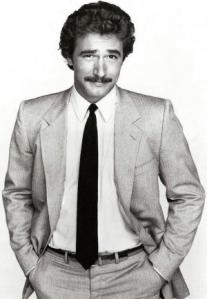
 The Action: Sir Harry Flashman and his wife Elspeth visit British Guiana right after their American Tour ended in August, 1876. A combination of Her Majesty’s Government’s interests and Flashman’s own hunger for large amounts of filthy luchre to sustain his and Elspeth’s grand new lifestyle wind up launching the British blackguard into his latest adventure.
  PART TWENTY-THREE: Here is a look at some of the Fool Killer’s targets from James L Pearson’s February of 1920 issue.
  NANG-GAI – Yet another son of Ndengei. Nang-Gai served as the supreme deity’s messenger or emissary. When the sound of the waves crashing on the Rakiraki reefs made so much noise that it was preventing Ndengei from sleeping he sent Nang-Gai to silence it. To this day the surf off Rakiraki is notoriously quiet.
  PART TWENTY: I need to interrupt my look at the 1910-1917 and 1919-1922 Fool Killer items for this time around. In a surprising development Balladeer’s Blog was contacted by THE actual Fool Killer. Using Jimmy Neutron-level science I determined that this correspondent was indeed the actual supernatural figure who had been at large in America since the 1830s.
  Coming to you as I wander in search of fools to kill, as usual a murder of crows following in my wake to feast upon the ample corpses I leave behind me in my travels.
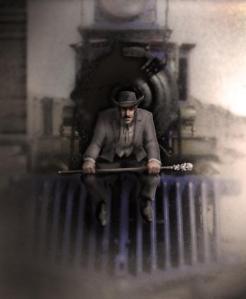 PART NINETEEN: James Larkin Pearson, creator of this new Fool Killer, featured a complaint that I can relate to, since I go through the same thing here at Balladeer’s Blog – “Democrats write and ask me to lambaste the Republicans and Republicans write and suggest that I cuss out the Democrats. All right, boys, I am going to comply with both requests, and then you will both be mad.”
  *** Equally sleazy, money-hungry “spiritualists” – nicknamed “Boogers” in the slang of the time. Arthur Conan Doyle was still alive in 1919 and, as usual, that otherwise rational man willingly served as a public cheerleader for those con artists who claimed to be able to contact one’s dead loved ones.
 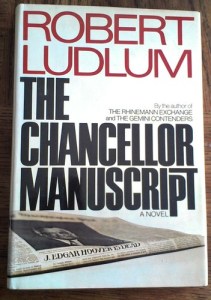 THE CHANCELLOR MANUSCRIPT (1977) – With the latest blatant abuses by the FBI and elsewhere coming to light here’s Robert Ludlum’s novel about abuse of intelligence-gathering by BOTH the left and the right. There are Deep State operatives, too, like in today’s headlines.
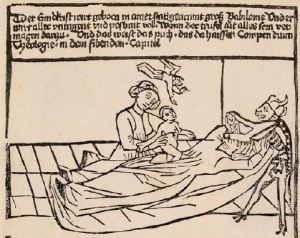 Block Books from centuries ago were a form of illustrated storytelling, most often associated with religious topics. Naturally in a period of limited literacy the graven woodblock picture- stories made theological tales even more popular with the masses. In approximately 1455 – 1480 these “proto- comic books” addressed the Antichrist and the End Times.
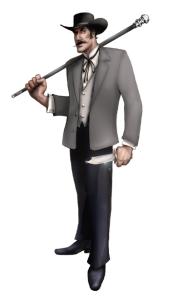 PART EIGHTEEN: In this issue the Fool Killer stated his mission in his newest incarnation (Or “regeneration” we could say with tongue in cheek.) was “the general overturning of all established institutions of every kind.” … “The Hour of Doom has struck for many of this old world’s pet institutions.” Quite a long way from his 1830s mission of driving the Devil out of the Tennessee Hills and killing fools who tried stealing the “hidden” gold of the Melungeons!
 Balladeer's Blog