
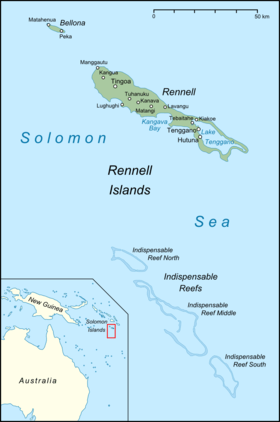
 In the style of Balladeer’s Blog’s separate examinations of Hawaiian and Samoan myths as a subset of Polynesian Mythology comes this look at the deities worshipped on the Polynesian outliers Bellona Island and Rennell Island. Despite its much smaller size Bellona had a larger population for much of their history.
NGE’OBIONGO – The goddess of the stone ovens used by the people of Rennell and Bellona. The ovens were shown such reverence that it was forbidden to eat near them or to scatter firewood or even to speak in raised voices in their vicinity. Nge’obiongo would punish anyone who violated those taboos, just as she punished women who were bad or lazy cooks or who prepared meals without first properly cleaning their hands.
Undercooking the food would also invite this deity’s wrath. On rare occassions some of the prepared food would be left in the ovens as an offering to Nge’obiongo.
 MAHUIKE – The earthquake god of Bellona and Rennell Islands (henceforth Bel-Ren). Like his counterparts in Hawaii and Samoa, Mahuike lived far underground and caused earthquakes by pushing at the earth with both of his arms.
Once, after a particularly destructive earthquake, the god Tehu’aingabenga fought Mahuike for injuring his worshippers and broke off one of the earthquake god’s arms. After that the quakes caused by Mahuike were never as severe. (In Hawaiian versions it is Maui who breaks the earthquake god’s arm off and in Samoan versions it is Ti’i Ti’i who does it. Bel-Ren myths do feature the figure Mautikitiki but he is less prominent than Tehu’aingabenga.)

 GNA – This neglected Norse goddess was one of the Asynjur (female Aesir) and served as the messenger of the female nature deity Frigga. Gna was as swift as Hermes from Greek myths and rode a horse named Hofvarpnir, a steed capable of galloping across the sky and the seas in addition to land. Gna wielded a spear and could travel as quickly as the breeze when she was astride Hofvarpnir.
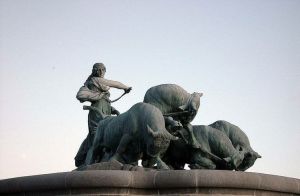 Balladeer’s Blog’s previous looks at neglected deities from the Norse pantheon of gods have been pretty popular, so here’s another one.
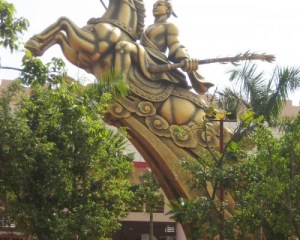 THAN GIONG – Vietnamese god of war and 1 of the 4 main deities in their mythology (often called The Four Immortals). The mother of Than Giong once fell into one of the enormous footprints left from long ago by Khong Lo, the primordial giant. She thereby became pregnant (you know mythology!) and gave birth to a baby who was always silent and unmoving for the 1st several years of his life. At length during an invasion by China the reigning member of the Hung Vuong Dynasty sent messengers around the kingdom asking for any help that could be given against the invaders.
 For my full list of Norse deities click here:
 Balladeer's Blog