Tag Archives: mythology

CHARLEMAGNE: OGIER AND THE CROWN OF DENMARK

FOR THE FIRST CHAPTER ON CHARLEMAGNE’S PALADINS CLICK HERE Ogier
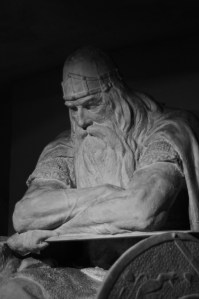
OGIER AND THE CROWN OF DENMARK – King Geoffrey of Denmark saw his lands invaded by pagan Vikings from the north. The ferocity and numbers of the invaders proved too much for Geoffrey and his men so the king sent messengers to Emperor Charlemagne asking for help.

Charlemagne nobly set aside the lingering hostility he felt for Geoffrey from the time when that King of the Danes refused him tribute and the Emperor had led his armies to defeat Geoffrey. Charlemagne decided to send troops to assist Denmark but also to test the character of his Paladin, Ogier the Dane … Geoffrey’s son.

The Emperor wanted to see how Ogier would conduct himself in such a situation, facing superior odds in the field AND having to contain his resentment toward his father Geoffrey for having sent him as a hostage to Charlemagne’s court after his military defeat long years earlier.

Charlemagne placed Ogier at the head of an army consisting of a thousand Paladins and thousands more common Frank soldiers. Wielding his enchanted sword Cortana, the Dane led his men north. Continue reading
13 Comments

Filed under Mythology

BEST OF SEPTEMBER 2019

Balladeer’s Blog’s end of year retrospective continues with this look at September’s best:

classical greecePOLEIS (CITIES) 422-419 B.C. – A look at the ancient Greek political comedy written by Eupolis. CLICK HERE
TRANSGRESS WITH ME: SEPTEMBER 23rd – Are you brave enough to share some more transgressive thoughts? CLICK HERE

Babylon ElectrifiedANCIENT SCIENCE FICTION – Messages From Mars (1892)  HERE , The Queen of Appalachia (1901) HERE , Babylon Electrified (1888) HERE , Looking Forward (1899) HERE , The Automatic Maid (1893) HERE

HEROIC WOMEN FIGHTING OPPRESSION IN THE MUSLIM WORLD – The title says it all. CLICK HERE

WOI EPIC – A Liberian epic myth about gods and demons. CLICK HERE

Isaiah WashingtonISAIAH WASHINGTON – And yet another Martin Luther King Person of Courage to profile – CLICK HERE Continue reading
5 Comments

Filed under Ancient Greek Comedy, Bad and weird movies, humor, LIBERALS AND CONSERVATIVES, Mythology, Neglected History, opinion

CHARLEMAGNE: CHARLOT’S VILLAINY

Balladeer’s Blog continues examining the legends of Emperor Charlemagne and his Paladins (knights).

Carolingian empireOur previous installment ended with the army of Charlemagne besieging the Muslim Saracen army which had taken Rome after forcing them to withdraw inside the city following their defeat in battle. Roland, Ogier and others had been knighted by Charlemagne himself after distinguishing themselves in combat.

The glory that Roland and Ogier had earned filled the Emperor’s treacherous son Charlot with envy and resentment and he bided his time waiting for a chance to strike at the two Paladins.

As the siege continued, boredom threatened to claim both sides, and Carahue, King of Mauritanius, one of the leaders of the Muslim forces, was filled with the desire to face Ogier in single combat. Disguising himself as a mere messenger, Carahue approached Charlemagne’s army and was taken before the Emperor himself.

Still pretending to be a messenger, Carahue told Charlemagne and his court that the King of Mauritanius extended a challenge to the Paladin who had borne the Oriflamme during the previous open-field battle. (The Oriflamme was Charlemagne’s banner as ruler of the Franks and combined the fleur-de-lis of the French with the eagle of the Germans.) Continue reading

15 Comments

Filed under Mythology

CHARLEMAGNE: HOW ROLAND AND OGIER BECAME PALADINS

CharlemagneThough Charlemagne was a real historical figure, a body of folkore has risen around him and his Paladins (knights). Part of that folklore was that the Pope crowned Charlemagne as the new Holy Roman Emperor on Christmas Day, even though the crowning really took place the following February. Since the story of Charlemagne’s crowning as Emperor was told as a Christmas story for centuries I always use Christmas time to examine him and his Paladins.
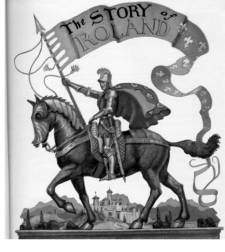
To start Round Three of Balladeer’s Blog’s look at Charlemagne lore I’ll examine some tales of the young Roland (Orlando to the Italians). Last December I covered Charlemagne’s reunion with his long-lost sister and her son Roland.

Roland storyHOW ROLAND AND OGIER BECAME PALADINS – The Emperor could not expect his nephew to immediately step into service as a Paladin, since he had a great deal to learn. Charlemagne placed him as a Page in the household of Duke Namo of Bavaria, where Roland began his career alongside many other young nobles.
Roland had to learn to curb his independent ways since he had up until then done as he pleased while stealing to feed himself and his mother. The young man adjusted, and learned courtly ways so well that he became a favorite of Duke Namo.

At age fourteen Roland became a Squire and began training for warfare in earnest. He learned how to handle swords and lances and how to care for the armor of the Paladin he served as a Squire. Horsemanship, hunting and swimming were also part of his education. Continue reading

10 Comments

Filed under Mythology

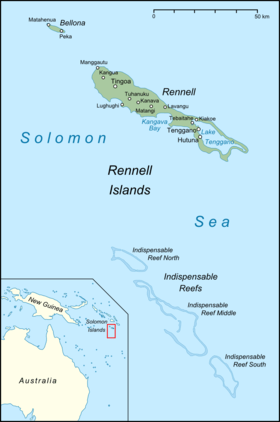
THE GODDESS SINA: BELLONA AND RENNELL VERSION

Balladeer’s Blog presents a look at the version of the Polynesian goddess Sina as reflected in the beliefs of Bellona and Rennell Islands. FOR OVER TWENTY MORE BELLONA AND RENNELL DEITIES CLICK  HERE

bellona-and-rennellSINA – The Bel-Ren counterpart to the Sina of the Hawaiian Islands (Hina) and the Samoan Islands (also called Sina). Like those figures she was the sister of Maui (Hawaiian) or Ti’i Ti’i (Samoan). However, this Sina was neither a moon goddess like her Hawaiian version nor a love and beauty goddess like her Samoan self.
Instead she fell under the Bel-Ren category called the Kakai. As the Atua were the major deities and the Apai were the unworshipped and/or mischievous deities the Kakai were classed as either pure Culture Gods or as the deities worshipped by the Hiti. The Hiti were the previous inhabitants of the Bel-Ren Islands and were all exterminated by the arriving Eight Clans.

(The Hiti lived on in Bel-Ren myths as impish, supernatural beings like the Menehune in Hawaii. They – like the exterminated Hiti – had once been the original inhabitants of their island group.) 

Sina was featured in the myth explaining how the various birds who visited the Bel-Ren Islands got their coloring. The creative and artistically inclined Sina interacted with the birds on a regular basis and her intimacy with them enabled her to paint and craft their feathers, wings, claws, beaks and eyes to give each species its unique look. Continue reading

4 Comments

Filed under Mythology

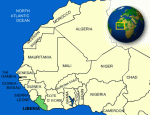
WOI: EPIC HERO OF LIBERIA

LiberiaBalladeer’s Blog presents another neglected epic myth from around the world. In this case, Liberia’s Woi Epic of the Kpelle people.
The Woi Epic is often studied for its use of music, dance, singing and audience participation to reflect the action in the story. Think of it as a combination opera, ballet, live drama and Rocky Horror Picture Show screening.

The order of the episodes in the epic is not set in stone and a performance may include only a few of the episodes, all of them or just one. The finish of each episode is marked by the performer(s) announcing “Dried millet, wese” to which the audience repeats simply “wese.”  

ONE – Woi, a culture deity and master of ritual magic, and his wife Gelengol are the only living things that exist. After Woi impregnates his wife she eventually gives birth to human beings, chickens, goats, cows, sheep and, after all other life-forms, spiders. (Plenty of African myths feature a female deity giving birth to multiple living creatures and many feature the woman also giving birth to tools and weapons and utensils.)    

TWO – Woi notes that the demonic figure Yele-Walo has stolen one of his bulls by sneaking up on it in the form of a rattan plant. Yele-Walo took the bull with him to his hideaway “behind the sky.” Woi prepares for battle and is aided by squirrel-monkeys, tsetse flies and horse-flies. Yele-Walo also steels himself for the upcoming fight. Continue reading

20 Comments

Filed under Mythology

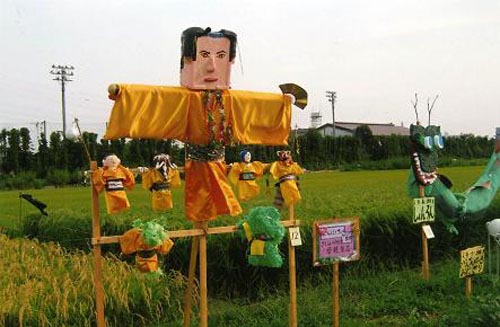
SHINTO DEITY: KUYEBIKO

 Kuyebiko was the Shinto scarecrow god. Originally he functioned as the protector of the rice fields, a task assigned him by his father Inari the rice god. 

He was considered to be incarnate in all scarecrows and eventually came to be  considered as a divinitory deity who knew everything that transpired under the heavens.

The leap from being the god of scarecrows to divinitory deity came about because of the never- closing eyes of scarecrows. Continue reading

2 Comments

Filed under Mythology

THE TOP PANTHEONS COVERED HERE AT BALLADEER’S BLOG

Balladeer's Blog

Balladeer’s Blog

Balladeer’s Blog’s examinations of pantheons of deities outside of the frequently-covered Greco-Roman, Egyptian and Norse have been very popular and well-received. To make sure all mythology buffs who visit here are aware of how many belief systems I’ve looked at here’s a convenient overview.

FuchiAINU  

Sampling of Deities: Shiramba the vegetation god, Hashinau-Uk the goddess of the hunt, Okikurmi the culture god and monster-slayer, Wakka-Ush the water goddess and Kando-Koro the sky god and ruler of the land of the gods.

Top Deity on List: Fuchi the fire goddess. 

Comment: This is one of the most popular of the out of the way pantheons I’ve covered.

FULL LIST CLICK HERE: https://glitternight.com/2014/11/20/the-top-gods-in-ainu-mythology/

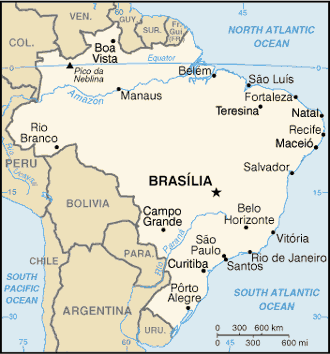
Tupari live near the Rio BrancoTUPARI

Sampling of Deities: Mulher the Earth goddess, Arkoanyo the bird god, Karam the sun goddess, Valedjad the storm god and Aunyaina the wild boar god.

Top Deity on List: Patobkia, the god who rules over the afterlife and the series of trials each soul undergoes.

Comment: With only thousands of the Tupari people left this is a sadly neglected pantheon of deities.

FULL LIST CLICK HERE: https://glitternight.com/2013/04/02/the-top-ten-deities-in-tupari-mythology/ Continue reading

18 Comments

Filed under Mythology

KOREAN GOD: TALHAE

King_Kyungsoon_of_Silla_2.jpg (200×233)TALHAE – Also called Tarhae. The wife of King Hamdalpa of Wan-Ha in Yongsong had been married to him for seven years but had yet to produce an heir to the throne. She prayed to the gods for a child and at length she produced a large egg, from which a handsome boy named Talhae emerged.
King Hamdalpa’s advisors told him a child born unnaturally from an egg was a bad omen and that he should get rid of the child. Hamdalpa had the boy placed in a large floating chest along with seven treasures plus a male and female slave.

A red dragon arose from the sea to guard the chest, a red dragon sent by a dragon god who was Talhae’s real father. The chest floated at sea for seven days, during which time Talhae grew to adulthood and stood a full nine feet tall.  

Disembarking at Karak the young god bought even more slaves with his treasure and climbed Mount Toham, followed by his retinue. Talhae sat and pondered at the top of the mountain for seven days, neither sleeping nor eating. Continue reading

6 Comments

Filed under Mythology

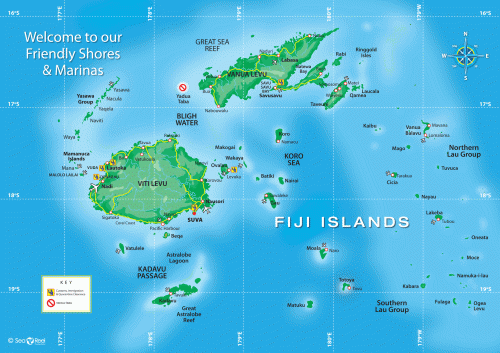
FIJIAN DEMIGOD TUILAKEMBA

Balladeer’s Blog’s look at The Gods of Fiji has been a hit! For another deity from Fiji here is Tuilakemba, whom I also went ahead and added to the main article. For more than 20 other gods from Fiji see my blog post HERE

Fiji 4TUILAKEMBA – This figure was the son of Tuilangi, the god who ruled over the Skyland, and a mortal woman. When Tuilakemba was a little boy he was often ridiculed by the other children for not having a father on hand like they did. One day the young demigod had had enough and threatened to kill his mother unless she told him who his father was.

She did so and Tuilakemba was spitefully satisfied. He took to carrying around an ironwood war-club wherever he went. He would use it to strike the heads off flowers, gleefully anticipating one day knocking off the heads of his enemies in wartime just as easily, given his massive strength.

On one occasion he took a nap, planting the ironwood war-club upright in the ground next to him while he slept. When he awoke he saw that the war-club had grown into an enormous tree which reached all the way up to the Skyland realm of his father. Tuilakemba took advantage of the situation and climbed up the newly-formed tree to the land above. 

The little boy walked through the jungle of Skyland until he reached the village ruled by his father Tuilangi. That lord of the land above was in the middle of a council of war regarding his armies’ recent losses in their ages-old conflict with the evil gods of the sky. Continue reading

9 Comments

Filed under Mythology