
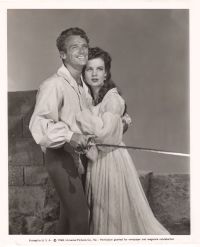
 “See how he apes his father” was a saying long associated with contemporary enemies of John Quincy Adams as a complaint about how the younger Adams was as stubborn and single-minded as his father John Adams. He pursued his own ends regardless of political consequences.
On a lighter note, I have always used those words as a compliment to jokingly describe the fun, high-spirited swashbuckler films of Douglas Fairbanks Jr. – especially those moments that were homages to specific scenes from his father’s silent film classics. Here’s a look at Junior’s sword-wielding spectacles.
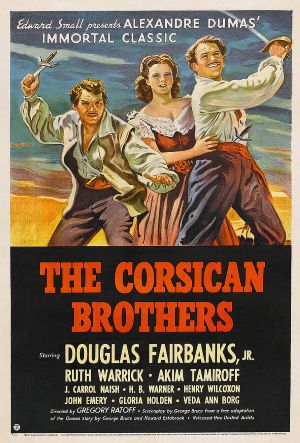 THE CORSICAN BROTHERS (1941) – Another of the many adaptations of the Alexandre Dumas novel that have very little to do with the original storyline. In this case the tale was transformed into an action-packed sword-fighting, gun blazing, hell-for-leather chase vehicle for Doug Jr.
That’s not a complaint, I’m just letting Dumas purists know in advance. In this movie set in the early 1800s the twin brothers from Corsica are Lucien and Mario Franchi. Due to family vendettas in Corsica the brothers are the sole survivors of their bloodline and as infants are hidden by family friends – Mario in France and Lucien in the Corsican hills.
 Each grows into a man of action, Lucien as a bandit chief and Mario as a dueling, gambling ladies’ man. When they are reunited they set out to bring down the man who massacred their family – Baron Colonna (Akim Tamiroff), now the tyrannical ruler of Corsica.
The brothers, with Lucien’s outlaw gang behind them, strike at Colonna and his forces again and again in their quest to free Corsica while avenging their family. Tragically, they both fall in love with the same woman (Ruth Warrick), leading to a bittersweet ending. 111 minutes. Continue reading
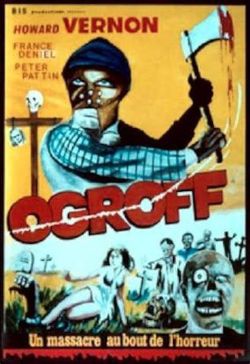 OGROFF aka The Mad Mutilator (1983) – This thoroughly bizarre French movie whose maker somehow conned horror icon Howard Vernon into appearing is easily one of the worst films ever made. Norbert G. Moutier owned a video store in France and published a horror fanzine.
 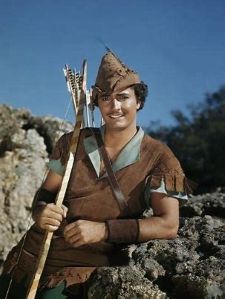 Today, actor and director John Derek is remembered mostly because of his wives – Bo Derek, Ursula Andress, Linda Evans and Pati Behrs.
 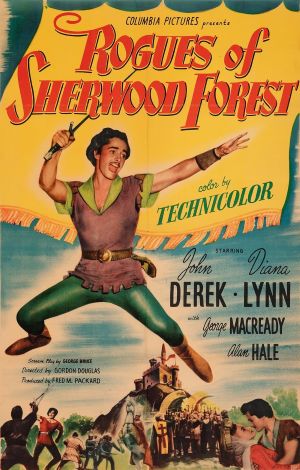 ROGUES OF SHERWOOD FOREST (1950) – John starred as Robin, Earl of Huntington, the son of Robin Hood. When Richard the Lionheart passes away in 1199 A.D. King John (George Macready) returns to his old ways of oppressing and heavily taxing the citizens. He also imports an army of foreign mercenaries faithful only to him, not England.
 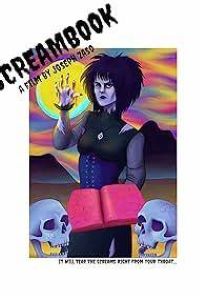 SCREAMBOOK (1984) – Ever see a feature length horror film written, produced and directed by a 13-year-old? And with nearly all the roles – of all ages – played by fellow teenagers? Obviously, I’ll be grading this flick on a curve in this review.
  THE DEATHMASTER (1972) – In between his pair of movies as the vampire named Count Yorga the one and only Robert Quarry starred as a vampiric Charles Manson wannabe in this film. The Deathmaster starts out with a great bit that wouldn’t look out of place in a Jean Rollin horror flick from France: the huge, hulking Barbado (Le Sesne Hilton) plays eerie flute music, seemingly luring ashore a sea-tossed coffin. This casket holds our “Deathmaster” – a vampire called Khorda.
 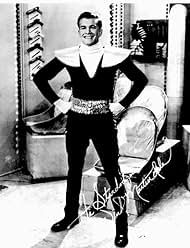 MARS PATROL (1953-1955) – At age 19 – and already smiling like somebody just broke his jaw – the go-getting Winston Conrad “Wink” Martindale was the star of 514 episodes of Memphis’ weekday show Mars Patrol. (Ignore the incorrect IMDb entry which lists him as the star of just 1 episode. Memphis newspapers and Martindale himself recount how he starred in the entire series.)
 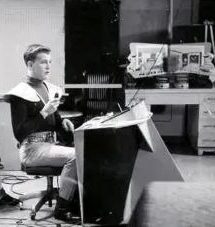 Martindale and the diminutive Mars Guard members wielded ray-guns in their adventures and also hosted episodes of old Flash Gordon and other space serials of the past, making Wink a kind of movie host variant as well. The young fans of Mars Patrol could write in and join the show’s Star Dodgers Club, complete with Captain Martindale photos and other merchandise.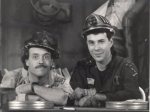
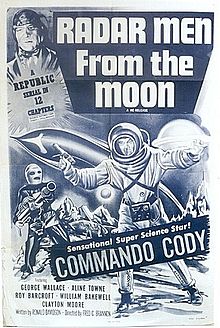 SERIAL: Before showing and mocking the movie machine-gun toting Randy and Richard, as members of the fictional Film Vault Corps (“the few, the proud, the sarcastic”) showed and mocked another chapter of the Republic Serial Radar Men from the Moon (1952).
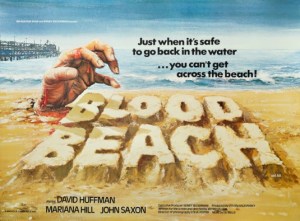 THE MOVIE: Blood Beach (1980) was one of the least effective horror films of the 1980s. It had a half-decent premise – a monster beneath the sand at a California beach sucking victims down into its hellish maw – but squandered that premise with incredibly slow pacing.
 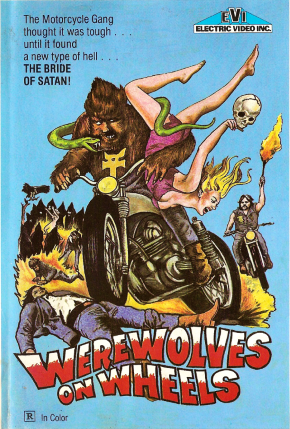 WEREWOLVES ON WHEELS (1971) – You just knew this was the movie I would start with. A biker gang hassles a group of Satanists in the usual biker way in films. The Satanists get revenge by cursing some of the bikers to start turning into werewolves and preying on the others.
 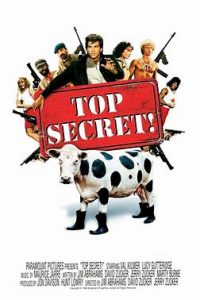 TOP SECRET (1984)
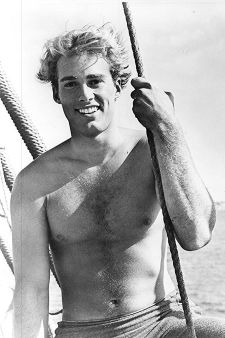 Balladeer’s Blog takes a look at the film appearances of Errol Flynn’s son Sean. The two did not get along, unfortunately, largely because of Errol only caring about Sean when the mood struck him according to Sean.
 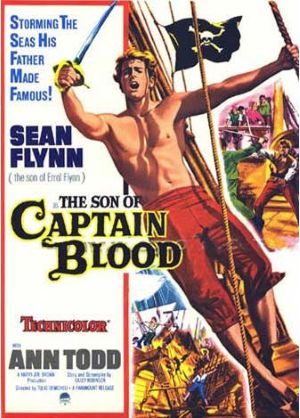 THE SON OF CAPTAIN BLOOD (1962) – Since the 1935 swashbuckler Captain Blood propelled Errol Flynn to stardom, the studio was hoping a Son of Captain Blood flick would do the same for Sean. Jock Mahoney, a former Tarzan and stunt man for Errol trained Sean in fencing and acrobatics to prepare for the role.
 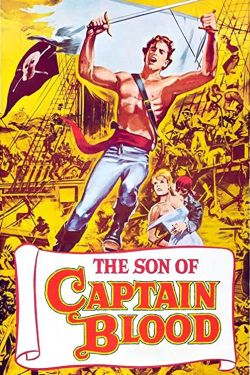 The ship Robert commands has among its passengers a handful of giggling young ladies being transported to England along with their stern lady chaperone. This new Captain Blood turns their heads and ultimately Abigail McBride (Alessandra Panaro) beats out the others for his heart.
