
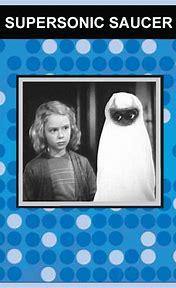
 SUPERSONIC SAUCER (1956) – In honor of the Thanksgiving holiday Balladeer’s Blog presents a look at another harmless, all-ages sci-fi turkey, this one from England. Supersonic Saucer was produced by our old friends in Great Britain’s Children’s Film Foundation, the same group behind the previously reviewed serial Masters of Venus.
Believe it or not, Frank Wells, son of H.G. Wells himself, penned the story for this So Bad It’s Good flick. At an English boarding school, a few students whose families are too poor to be able to pay for their travel expenses wind up having to spend the holiday break at the school. They are looked after by the Headmaster and his tween son Rodney (Fella Edmonds), a science nerd who resents having to babysit.
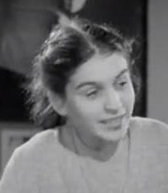 Top-billed actress Marcia Manolescue, an English actress of Asian descent, plays Sumac, one of the students whose family could not pay travel fare home and back. Another such student is Greta (Gillian Harrison) and rounding things out is Adolphus (Andrew Mette-Harrison), the tubby youngest character.
While killing time over the holiday break our youngsters visit an observatory, where they are allowed to use the telescope for a time. They spot what seems to be a spaceship headed for Earth from Venus, but none of the adults on hand believe them.
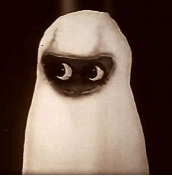 We viewers know the kids are in the right, and the spaceship/ flying saucer is really a Venusian youngster. That alien entity used its race’s ability to morph from Muppet-like form to amoeboid form to flying saucer form fit for interplanetary travel.
The alien visits our lead characters upon arrival on Earth, drawn to them by the telepathic “fix” it got on them when they spotted it through the telescope. Because of the Venusian’s transitionary form that resembles an oversized amoeba the youngsters name the alien “Meba.”
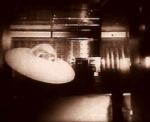 The goofy looking Venusian resembles a thick, tall worm in a white hijab in its “normal” form but is hilariously rendered as a cartoon flying saucer with eyes for its airborne and spacefaring form. The “special” effect is as laughable as the cartoon spaceships in American movies like Invaders from Mars.
Continue reading
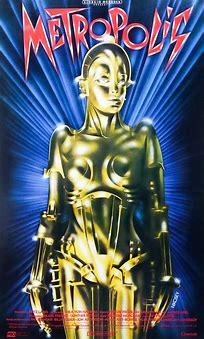 METROPOLIS – Volumes have been written about Fritz Lang’s 1927 silent movie sci-fi masterpiece. I love the film myself but rather than write the 9,899,974th glowing review of the 1927 original I will instead take a look at the 1984 re-issue, produced by Giorgio Moroder, who also did soundtracks for movies like Scarface, Midnight Express, and later Top Gun.
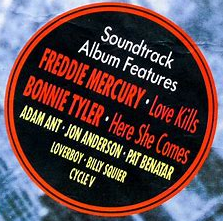 Rather than have the usual classical or similar music play as accompaniment to a silent movie, composer Giorgio Moroder wrote a rock and pop music score to attract a generation of filmgoers who might otherwise have never sat through a silent movie in their lives. Freddie Mercury, Pat Benatar, Adam Ant and Billy Squier were among those performing Moroder’s score.
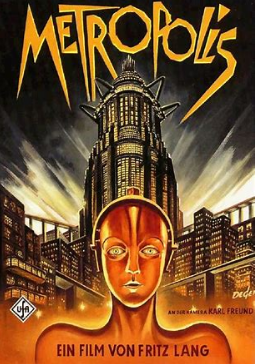 Not only 1984 audiences but all subsequent generations of viewers which were drawn to silent movies in general thanks to airings of Metropolis (1984) may never have brought the new blood and passion to the early cinematic artform if not for Moroder.
 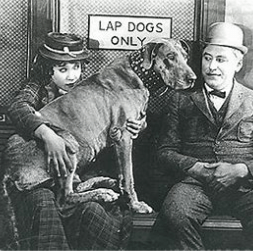 Balladeer’s Blog takes another look at the films of a silent movie star. This time I’m reviewing some of the films featuring trained animal star Teddy the Great Dane aka Teddy the Dog aka Keystone Teddy. From 1915 to 1924 Teddy starred or otherwise appeared in silent shorts as well as feature-length movies.
 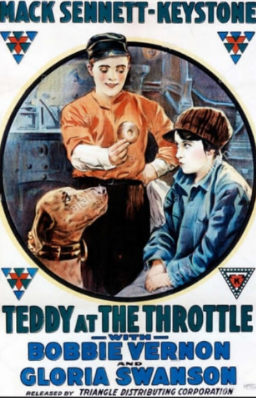 TEDDY AT THE THROTTLE (1917) – This Mack Sennett short at Keystone Studios was one of two films in which Teddy actually got his name in the title. In this light-hearted affair the Great Dane plays the pet of THE Gloria Swanson.
 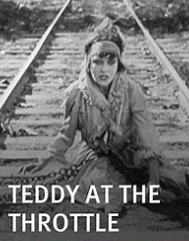 Beery’s villain character is embezzling money from the romantic leads Gloria Swanson and Bobby Vernon. Teddy, the REAL star, is cute and lively, plus he bravely saves Gloria’s life in the end when Beery ties her to railroad tracks after his villainy is exposed.
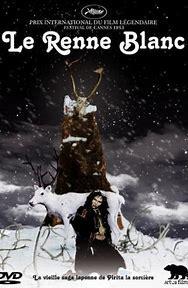 THE WHITE REINDEER (1952) – As Halloween Season nears its end, Balladeer’s Blog takes a look at a fascinating and haunting Finnish horror film. First off, let me assure readers that The White Reindeer is, indeed, a serious movie despite the way that some glib descriptions of it make it sound like just another campy black & white monster movie from long ago.
 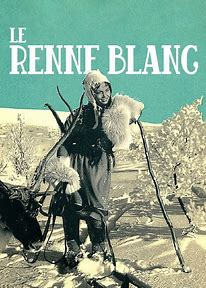 Blomberg’s best move was just accepting the fact that he didn’t have a big enough budget for convincing special effects so he relies on stylish editing, shadows and every camera trick in the book for the transformation scenes.
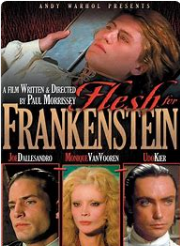
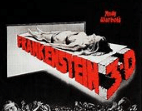 Halloween Month rolls along here at Balladeer’s Blog with a look at two notoriously bad horror movies which use Andy Warhol’s name despite him not really having anything to do with them and credit Antonio Margheriti as the director even though Paul Morrissey wrote and directed them.
 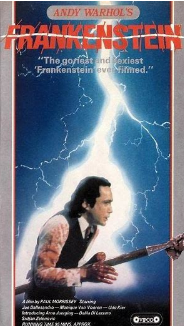 ANDY WARHOL’S FRANKENSTEIN (1973) – Also known as Flesh for Frankenstein, this 3-D monstrosity and its sister film, Andy Warhol’s Dracula (aka Blood for Dracula) used to be among the most well-known “So Bad They’re Good” movies. Oddly, they fell pretty much off the radar long ago, but get rediscovered every so often and enjoy a brief surge in notoriety from successive generations of horror fans.
  These two movies are also like 1970s time capsules, too. Recently relaxed standards for what could be shown on the big screen yielded a LOT of cheap films that were clearly made just to see how much gory violence and kinky titillation the creative teams could get away with.
 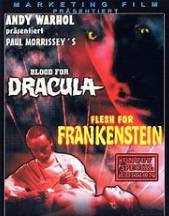 Andy Warhol’s Frankenstein and Andy Warhol’s Dracula deserve my usual warnings to horror fans who really hate extreme violence and bizarre sex. Don’t go below the “Continue reading” line or you’ll probably regret it. These films are mild compared to
 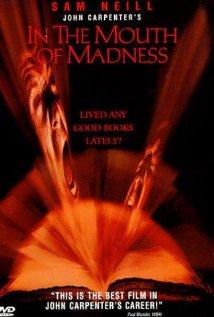 IN THE MOUTH OF MADNESS (1994) – Directed by John Carpenter and written by Michael De Luca, this movie was an unabashed valentine to H.P. Lovecraft, Stephen King’s imitations of Lovecraft, and The King in Yellow by Robert W Chambers. The King in Yellow, of course, is the 1895 book
 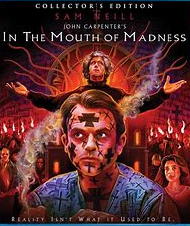 Soon, Trent is visited in his padded cell, where he has used a black crayon to cover his body and the padded walls with crucifixes for protection. His visitor is Dr Wrenn, played by David Warner, the panicked, crucifix-surrounded man from The Omen, now talking to the panicked, crucifix-surrounded Sam Neill in this film. (I admit that’s a sly touch in keeping with the style of the movie. It even has echoes of the victim in the 1970s film Equinox fixating on his protective crucifix.)
 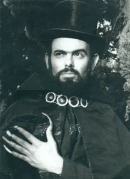 As Halloween Month continues, Balladeer’s Blog presents another seasonal post. Over the years I’ve reviewed plenty of the horror films made by Brazil’s King of Horror since the 1960s – Coffin Joe (Ze do Caixao) aka Jose “Mojica” Marins. I’ve even reviewed
 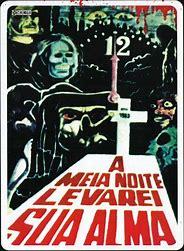 AT MIDNIGHT I’LL TAKE YOUR SOUL (1963)
 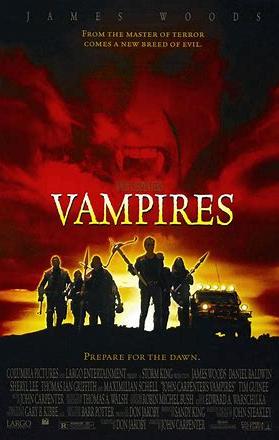 JOHN CARPENTER’S VAMPIRES (1998) – Halloween Month rolls along with this look at John Carpenter directing James Woods as Vatican-sanctioned vampire hunter Jack Crow. As always, James Woods is like a force of nature. When he’s on the screen he virtually blows away most of the people with whom he shares that screen.
 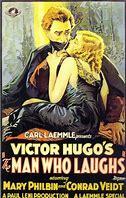 THE MAN WHO LAUGHS (1928) – I have no idea why Conrad Veidt doesn’t get the silent horror film love that Lon Chaney and Paul Wegener receive. In this final silent horror movie for Veidt, he shines once again in another landmark film. This one is based on the neglected Victor Hugo story about a figure who, like Hugo’s Quasimodo, has a monstrous disfigurement that causes him to be shunned and feared.
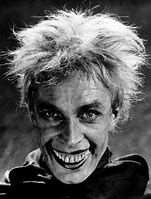 Dea falls in love with Gwynplaine’s poetic nature in fact, but when the grotesque smiler is discovered to be of noble descent the pair are separated by villainous figures involved in aristocratic court intrigues. Olga Baclanova co-starred as Duchess Josiana, the lead heavy in this forgotten Gothic horror classic.
  Halloween Month continues here at Balladeer’s Blog with this look at three notorious – but not necessarily all that good – horror films from iconic Italian director Lucio Fulci.
  THE BEYOND (1981) – A woman inherits The Seven Doors Hotel, a run-down inn outside New Orleans in the Louisiana countryside. It was once the site of an infamous murder in the 1920s and supernatural activities break out as our heroine Liza Merrill (Katherine MacColl) tries to refurbish the place.
