
 Halloween Month rolls along here at Balladeer’s Blog with a look at two notoriously bad horror movies which use Andy Warhol’s name despite him not really having anything to do with them and credit Antonio Margheriti as the director even though Paul Morrissey wrote and directed them.
Sophia Loren’s husband Carlo Ponti co-produced both films.
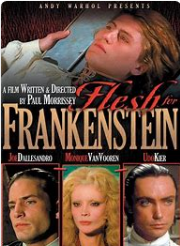
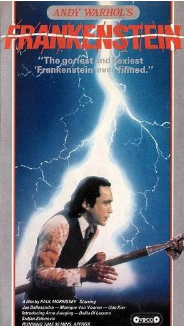 ANDY WARHOL’S FRANKENSTEIN (1973) – Also known as Flesh for Frankenstein, this 3-D monstrosity and its sister film, Andy Warhol’s Dracula (aka Blood for Dracula) used to be among the most well-known “So Bad They’re Good” movies. Oddly, they fell pretty much off the radar long ago, but get rediscovered every so often and enjoy a brief surge in notoriety from successive generations of horror fans.
The making of these two grossout movies, which were filmed back-to-back in Italy, would make a better movie than both of them combined in my opinion. Criminal charges, false screen credits and much more behind the scenes lore would help put such a flick up there with Ed Wood and The Disaster Artist.
 These two movies are also like 1970s time capsules, too. Recently relaxed standards for what could be shown on the big screen yielded a LOT of cheap films that were clearly made just to see how much gory violence and kinky titillation the creative teams could get away with.
Attaching Andy Warhol’s name to this pair of Paul Morrissey flicks helped appeal to pretentious Warhol fans and gave some critics the excuse to read deeper meanings into the sophomoric productions. Suddenly, awkward grossout scenes, idiotic dialogue and non-existent scares were being interpreted as “deconstructions of the Universal monster movies” or as “director/writer Paul Morrissey skewering the very countercultural sex revolutionaries that were among his biggest fans …”
Sheesh! At least purely mercenary splatter film legends like Herschell Gordon Lewis never pretended that their flicks were anything but cash-grabs that piled on the blood and gore.
 Andy Warhol’s Frankenstein and Andy Warhol’s Dracula deserve my usual warnings to horror fans who really hate extreme violence and bizarre sex. Don’t go below the “Continue reading” line or you’ll probably regret it. These films are mild compared to Headless or Father’s Day or others I’ve reviewed, but are stomach-turning nonetheless.
So, let’s dive into two of the strangest Dracula and Frankenstein pairings this side of Blacula and Blackenstein. Continue reading
 THE DEVIL OF THE MARSH (1893) – Written by H.B. Marriott Watson. Halloween Month continues with this review of a short horror piece about a unique female monster who inhabits the marsh. The story was first published in the 1893 collection Damnable Tales.
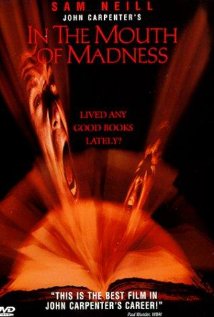 IN THE MOUTH OF MADNESS (1994) – Directed by John Carpenter and written by Michael De Luca, this movie was an unabashed valentine to H.P. Lovecraft, Stephen King’s imitations of Lovecraft, and The King in Yellow by Robert W Chambers. The King in Yellow, of course, is the 1895 book
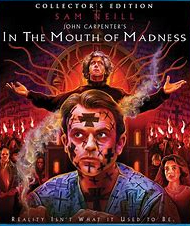 Soon, Trent is visited in his padded cell, where he has used a black crayon to cover his body and the padded walls with crucifixes for protection. His visitor is Dr Wrenn, played by David Warner, the panicked, crucifix-surrounded man from The Omen, now talking to the panicked, crucifix-surrounded Sam Neill in this film. (I admit that’s a sly touch in keeping with the style of the movie. It even has echoes of the victim in the 1970s film Equinox fixating on his protective crucifix.)
 EERIE #57 (June 1974)
 NOTE: Warren Publications are fondly remembered for their horror and sci-fi magazines like Creepy, Eerie, 1984 and Vampirella (at right). As magazines and not comic books, Warren’s output was not limited by the comics code and could therefore delve into adult themes and intense violence.
 THE LIVING MUMMY (1910) – Written by Australian author Ambrose Pratt. Dr. Pinsent, a two-fisted young archeologist, is running an expedition in the sands of Egypt. The beautiful May Ottley and her father, an accomplished archeologist himself, ask Pinsent to lend them some of his workmen for a few days.
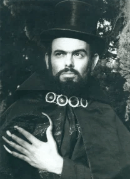 As Halloween Month continues, Balladeer’s Blog presents another seasonal post. Over the years I’ve reviewed plenty of the horror films made by Brazil’s King of Horror since the 1960s – Coffin Joe (Ze do Caixao) aka Jose “Mojica” Marins. I’ve even reviewed
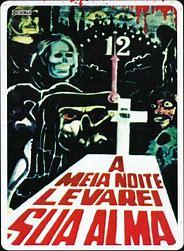 AT MIDNIGHT I’LL TAKE YOUR SOUL (1963)
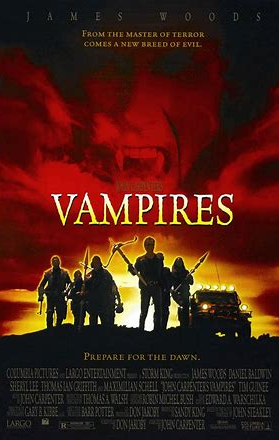 JOHN CARPENTER’S VAMPIRES (1998) – Halloween Month rolls along with this look at John Carpenter directing James Woods as Vatican-sanctioned vampire hunter Jack Crow. As always, James Woods is like a force of nature. When he’s on the screen he virtually blows away most of the people with whom he shares that screen.
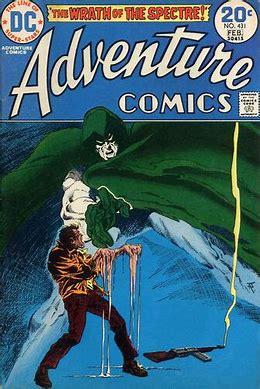 ADVENTURE COMICS Vol 1 #431 (February 1974)
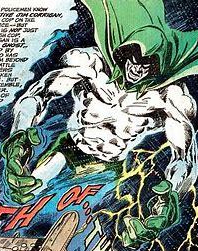 When situations demanding greater than human intervention arose, Jim could become the Spectre, his ghostly form in which he wielded vast powers that he used against earthly villains as well as supernatural menaces.
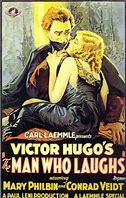 THE MAN WHO LAUGHS (1928) – I have no idea why Conrad Veidt doesn’t get the silent horror film love that Lon Chaney and Paul Wegener receive. In this final silent horror movie for Veidt, he shines once again in another landmark film. This one is based on the neglected Victor Hugo story about a figure who, like Hugo’s Quasimodo, has a monstrous disfigurement that causes him to be shunned and feared.
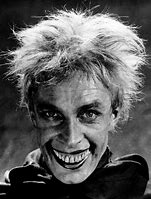 Dea falls in love with Gwynplaine’s poetic nature in fact, but when the grotesque smiler is discovered to be of noble descent the pair are separated by villainous figures involved in aristocratic court intrigues. Olga Baclanova co-starred as Duchess Josiana, the lead heavy in this forgotten Gothic horror classic.
 Halloween Month continues here at Balladeer’s Blog with this look at three notorious – but not necessarily all that good – horror films from iconic Italian director Lucio Fulci.
 THE BEYOND (1981) – A woman inherits The Seven Doors Hotel, a run-down inn outside New Orleans in the Louisiana countryside. It was once the site of an infamous murder in the 1920s and supernatural activities break out as our heroine Liza Merrill (Katherine MacColl) tries to refurbish the place.

