
 Halloween Month continues here at Balladeer’s Blog with this look at three notorious – but not necessarily all that good – horror films from iconic Italian director Lucio Fulci.
As always, because I review everything from mild horror films to extreme, I will give notice to Fulci newcomers that his movies are known for very, very graphic violence and stomach-turning special effects. If that’s not your type of horror, avoid reading anything below the “continue reading” line.
 THE BEYOND (1981) – A woman inherits The Seven Doors Hotel, a run-down inn outside New Orleans in the Louisiana countryside. It was once the site of an infamous murder in the 1920s and supernatural activities break out as our heroine Liza Merrill (Katherine MacColl) tries to refurbish the place.
The 1927 slaying involved an outraged mob forcing their way into the hotel, dragging the artist and occultist Schweik down to the basement. Once there they killed him in three graphic stages for practicing Black Magic.
Meanwhile, a soon to be blind woman reads The Book of Eibon and foresees a time when the hotel may be used to unleash nightmarish forces from the beyond.
NOTE: The Book of Eibon is Fulci’s nod to the works of American horror writer Clark Ashton Smith, since Eibon was an ancient sorcerer in Smith’s works. Smith tied many of his own stories to H.P. Lovecraft’s lore regarding the Old Ones, malevolent figures which once ravaged the world and want to again.
Fulci refrains from using the Old Ones and instead makes it the standard Hell whose forces may be unleashed on the real world through an occult “gate” in the hotel. An old painting by the murdered Schwenk ties into the overall mystery.
Louisiana physician John McCabe (David Warbeck) becomes romantically involved with the heroine Liza, whom he meets while treating various people seriously injured while trying to restore her hotel. You know the tropes – the supernatural activity increases, the body count rises and unimaginable evil is unearthed in the hotel’s basement.
I’ll avoid spoilers, suffice it to say it’s typical Fulci – disturbing, sometimes surreal visuals and 1980s gore in service to an otherwise standard horror story. That’s not an insult, just an observation. The Beyond is all about the presentation, and if you’re in the mood for self-consciously edgy horror, you’re likely to enjoy the film.
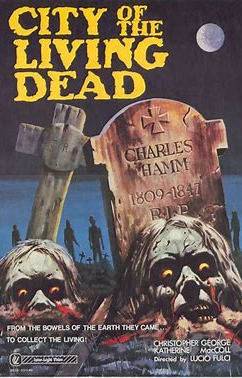 CITY OF THE LIVING DEAD (1980) – In this earlier flick, Lucio had already gone full Lovecraft shoutout, using the town of Dunwich – as in The Dunwich Horror – and the ancient Book of Enoch – as in a riff on Lovecraft’s fictional Necronomicon.
A priest gone bad commits suicide in a Dunwich cemetery, completing a ritual which will unleash legions of the living dead upon the Earth on All Saints’ Day. So, just as Fulci used Clark Ashton Smith’s offshoots of Lovecraft’s Cthulhu Mythos to jazz up a standard haunted establishment tale in The Beyond, this earlier work used actual Lovecraft elements to jazz up a Romeroesque tale of zombies on the loose.
Reporter Peter Bell (Christopher George) and occult buff Mary Woodhouse leave New York City to investigate Father Thomas’ suicide in Dunwich. Peter, Mary and various Dunwich residents are tormented by supernatural rains of maggots and other horrors.
While waiting for All Saints’ Day to arrive, the reanimated Father Thomas has been killing victims in graphically gory ways, then having them join him as one of the living dead.
That slow recruitment method was just a prelude, however, as, at the appointed time, the living dead begin to infest Dunwich (and presumably elsewhere). We get some of the standard “characters besieged by zombies” set pieces which had not yet been as worn out in 1980 as they are today.
The climactic scenes take place in the Dunwich graveyard, where the surviving characters hole up in the late Father Thomas’ family tomb while searching for a means of shutting off the flood of zombies rising up. Again, I’ll avoid spoilers for newbies.
I will point out, though, that Lucio Fulci actually predated director Stuart Gordon in terms of using Lovecraftian elements as a frame for graphic gore and worse. That’s not a shot at Gordon, just a statement, since many critics still refer to Stuart as the pioneer in turning Lovecraft into Grand Guignol.
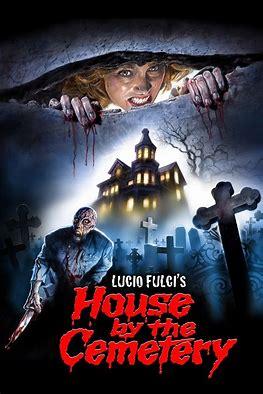 HOUSE BY THE CEMETERY (1981) – It doesn’t matter what order in which you view these three “Gates of Hell” movies, as Fulci called them. This 1981 work centers around married couple Norman and Lucy Boyle (Paolo Malco and Katherine MacColl) plus their son Bob (Giovanni Frezza), who temporarily move into a very old New England home called Oak Mansion by some and the Freudstein Estate by others.
Norman studies old homes and architecture but his research this time reveals that Dr. Freudstein long ago used Oak Mansion as a site for grotesque experiments on human guinea pigs – men, women and children. Young Bob is haunted by a ghostly child while Lucy and others have their own encounters with paranormal forces on the premises.
The ghosts of Freudstein’s adult and child victims continue tormenting the Boyles and their allies. Eventually, the presumed dead Dr. Freudstein comes out of hiding to reveal the inhuman way he has kept himself going over the past century.
More complications follow, but again it’s Fulci’s usual horror tropes decorated with intense gore and extreme concepts.
The description I always use is this – If you’re a horror fan who wishes that films like The Shining, or Night of the Living Dead, or The Sentinel would have gone much further with their violence, then definitely check out Lucio Fulci’s body of work. He’s considered a master, but his movies are gore-heavy and often substitute incoherence for genuine scares.
FOR MY REVIEW OF SEVEN ZOMBIE MOVIES THAT ARE AT LEAST UNIQUE CLICK HERE.
FOR MY LOOK AT THE CENTRAL FIGURE IN THE TERRIFIER MOVIES CLICK HERE.

