
 Balladeer’s Blog always marks the holiday called Frontierado, which is observed every year on the first
 Friday in August. This year that will be August 5th. Frontierado is about the myth of the old west, not the grinding reality.
A topic I haven’t covered in the past is the legendary Pony Express, which operated from April 3rd, 1860 to October 26th, 1861. Prior to the spread of telegraph wires all the way across the continent, the Pony Express was the fastest way of getting messages – and mail – from Missouri to California and vice versa.
Their riders, officially titled Expressmen, faced perils from nature, bandits and hostile Native Americans depending on circumstances at any given moment. Everything boiled down to speed, so to save on weight on the horses Expressmen were only permitted to carry one pistol after a few riders were caught carrying two pistols and a rifle or more.
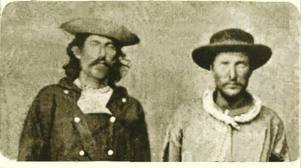 I will cover many of the other riders as we get closer to the actual date of Frontierado, but for today here is a brief look at the first Pony Express riders to depart from Saint Joseph, MO headed west and from Sacramento, CA headed east. There is still some dispute about which men officially count as the first riders, with two men put forth for both routes.
WEST FROM ST. JOSEPH – The first potential riders from St. Joseph, MO were, alphabetically, Johnny Fry and “Sailor Billy” Richardson. After ceremonial speeches by politicians and businessmen, a cannon shot inaugurated the first ride westward around 7:15PM on April 3rd, 1860.
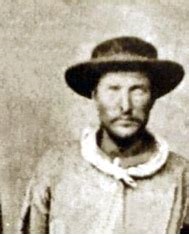 JOHNNY FRY was born in Bourbon County, Kentucky in 1840 (exact date unknown) and in 1857 his family moved to Missouri. After the firing of the cannon, whoever the first rider was, Fry or Richardson, they galloped to the ferry Denver waiting at the landing on Jules Street. The Denver carried the rider across the Missouri River to Elwood, KS where that first ride resumed. Continue reading
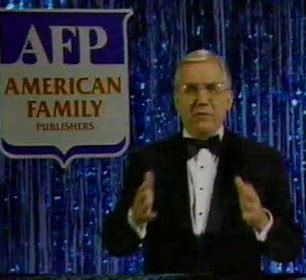 Here at Balladeer’s Blog I enjoy writing about all aspects of mythology and folklore and the way that a popular misconception can be spread. Once again the false claim that Ed McMahon (at left) was affiliated with Publishers Clearing House instead of American Family Publishers is making the rounds. Every few years this story resurfaces and is often cited as an example of the Mandela Effect.
 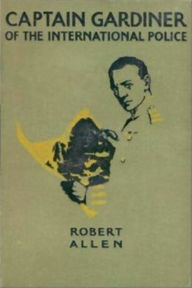 CAPTAIN GARDINER OF THE INTERNATIONAL POLICE (1916) – Robert Allen Dodd wrote this story over one hundred years ago under the name Robert Allen. Narration informs us that the story is set 60 years after the conclusion of the then-raging World War. Since we know it ended in 1918 we can look forward to visiting the “far-off future” of 1978.
 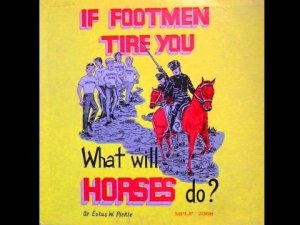 IF FOOTMEN TIRE YOU, WHAT WILL HORSES DO? (1971) – Category: A neglected bad movie classic that deserves a Plan 9-sized cult following.
  Pirkle serves as the narrator of this quirky little mess, ranting on and on in his over-the-top way about how the USA has turned away from the Bible and will suffer the consequences. He’s like a combination of Criswell in Plan 9 From Outer Space and the sermonizing narrator from Blood Freak (qv).
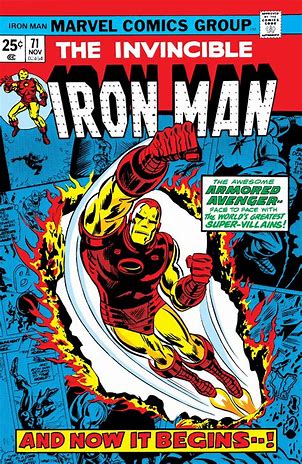 IRON MAN Vol 1 #71 (November 1974)
  The Yellow Claw seized the Mandarin’s castle and killed his rival supervillain as the opening battles in the War of the Supervillains which has been set in motion by
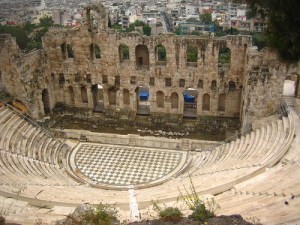
 The “greater” variation, to the proud, sea-faring Athenians, who “ruled the waves” long before Britons came along, involved throwing their wine-lees at plates floating in a pool, with the winner being the one who sank each plate. This small-scale equivalent of naval warfare was, according to Athenaeus, the more prestigious version and was characteristic of a more “high-end” party.
 MICHEL AUDER’S CLEOPATRA (1970) – It’s weirdness squared in this overlooked flick which Michel Auders directed utilizing assorted Andy Warhol menagerie figures in the cast. Auder himself played Caesar, with modern-day Rome as the seat of his empire. Viva portrayed Cleopatra with her domain of Egypt being set in the modern-day state of New York with snowmobiles as horses. Yes, it’s one of THOSE kinds of films.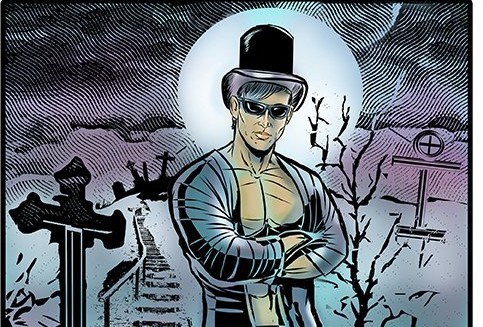
 Balladeer's Blog