
 The latest attempt at cramming the X-Men’s lengthy, years-long Dark Phoenix storyline into one movie is now in theaters. With everybody reviewing that cram course Balladeer’s Blog will instead take a look at the female Phoenix character from the original 1966-1971 run of Dark Shadows.
Amazingly enough, I often encounter people who claim to have never heard of the Gothic Horror soap opera Dark Shadows. Not the original 5-day a week cult series (still available in reruns), not the movies, not the attempted reboot in 1991 and not the ongoing series of audio plays set in the 1970s onward. If anything they’ve heard of the incredibly lame Tim Burton comedy version of the show starring Johnny Depp.
 Decades before Bella Swan was torn between a supposedly hunky vampire and a supposedly hunky werewolf in the Twilight novels, female readers of Tiger Beat magazine were torn between Dark Shadows‘ horror heart-throbs. Jonathan Frid’s vampire Barnabas Collins was one and David Selby’s werewolf/ warlock/ Dorian Gray-figure Quentin Collins was the other.
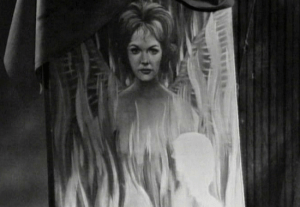
 In terms of female horror heart-throbs from Dark Shadows, Lara Parker’s evil witch Angelique is the best known, but obviously this post will address the unusual supernatural menace the Phoenix, aka Laura Collins, played by Diana Millay (right) on the original Dark Shadows.
In Dark Shadows lore Laura Collins was sold to a Phoenix Cult in Egypt in the 1700s by her evil lover, for whom she had abandoned her husband back in America. The cult used Laura as an offering/ guinea pig, transforming her into a supernatural figure called the Phoenix. Continue reading
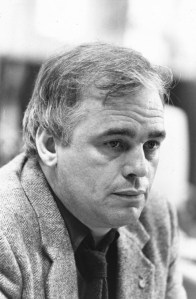 THE MANIPULATORS (1970) – The words “gritty” and “streetwise” seem never to be used when describing vintage television programs from Canada but they certainly apply to The Manipulators (Originally the title was to be The Clients).
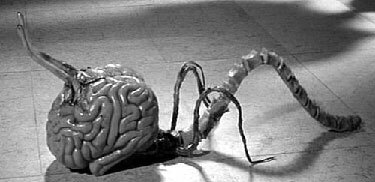 FIEND WITHOUT A FACE (1958)
 EARTH VS THE FLYING SAUCERS (1956)
 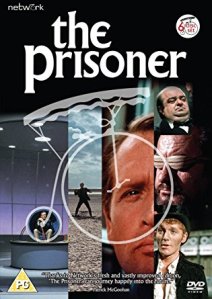 Recently Balladeer’s Blog wrapped up an in-depth examination of all 17 episodes of Patrick McGoohan’s pioneering 1967 series The Prisoner. Before Lost, before The X-Files, before Twin Peaks, there was this innovative British series which was equal parts science fiction and existentialism.
  alladeer’s Blog CONCLUDES its examination of the 1967 science fiction/ existential drama The Prisoner
 Episode Title: ONCE UPON A TIME … This installment is PART ONE OF THE TWO-PART SERIES FINALE.
  Leo McKern returns as the same Number Two he portrayed back in The Chimes of Big Ben. The Number Twos are the rotating series of executives who manage the prison-city called the Village. The midget Butler (Angelo Muscat), the only character besides Patrick McGoohan to appear in every episode of the series, serves McKern breakfast right there in Number Two’s office inside the Green Dome.
  “Why do you care?” he asks our protagonist when he answers. (I’d have preferred the more specific question “Why do you STILL care?”) McGoohan makes it clear he recognizes the voice and when Number Two asks the same question again he tauntingly replies “You’ll never know.”
  Episode Title: IT’S YOUR FUNERAL … In the ongoing debate over the exact ordering of the 17 episodes of The Prisoner I place this one 3rd from the last.
  It’s Your Funeral centers around an assassination attempt in the Village and features how our main character’s rebellious nature has begun inspiring assorted other Villagers to commit their own subtle acts of defiance to the Villagekeepers.
  Episode Title: HAMMER INTO ANVIL … In the ongoing debate over the exact numbering of the 17 episodes of The Prisoner I place this one 4th from the last.
  THE STORY: Amid a dramatically convenient thunderstorm this episode’s Number Two, the rotating series of executives who manage the prison-city called the Village, interrogates a female prisoner called Number Seventy-Three. Her wrists are still bandaged from her recent suicide attempt, an action she tried in order to escape captivity in the Village.
  DO NOT FORSAKE ME, OH MY DARLING – This is the third and final of the 3 episodes I would drop from this 17 episode series because they either do not serve the premise or don’t serve it well. I will synopsize the storyline, point out why I would drop it and add how I would change it.
 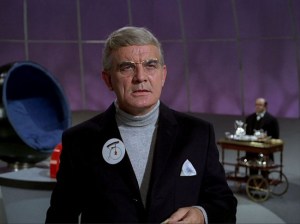 The Villagekeepers demonstrate for this agent the Colonel (yes, a third “colonel” appears in the series) Dr Seltzman’s device for switching minds between two human subjects. They do not fully understand the process nor do they understand how to switch the minds back to their respective bodies afterward.
  A CHANGE OF MIND
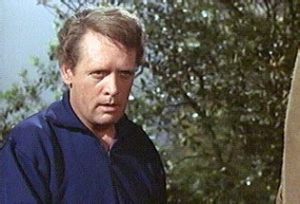 The Prisoner is exercising on some makeshift gymnasium equipment that he has constructed for himself in the woods just outside the prison city called the Village. Some Villagers who may or may not be thugs of the Villagekeepers gather around and taunt our protagonist for his antisocial, non-conformist ways. They also threaten to report him to “the Committee” for his dissident behavior.
