
Balladeer’s Blog resumes its examination of ancient Greek comedies.
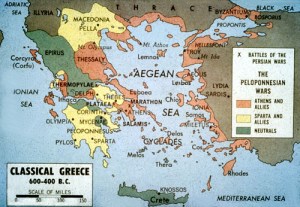 POLEIS – In this post I’m looking at Poleis (Cities), written by Eupolis, one of the Big Three of Ancient Greek Comedy along with Aristophanes and Cratinus. This satirical comedy is dated from approximately 422 B.C. to 419 B.C. Like so many other such comedies it has survived only in fragmentary form.
The title refers to the all-important Chorus in ancient Greek comedies. In this case the chorus consisted of actors costumed to represent some of the city-states which were under the influence of Athens at the time.
As for how people can be “costumed” as cities, picture how it would be done with American cities. The chorus member representing New York might be depicted as the Statue of Liberty, Saint Louis as the Arch, Pittsburgh as a steel worker, Los Angeles as a brain-dead movie star and so on.
Part of the political satire dealt with the love-hate relationship that many subject- states had with Athens. Being the combination Paris/ Tokyo/ New York City of its time, Athens had a lot to offer its allied polities, but a certain air of tension always existed because of what some of those locations felt were Athens’ high-handed ways of dealing with them.
Eupolis depicted the personified subject-states/ allied states as workers with a not altogether beloved “boss,” Athens. Continue reading
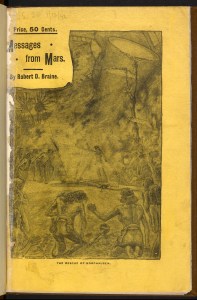 MESSAGES FROM MARS BY THE AID OF THE TELESCOPE PLANT (1892) – Written by Robert D Braine. I shortened the title for the blog post headline. The main character of this novel is a sailor named Nordhausen. After leaving Madagascar our hero winds up shipwrecked on an uncharted island.
  The natives take him through a cave entrance to their hidden village which is a blend of the primitive and the futuristic. For the “sacrilege” of damaging one of the telescope plants Nordhausen is to be executed. The means? A device formed from several of the lens-like leaves which magnify the sunlight into a makeshift heat-ray, like holding a magnifying glass over a piece of paper to catch it on fire.
  PART TWENTY-NINE – As always part of the fun comes from the way the Fool Killer’s opinions are a mix of today’s left-wing and right-wing attitudes. Some you’ll agree with, others you won’t but it’s always interesting.
 THE QUEEN OF APPALACHIA (1901) – Written by Joe H. Borders. This novel features Paul Thornton, a merchant in Kentucky, and his Lost World adventures. While hiking in the wilderness Paul saves a beautiful woman from drowning. The woman is, coincidentally enough, utterly identical to Paul’s girlfriend May Arnold.
  Here’s Balladeer’s Blog’s examination of Don McGregor’s 1973-1975 Black Panther story Panther’s Rage. I’m no comic book expert but in my opinion Panther’s Rage surpasses much of the work done by the overrated and overpraised Alan Moore.
 BABYLON ELECTRIFIED (1888) – Written by Albert Bleunard. In the tradition of his fellow Frenchman, Jules Verne, Bleunard crafted this work of science fiction with an international cast.
  LOOKING FORWARD: A DREAM OF THE UNITED STATES IN 1999 (1899) – Written by Arthur Bird. This is speculative science fiction looking at world events and scientific advances from 1899 to 1999. Since the U.S. was coming off the 1898 war with Spain that accounts for the way Spain is presented as the major villain on the global scene.
  BIETIGHEIM (1886) – Published anonymously in 1886 this work of alternate history accurately predicted some of the actual results and fallout of the coming First World War (1914-1918). Bietigheim is presented as a series of John Minor lectures about world history as seen from “futuristic” 1932.
  PART TWENTY-SEVEN: Here is a look at some of the Fool Killer’s targets from James L Pearson’s April of 1920 issue. As always we find an intriguing mix of attitudes, some of which would please us today or anger us today.
