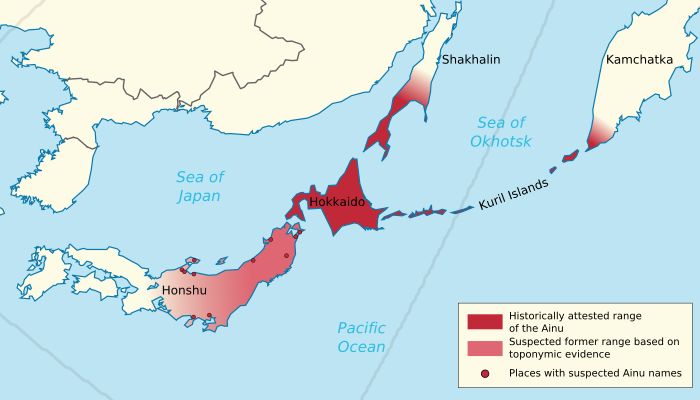
 The Ainu people of Japan suffered oppression at the hands of the Japanese which was similar to that suffered by various conquered peoples around the world at the hands of the Western World, Russia, China and the Muslim World.
The Ainu migrated south to the Japanese islands from the northern lands of the Inuit. Regular readers of Balladeer’s Blog will recognize the similarities between the Ainu and Inuit belief systems and methods of worship. In addition, certain linguistic similarities will be noted between the Ainu and the Japanese. The Shinto “kami” becomes the Ainu “kamui”, to cite the most prominent example.
As with the Inuit, exact names and aspects of the following deities can vary, with the most pronounced differences being in Saghalien.
- NOTE: I am still working out my entry on the Ainu bear god. If you know the Ainu then you know that that entry alone may double the size of this article.
RUKORO – The Ainu god of the male privy. No, I’m not kidding. The powerful stench from his domain serves the useful purpose of fending off evil spirits. Because of his association with evacuation and expulsion of things unclean he is regarded as a powerful exorcist. There is no corresponding goddess of the female privy, owing to primitive taboos about menstruation.
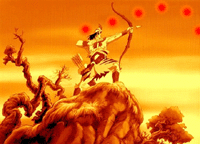
 CHUP – The sun god of the Ainu. His wife is Tombe, the moon goddess. Ainu homes orient their sacred window toward the east to greet the rising sun. Until recent decades it was customary to salute the sun upon exposure to its rays, similar to the practice of genuflecting to the center of an altar, but done without kneeling.
It was considered disrespectful to bodily cross the rays of sunlight striking the hearth through the sacred window. It was better to wait until the position of the sun changed. An inau, one of the idols or totems of the Ainu people, would be set up to honor the sun. That inau bears an incised outline of the orb of the sun and during rituals libations and praise are offered up to Chup. Continue reading
 Labor Day weekend is the appropriate time to post this look at neglected working class folk hero Joe Magarac. This figure was the Steel Mill equivalent of Paul Bunyan and John Henry.
  As a lame play on words since this is Labor Day season I’ll present Joe Magarac’s origin and then depict his tales as “Labors” like in The Labors of Hercules.
 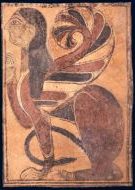 The Etruscan people, who were a bit of a bridge between the ancient Greek world and the emerging Roman world long ago, remain a historical enigma in so many ways.
 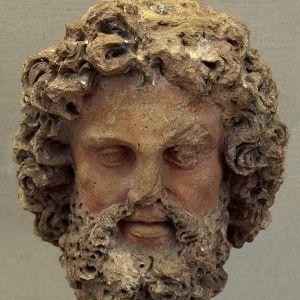 TINIA – The Chief of the Etruscan deities, like Zeus to the Greeks and Jupiter to the Romans. In the Etruscan creation myth Tinia separated the Earth from the sky and delineated borders between nations. Tinia ruled the sky and wielded three sorts of lightning bolts – one sort for warnings, one sort for intervening in affairs of gods or men for good or ill and one sort for inflicting catastrophes.
 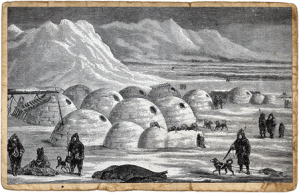 3. SILA – The god of the weather and of the animating life-force, frequently manifested as the winds, which were looked on as the “breathing of the world.” For this reason he was also the deity governing the breathing of humanity and animals as well, since breath flows like wind in and out of us all. The life force was said to come from Sila and flow back into Sila after death, and then, through the lesser deities, was eventually sent back into the world via reincarnation. Because singing, humming and tale-spinning are also done with the breath Sila was also seen as the god of songs, tales, music and other creative inspiration.
 For April Fool’s Day here’s a look at one of the original Fool Killer Letters from Charles Napoleon Bonaparte Evans’ newspaper the Milton Chronicle. This one expresses his disgust with the Civil War tearing the nation apart and his intention to hibernate until it’s over.
  PART THREE: The third surviving Fool Killer Letter. (See Part One for an explanation)
  JUNE 28th, 1861 – From “Down about Norfolk, VA.” (The Fool Killer wandered North Carolina and Virginia – which back then still included what is now West Virginia – and the dark-humored Fool Killer Letters were syndicated in several newspapers in addition to his North Carolina “birth place” the Milton Chronicle.)
 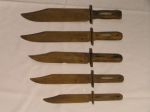 In this letter the Fool Killer adds a collection of Bowie knives to his arsenal alongside his ever-present club/ walking stick/ cudgel. Future incarnations of the Fool Killer in folk tales, short stories, novels and plays will assign him various axes, guns and even a scythe.
 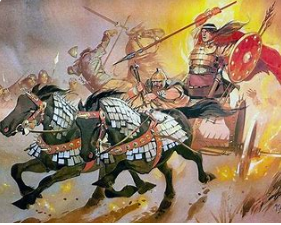 THE PHANTOM CHARIOT OF CUCHULAINN (Siaburchapat Con Culaind) – This tale is dated to around the mid-400s A.D. because of the presence of St. Patrick.
 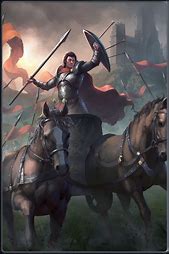 The next day, St. Patrick and King Loegaire are both on hand at the appointed place when Cuchulainn appears, riding in his chariot driven by his usual charioteer Laege. The demigod’s two horses – the Dub Sainglend (black horse of Saingliu) and the Liath Macha (gray horse of Macha) – are pulling the chariot.
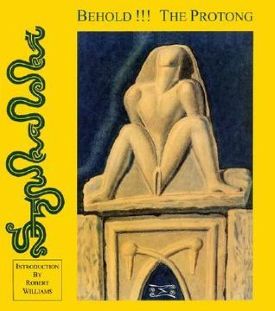 STANISLAV SZUKALSKI (1893-1987) – Just as L. Ron Hubbard went from being a pulp story writer to founder of a nutzoid religion, Stanislav Szukalski went from being a celebrated, even brilliant, artist to founder of an equally irrational belief system.
 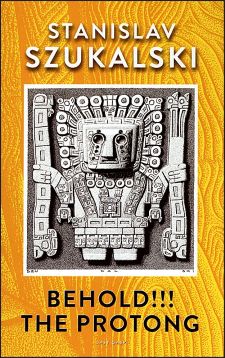 The topic of this blog post, however, is Zermatism, the insane philosophy that Szukalski founded in 1940. He named it after the city of Zermatt, where he was convinced that survivors of a pre-deluge civilization settled.