

Nayanazgeni, the Navajo god of war.
Readers have been asking for a Chapter Guide to my exhaustive examination of God Slayer, my title for the Navajo myth about Nayanazgeni, their god of war, and his quest to destroy the Alien Gods called the Anaye. Here it is:
I. BIRTH OF THE ANAYE – This chapter deals with the Separation Myth and how Navajo women’s unnatural sex acts (or liasons with Coyote or possibly Begochidi) spawned the dark, alien gods called the Anaye – click HERE
II. WHEN A GOD DIES – Nayanazgeni (“Alien God Slayer”) notches his first kill as he takes down a gigantic, double-headed Anaye who rides upon a Kaiju-sized cougar – click HERE Continue reading
 GNA – This neglected Norse goddess was one of the Asynjur (female Aesir) and served as the messenger of the female nature deity Frigga. Gna was as swift as Hermes from Greek myths and rode a horse named Hofvarpnir, a steed capable of galloping across the sky and the seas in addition to land. Gna wielded a spear and could travel as quickly as the breeze when she was astride Hofvarpnir.
 Balladeer’s Blog’s previous looks at neglected deities from the Norse pantheon of gods have been pretty popular, so here’s another one.

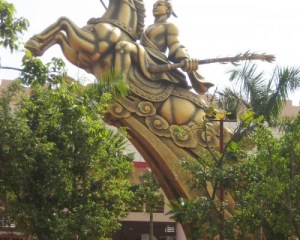 THAN GIONG – Vietnamese god of war and 1 of the 4 main deities in their mythology (often called The Four Immortals). The mother of Than Giong once fell into one of the enormous footprints left from long ago by Khong Lo, the primordial giant. She thereby became pregnant (you know mythology!) and gave birth to a baby who was always silent and unmoving for the 1st several years of his life. At length during an invasion by China the reigning member of the Hung Vuong Dynasty sent messengers around the kingdom asking for any help that could be given against the invaders.
 For my full list of Norse deities click here:
 Balladeer’s Blog concludes its examination of the grand and exciting Hawaiian epic about the goddesses Pele and Hi’iaka.
