
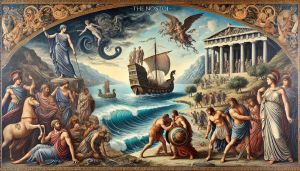
 THE NOSTOI aka THE RETURNS is a neglected epic in the Trojan War cycle. It is attributed to Agias or to Eumelus of Corinth. In the Epic Cycle, The Nostoi comes after The Sack of Troy and before The Odyssey. The epic deals with the homeward journeys of certain Greek heroes of the Trojan War other than Odysseus. The verse rendition of The Nostoi survives only in fragmentary form but there are surviving prose summaries of the work written by Proclus and Apollodorus.
THE NOSTOI – Picking up from the end of The Sack of Troy, the goddess Athena is still angry with the triumphant Greeks for the way Ajax the Lesser led the desecration of her temple inside Troy. She causes arguments among some of the Greek leaders, including the brothers Agamemnon and Menelaus, as a prelude to more deadly measures to come.
*** Diomedes and Nestor, free of hubris and considered free of the taint of the temple’s desecration, are granted swift and untroubled voyages with their fleets as they return home to Argos and Pylos, respectively.
*** Agamemnon is visited by the ghost of Achilles, who warns him not to set sail because of Athena’s anger. Impatient to return home, Agamemnon tries to appease Athena with a quick sacrifice, then departs. A storm sent by Zeus at Athena’s request ravages Agamemnon’s fleet, killing many on the Kapherian rocks, including the mad Ajax the Lesser. (One account says Athena stole one of Zeus’s thunderbolts and caused the storm herself.) Continue reading
 PART 68 – Some of the Fool Killer’s targets on both sides of the aisle in the February 1914 edition of James Larkin Pearson’s version of the folk figure:

 Previously Balladeer’s Blog examined Cypria and Aethiopis, two of the neglected Greek epics. Cypria recounted the events leading into The Iliad while Aethiopis picked up the tale of the Trojan War after the death and funeral of Hector at the end of The Iliad. The neglected epic I’m examining today is Iliad Minor, the next in line chronologically. The author is speculated to have been either Lesches, Thestorides, Diodoros, Kinaithon or even Homer himself.
 PART 67 – Some of the Fool Killer’s targets on both sides of the aisle in the January 1914 edition of James Larkin Pearson’s version of the folk figure:
 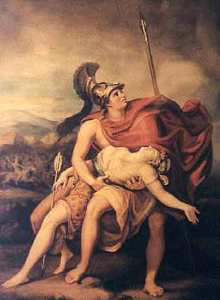 Previously Balladeer’s Blog examined Cypria, the neglected Greek epic myth that dealt with the events leading up to the Trojan War all the way up to Achilles leading the Greek forces in establishing a beachhead at Troy. The Trojan forces were then forced to retreat inside the walls of Troy itself, leaving the outside settlements to be sacked by the Greek forces. This led right into the whole Briseis/Chryseis conflict between Achilles and Agamemnon that opened up The Iliad.
 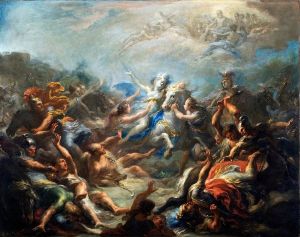 FOUR – A council of the gods is held on Mount Olympus as the goddesses Venus and Juno make their cases for and against Aeneas and his fellow survivors of fallen Troy. Venus argues for them since Aeneas is her son, while Juno retains her position against Aeneas because she wants to prevent the founding of Rome.
 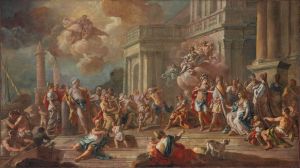 THREE – Aeneas and his fleet of survivors of fallen Troy arrive at Latium in what is now west central Italy. They are made welcome by King Latinus, who offers his daughter Lavinia to Aeneas as a bride per the oracles foreseeing the arrival of strangers possessed of greatness and whose leader he should marry to Lavinia.
 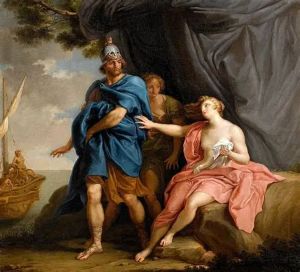 TWO – Aeneas and his companions, the survivors of the Fall of Troy, are still lingering in Carthage. Queen Dido, not knowing that the Roman State which Aeneas will spawn will also be the future destroyer of Carthage, remains deeply in love with Aeneas.
 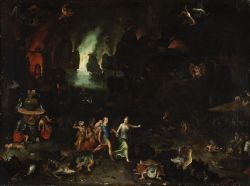 Playing into (or maybe establishing) the enduring cliche about people in a burgeoning romance being driven closer by needing relief from a downpour, Dido and Aeneas start to feel even friskier. Juno manipulates things further by having nature and animal life in the cave behave in ways that parallel a wedding ceremony.
  Recent movie news about the latest screen adaptation of The Odyssey happened to make me reflect on the lack of a big screen version of the poet Virgil’s epic The Aeneid. For newbies to the tale, I’m posting this very brief synopsis of the story – the first half a mythic voyage like Jason and the Argonauts and The Odyssey and the second half a tale of warfare as Aeneas leads his fellow survivors of fallen Troy in their mythic conquest of what would become Rome.
