Category Archives: Mythology

NAVAJO EPIC MYTH – THE WAR GOD VS THE ANAYE

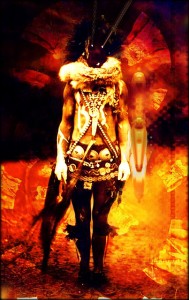
nayanazgeni the navajo god of war

Nayanazgeni the Navajo god of war

Readers have been asking for a Chapter Guide to my exhaustive examination of God Slayer, my title for the Navajo myth about Nayanazgeni, their god of war, and his quest to destroy the Alien Gods called the Anaye. Here it is:

I. BIRTH OF THE ANAYE – This chapter deals with the Separation Myth and how Navajo women’s unnatural sex acts (or liasons with Coyote or possibly Begochidi) spawned the dark, alien gods called the Anaye – click HERE

II. WHEN A GOD DIES – Nayanazgeni (“Alien God Slayer”) notches his first kill as he takes down a gigantic, double-headed Anaye who rides upon a Kaiju-sized cougar – click HERE 

III. VISIONS OF THE SPIDER GODDESS – The war god and his brother set out on a quest to meet their father, the sun god Tsohanoai, and encounter the Spider Goddess – Naste Estsan – who foresees the dangers of their upcoming journey and bestows upon them magical implements to aid them- click HERE    Continue reading

6 Comments

Filed under Mythology

JAPAN’S HILARIOUSLY WEIRD 1861 LOOK AT AMERICAN HISTORY

My fellow fans of J-Horror know that Japan practically invented weirdness. What none of us knew is how far back they go with that mastery of entertaining madness.

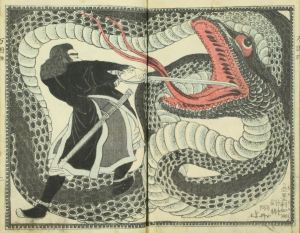
John Adams fighting a giant snakeTheir view of American history is mind-boggling. This 1861 work of “J-History” if you will, features little-known events like JOHN ADAMS FACING A GIANT SNAKE (left) and George Washington fighting a tiger. It also corrects the mistaken assumption that Washington’s wife was named Martha when her real name was apparently “Carol.” (?)  

Balladeer’s Blog’s Presidential Action and Horror Films bit only WISHES it could be this mind-bending. Credit Nick Kapur with drawing attention to this item from the Waseda University Library.

My favorite part: the illustration of Benjamin Franklin casually HOLDING A CANNON IN HIS ARMS while firing it at a squadron of Red Coats! Now that’s badass. And begs for a movie – “The Rock IS Benjamin Franklin!” And he’d have to follow up blowing away the Brits with an action hero quip like “A penny saved is a penny earned, you bastards!”  

Every single page of this acid trip Continue reading

18 Comments

Filed under Mythology, Neglected History

PELE AND HI’IAKA – EPIC OF HAWAII

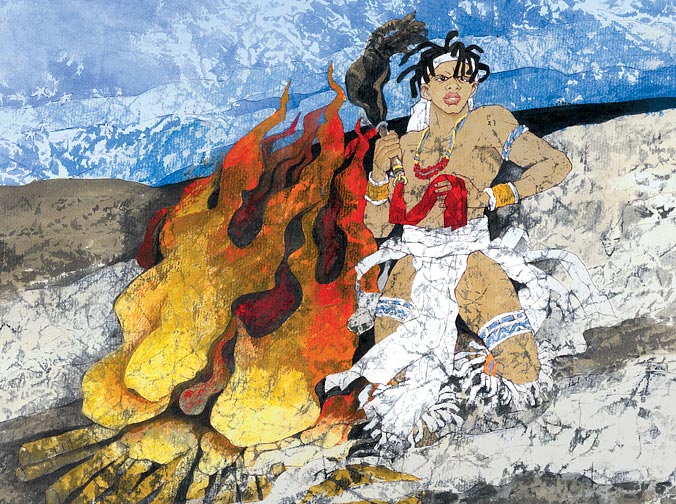
The Hawaiian epic myth about the fire & volcano goddess Pele and her sister Hi’iaka is a masterpiece of storytelling.

PELE

PELE

PART ONE

On the Big Island of Hawaii the fire and volcano goddess Pele was relaxing with her younger sister Hi’iaka, the goddess of pathways and wayfarers. Hi’iaka was watching two Hawaiian women performing a Hula dance dedicated to Laka, the goddess of love, beauty and fertility and the deity who had invented Hula dancing. 

Despite Hi’iaka’s excited praising of the dancing girls’ talents Pele found herself bored by the proceedings and fell asleep. Laka, enjoying the dance and the traditional post-dance offerings to her, felt disrespected by Pele’s inattention. Using her powers as the goddess of love she sent a dream to the sleeping Pela – a dream that would have far-reaching consequences and forever change the relationship between the fire goddess and her sister Hi’iaka. Continue reading

2 Comments

Filed under Mythology

FOOL KILLER FIFTY-SEVEN: JULY OF 1912

Balladeer’s Blog continues its examination of the many facets of Fool Killer lore. FOR PART ONE, INCLUDING THE HISTORICAL CONTEXT IN THE 1850s, CLICK HERE  

Fool Killer garbPART 57 – Some of the Fool Killer’s targets in the July 1912 edition of James Larkin Pearson’s version of The Fool-Killer. As I always point out, Pearson was difficult to categorize, which makes things interesting because he combines what we think of as left-wing and right-wing attitudes.

*** As an example of what might be labeled a left-wing viewpoint, Pearson and his Fool Killer targeted One Percenters like today’s Bush Family, Biden Family, Big Tech Fascists, etc. His 1912 way of putting it was to point out the difference between the Ninety-Nine Percent, or “the ninety and nine” among the working class and the poor, and “the one” or One Percenters who exploit the ninety and nine.

*** As an example of what might be labeled a right-wing viewpoint, Pearson and his Fool Killer pushed the virtues of religion and sticking to the teachings of Jesus.

*** The Fool Killer targeted traveling snake-oil salesmen, who in 1912 still roamed the country with their rip-off “medicines” of dubious content. Continue reading

6 Comments

Filed under Mythology, Neglected History, opinion

MWINDO – EPIC MYTH OF AFRICA

Balladeer’s Blog’s examination of an epic myth of the Nyanga people of Africa.

PART ONE

MwindoMwindo is yet another semi-divine hero from global mythology. This epic will explore his unusual birth, his heroic deeds and victories over various monsters and hostile gods.

Many of the myths from Africa survived mostly in oral form until comparatively recent decades, so there are even more variations of African epics than readers may be used to. To cite just one example: Mwindo himself is usually referred to by the epithet Kabutwa-kenda, “the little one just born yet walking”. However there are a few versions of the myth in which Mwindo and Kabutwa-kenda are TWO SEPARATE FIGURES and are half-brothers.

masc graveyard smallerIn the versions where they are two separate entities Mwindo is a villainous figure while Kabutwa-kenda is the main hero of the epic. Regular readers of Balladeer’s Blog will be reminded of the Navajo twin gods Nayanazgeni and Thobadzistsini. Nayanazgeni was usually the hero of the epic about the defeat of the evil gods called the Anaye but in the Apache version of the myth his brother Thobadzistsini is the hero and Nayanazgeni is reduced to being a comic relief coward. 

To stay in the area of comparative mythology for a moment Mwindo also shares qualities with the Sumerian demigod Gilgamesh. Like Gilgamesh, Mwindo goes from being brashly overconfident about his own supernatural powers to becoming a more humble hero and more capable ruler as the tale goes on.

The Mwindo Epic begins in the village of Tubondo, surrounded by raphia trees and located on a high hill. The founder and Chief of the village was named Shemwindo and he had seven wives because the Nyanga considered seven to be the number of perfection. Nyanga villages had seven separate kinship halls even if there were not seven separate kinship groups in the village. This was done out of deference to the sheer perfection of the number seven.  Continue reading

18 Comments

Filed under Mythology

TWELVE DEITIES FROM INUIT MYTHOLOGY

 Inuit mythology is almost criminally neglected. Personally I find it  fascinating and there is a  wealth of underappreciated information to be passed along. Inuit is the term used now, largely replacing  ”eskimo”  which was a pejorative term coined by the Algonquin Indians long ago. The geographical area of the Inuit myths ranges from Siberia across the Bering Strait through Alaska, Canada and Greenland. Names used for the following deities vary across that vast area. Some Inuit settlements like Ayaatayat (near present- day Cape Denbigh) date back 10,000 years. The Inuit were often at war with various Native American tribes and, as a testament to the  fighting  ability of the ancient Inuits they drove the Vikings themselves out of part of Greenland. The Inuit deities are as fascinating as the figures in any other pantheon.

12. NARSSUK – The god of the west wind and a son of the god Sila. Narssuk was depicted as an enormous infant whose winds were generated by the flapping of his caribou- skin diaper. In some versions the goddess Pukimna made the diaper for him. Narssuk supposedly would Continue reading

28 Comments

Filed under Mythology

FOOL KILLER FIFTY-SIX: MAY 1912

Balladeer’s Blog continues its examination of the many facets of Fool Killer lore. FOR PART ONE, INCLUDING THE HISTORICAL CONTEXT IN THE 1850s, CLICK HERE 

fool killer picPART 56 – Some of the Fool Killer’s targets in the May of 1912 edition of James Larkin Pearson’s version: 

*** Columnist Al Fairbrother, who wrote so many columns pandering to different groups of readers that he would often get caught having published hard-hitting editorials on both sides of a particular issue. The latest instance that irked Pearson and his Fool Killer was a pair of columns Fairbrother wrote, one bashing Theodore Roosevelt for thinking about running for president again and one praising him for it.

*** The Meat Trust, for, as usual “somehow” (wink) obtaining favorable court rulings okaying its dilution of beef products with unlabeled amounts of dog-meat and horse-meat.

*** The latest inane fashion fad: women’s hats with batteries in them to supply power to electric lights which decorated said hats. 

*** The Taft Administration and other federal bodies responsible for trying every trick in the book to harass The Appeal To Reason, a Girard, KS newspaper which courageously took on Big Business and Wall Street. The paper was always being dragged into court over the slightest pretext with even the post office being used to harass it and its subscribers (like the way the Biden Administration is trying to wipe out dissenting opinions by tagging them as “domestic terrorism”). Continue reading

5 Comments

Filed under Mythology, Neglected History, opinion

BAKARIDJAN KONE: AN AFRICAN EPIC MYTH

Balladeer’s Blog resumes its blog posts about neglected mythological epics from around the world. This particular epic comes from the Bambara people of the Kingdom of Segu in what is now Mali.
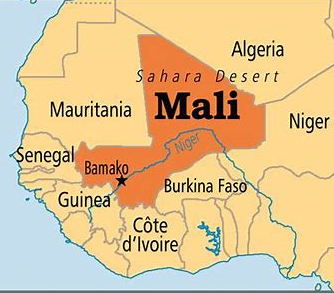
MaliTHE BAKARIDJAN KONE EPIC – Djeli, the poet-historians of the Bambara people for over 300 years, would often recite, chant and sing this epic myth while playing their stringed instruments called ngoni.

A. The future father of Bakaridjan Kone is a noble-born farmer in Disoro Nko. He grows tired of his agrarian lifestyle and his wives. (“Segu City’s where he’d rather be/ He gets allergic smelling hay” Had to be said.) Hearing that Da Monzon, the great ruler of the Kingdom of Segu, knows how to create gold, the disenchanted farmer goes to Segu City and becomes part of the court of Da Monzon, only to learn the gold story is not true.
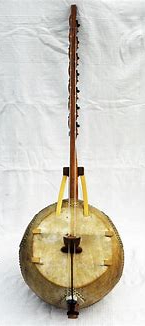
A ngoni instrument

A ngoni

B. Kumba, one of the errant farmer’s wives, gives birth to a boy. His deadbeat dad refuses to be present for the naming ceremony but hints around to Da Monzon that maybe he should provide him with a gift to celebrate the birth. Da Monzon is disgusted with the man for abandoning his wives and not being present for said naming ceremony.

              Instead, the king sends cowries to the wives so they can perform a proper ceremony, at which he wants the baby to be named Bakaridjan Kone. As the provider of the boy’s name, Da Monzon has made himself the child’s adopted father.

C. Years go by, and, royal politics being what they are no matter the culture or time period, Da Monzon begins to worry that he may get killed and/or overthrown before any of his sons are old enough to take over as king. His morike (oracle or diviner) tells him that no full-grown man poses a threat, but there is a boy-child who would one day be able to seize the throne. The morike advises Da Monzon to find a boy who is tough enough to not cry out when his foot is pierced by the king’s spear. THAT is the boy who might overthrow the king. Continue reading

22 Comments

Filed under Mythology

FOOL KILLER FIFTY-FIVE: APRIL 1912

Balladeer’s Blog continues its examination of the many facets of Fool Killer lore. FOR PART ONE, INCLUDING THE HISTORICAL CONTEXT IN THE 1850s, CLICK HERE  

Fool Killer with staff and Bowie knifePART FIFTY-FIVE – Here is a look at some of the Fool Killer’s targets in the April of 1912 edition of James Larkin Pearson’s version of the character:

*** The Steel Trust – Andrew Carnegie, J.P. Morgan, John Rockefeller and other “Big Ikes of the Steel Trust”, as Pearson and his Fool Killer called them. The bloated rich pigs were in the news again because – just like today’s corporate rich pigs at Google, Facebook, Twitter and others they were being called out on their prejudiced behavior and their contempt for the notion that Congress or the Stanley Committee or anyone else could hold them accountable.

              They had recently boasted that they were above nations because without their steel the U.S. and some other countries could not wage war or engage in engineering & construction projects or build cargo ships, railroads, etc. Whistleblowers at the steel companies had recently made public statements about the ways the Steel Trust collaborated to control steel prices, EXCLUDE COMPETITION and undertake other acts in violation of Anti-Trust laws at what they called “Gary Dinners.” Testimony from 55 figures had already been heard.

              Another way they were just as disgusting as today’s Big Tech/ Technofascists was the way that untold numbers of SUBPOENAED DOCUMENTS HAD BEEN DESTROYED BY THE CORPORATIONS INVOLVED (like privileged white one-percenter Hillary Clinton flagrantly destroyed so much of the evidence against her). Those documents allegedly contained proof that Steel Trust figures had not only violated the law but had committed perjury in their courtroom testimony. Corporate fascists like Jack Dorsey, Mark Zuckerberg and others seem to slither the same way no matter the time period.

Fool Killer Red*** Judges and other high officials who betrayed their public trusts. He favored the recall process for judges as well as others. 
*** Tobacco companies plus tobacco users like smokers and snuff-chewers. Continue reading

9 Comments

Filed under Mythology, Neglected History

THE QUEST OF SETH FOR THE OIL OF LIFE (1962): HAPPY EASTER!

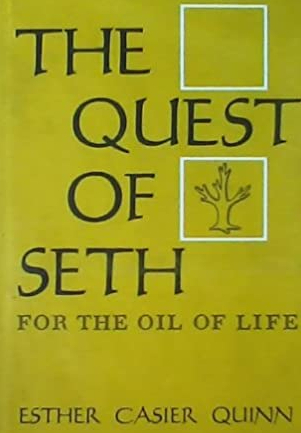
Quest of SethTHE QUEST OF SETH FOR THE OIL OF LIFE (1962) – Written by Esther Casier Quinn, this is one of the best and most concise works of comparative mythology that I have ever read. I meant to review this book way back when I started Balladeer’s Blog in 2010 but for various reasons it kept falling by the wayside. The Quest of Seth for the Oil of Life is also known as The Quest of Seth for the Oil of Mercy, The Legend of the Rood and many other titles.

Quinn draws from a multitude of sources to provide several variations of this tale and explores the ways in which the course of history shaped the revisions and embellishments involved in this legend. The Seth of the title is the son of Adam and Eve, the Oil of Life/ Oil of Mercy is often said to represent Jesus Christ, the Rood refers to the cross on which Jesus was crucified and its “legend” details the history and many forms of the tree/ wood that eventually became that cross. 

For those not familiar with this particular popular offshoot of the canonical story of Jesus Christ here’s a brief overview:
Continue reading

6 Comments

Filed under Mythology