
Balladeer’s Blog examines yet another ancient Greek comedy which has survived only in fragmentary form.
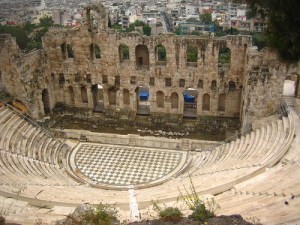
The Ruins of the Theater of Dionysus in Athens.
COTTABUS PLAYERS (c 420s B.C.) – This comedy was written by Ameipsias, whose career as an Athenian comic poet ran from approximately the 420s B.C. to the 390s B.C. In the Dionysia Festival of 423 B.C. he won 2nd Place for his comedy Connus and in 414 B.C’s Dionysia he won 1st place for The Revelers. Ameipsias also won 1st place at a Lenaea Festival but the year and title of his entry are not known.
Regular readers of Balladeer’s Blog will remember that Cottabus was a party game in ancient Athens and had two variations. The “lesser” variation involved the hard-drinking guests (and virtually ALL guests at ancient Athenian parties were hard-drinking) throwing the wine-lees at the bottoms of their cups at a plate balanced on a pole, with the winner being the one who knocked the plate off the pole.
 The “greater” variation, to the proud, sea-faring Athenians, who “ruled the waves” long before Britons came along, involved throwing their wine-lees at plates floating in a pool, with the winner being the one who sank each plate. This small-scale equivalent of naval warfare was, according to Athenaeus, the more prestigious version and was characteristic of a more “high-end” party.
The all-important Chorus of this comedy by Ameipsias was presumably a set of rowdy, drunken Cottabus players. Let’s take a look at what can be gleaned from the surviving fragments:
** The comedy’s characters were SO drunk (“How drunk were they?”) they were using their projectile vomiting instead of wine-lees to sink the floating plates. Continue reading
 TAXIARCHOI – Written by Eupolis, who – along with Aristophanes and Cratinus – was one of the Big Three of Attic Old Comedy. The premise serves as a pointed reminder of the inherent ugliness in all taxation – that the power to impose and collect taxes is, ultimately, backed up by the use of force.
 THE BANQUETERS – By Aristophanes. This was the very first comedy from the Athenian whose name is synonymous with ancient Greek comedies, especially political satires. The nineteen-year-old presented a landowner from Athens whose two sons were being introduced to his phratry brothers at a banquet dedicated to Herakles.
 WEALTH GODS (PLUTOI) – By Cratinus. In this satirical comedy the Titans are depicted overthrowing Zeus in a metaphor for the fall of the political leader Pericles. This was a reference either to his actual death or to the loss of his position as Strategos (Commander in Chief) depending on which year you go with for the comedy.
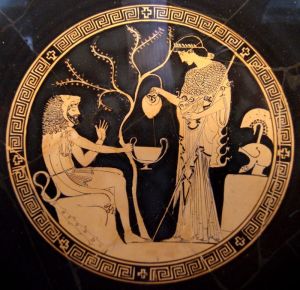 CRATES – Crates’ career spanned from approximately the 450s B.C. to the 430s B.C. We have fragments from nine or ten comedies from an unknown total output. From other sources we know that comedies as stage productions began sometime around 500 B.C. or earlier so Crates came fairly early to the artform.
  NEIGHBORS – We do not have even a hypothetical year for this work, unfortunately. Since titles sometimes referred to the all-important Chorus of a Greek comedy there is speculation that the chorus members were “Neighbors” of some sort (Duh!) but nothing is known about the plot.
 LYSIPPUS – This writer of Attic Old Comedy redefines the expression “fragmentary” because even less is known about his life than about shadowy figures like Susarion and Epicharmus. Lysippus came in 1st place with an unknown comedy at a Dionysia around 440 BCE. Fragmentary evidence survives from just three of his comedies out of an unknown total body of work so this will be my shortest blog post on ancient Greek comedy.
 The Clouds was written by Aristophanes around 423 BCE and next to Lysistrata, which I examined last week, is the Big A’s most- discussed satire, mostly because of its lampooning of the philosopher Socrates, a contemporary of Aristophanes. Many modern readers, who have been programmed to sneeringly “deconstruct” old works of art rather than understand them, love to regard this comedy with hostility. They accuse Aristophanes of being “anti – intellectual” for subjecting Socrates in particular and the Sophist philosophers in general to the same satirical criticism that every other aspect of Athenian society was subjected to in comic plays.
  In the ancient Greek democracy Athenian citizens were expected to represent themselves in court in both criminal and civil proceedings.

 Balladeer’s Blog presents another examination of an ancient Greek political satire. This comedy by Aristophanes was one that I was planning on covering very soon when I started posting my reviews of Attic Old Comedy years ago. For various reasons it kept falling by the wayside.
  More than 2,300 years before George Orwell’s Animal Farm and 1984, Aristophanes was dealing with some of the same political themes.
  Balladeer's Blog