
 In the realm of pop culture it continues to be Marvel Comics’ world! Over the past few years Balladeer’s Blog has been reviewing some old, old, OLD Marvel stories from decades ago. From the research I’ve done, I feel the late 1960s through mid-1970s were Marvel’s creative height, with only the Uncanny X-Men title retaining consistent art and story-telling quality beyond that time period.
I’ve covered The Celestial Madonna Saga (1973-1975), which also contained The Avengers/ Defenders War and the original Thanos War within its own storyline. I’ve examined the 13-part Black Panther story titled Panther’s Rage (1973-1975), the original Kree-Skrull War (1970-1971) and, most recently, the 7-part Adam Warlock tale The Magus (1975-1976).
Readers requested more Marvel, so, since these are fun and light time-passers, here comes Killraven, the Warrior of the Worlds.
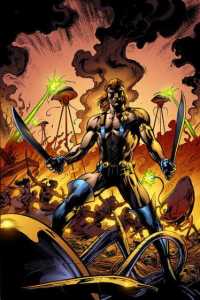 WAR OF THE WORLDS/ WARRIOR OF THE WORLDS/ KILLRAVEN: In the early 1970s Marvel was experimenting with hybrid titles combining the old and the new by fusing licensed properties with unique Marvel twists.
The most famous and longest-lasting example was Shang Chi, Master of Kung Fu. In 1973 Marvel licensed the use of Sax Rohmer’s Fu Manchu plus other characters from the Fu Manchu tales. Rather than just churn out a Fu Manchu comic book series “the House of Ideas” instead combined it with the Kung Fu craze of the time and created Shang Chi, the son of Fu Manchu.
Shang Chi, as a surrogate Bruce Lee, and Sir Denis Nayland-Smith, as a surrogate Braithwaite from Enter: The Dragon, were the core of the new series. Shang Chi started out as an operative of his evil father Fu Manchu, but realized the error of his ways and threw in with Sir Denis and his team to battle his father’s malevolent schemes.
In 1976 Marvel licensed the rights to do a comic book tie-in series with 2001: A Space Odyssey and ultimately incorporated their most popular character from that series – Mister Machine aka Machine Man – into the mainstream Marvel Universe.
The same year as Shang Chi – 1973 (so BEFORE Star Wars) – Marvel had worked similar “synergy” by taking their license to do a comic book series based on H.G. Wells’ War of the Worlds and combining it with sci-fi post-apocalypse action. The main character was Jonathan Raven, aka Killraven, a charismatic rebel leading an uprising against Earth’s 21st Century Martian conquerors.
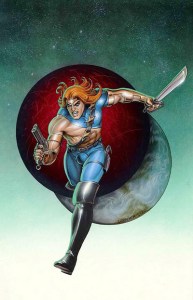 Killraven’s use of a sword AND futuristic firearms in action set against a post-apocalyptic backdrop also brought a little John Carter of Mars appeal into the series. By 1976 the promising saga was canceled due to poor sales but gained a cult following in the decades since then.
Killraven’s influence could be seen in the original 1980s mini-series V, especially the element of humans being used as food by our alien overlords and the sentimental “heroic freedom fighters versus evil tyrants” appeal. Killraven writer Don McGregor incorporated similarly themed stories and characters into Sabre, his other post-apocalypse comic book series.
Even Star Wars reflected some aspects of Killraven’s tales: the Rebel Alliance against the bad guys, the armored badass (The High Overlord in Killraven’s case) and, of course, the way Killraven wielded enigmatic, more than human abilities called simply “the Power” in K.R.’s series. (PLEASE NOTE: Killraven’s use of The Power came years before Star Wars and The Force.) The young sword-wielding hero was slowly mastering the Power as the series went along, but cancellation cut short his development of his paranormal gifts.
 And yes, I know that both Killraven and Star Wars drew on the same vast inheritance of sci-fi tropes but the close proximity of K.R. (1973-1976) to Luke Skywalker (1977 onward) makes the comparisons inevitable.
About fifteen years back, Tom Cruise was set to star as Killraven but eventually all K.R. elements were dropped from the project and Cruise starred in simply another remake of War of the Worlds instead. You have to wonder if the Marvel name would have motivated the filmmakers to keep the Killraven angle if the movie had been done AFTER Marvel became the dominant source for cinematic blockbusters that it is now.
At any rate, let’s dive into the very first appearance of Killraven in 1973: Continue reading
 Block Books from centuries ago were a form of illustrated storytelling, most often associated with religious topics. Naturally in a period of limited literacy the graven woodblock picture- stories made theological tales even more popular with the masses. In approximately 1455 – 1480 these “proto- comic books” addressed the Antichrist and the End Times.
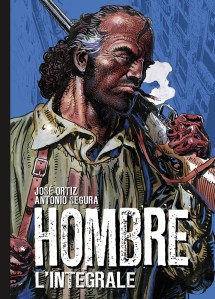 AT THE END OF THE RIVER – More Weirdness at the End of the World, this time with an adventure featuring Spain’s answer to Mad Max: Hombre himself. This character was created by Antonio Segura and Jose Ortiz in 1981 in the Spanish publication Cimoc. Hombre went on to appear in notably “adult” comic books and magazines around the world, including reprints in Heavy Metal here in America.
 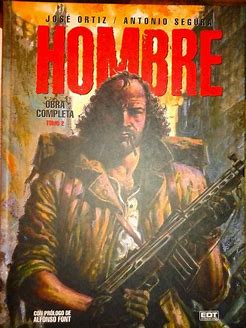 The title character Hombre roams our post-apocalypse planet armed to the teeth and ready to kill or be killed on a daily basis. His first-person narration echoes the best aspects of hard-boiled Film Noir detective stories while the action and mis en scene combine the best elements of Spaghetti Westerns, Post-Apocalypse movies and Martial Arts flicks. Think Six-String Samurai but without the rock and roll samurai.
 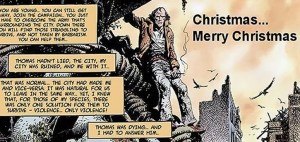 Segura mostly avoided easy narratives and my least favorite storyline involved Atila, the badass woman warrior. The character was great, but the tale seemed very UN-Segura-like to me. I probably would have liked her in her own spin-off story but having two such nigh-indestructible figures in one tale put things too far into the realm of upbeat fictional tropes to me. I’m virtually alone on that, by the way, since most fans LOVE the Atila story.
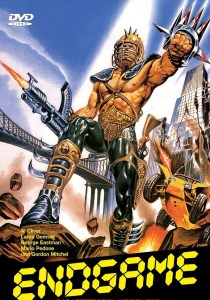
 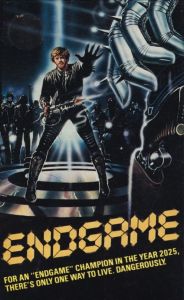 ENDGAME (1983) – More Weirdness at the End of the World with yet another Italian imitation of The Road Warrior. These Spaghetti-pocalypse movies were to the 80s what Spaghetti Westerns were to the 60s and 70s.
  Lilith works like a figurative Mutant Called Moses (with apologies to Harriet Tubman) and has been heroically smuggling mutants out of the cities, Underground Railroad style.
  Here at Balladeer’s Blog I’ve always had a soft spot for the Resident Evil movies. I’m not implying that they’re good by any means, but as guilty pleasures I consider them pretty watchable in a Spaghetti Western sense. You don’t expect logic or well-maintained continuity in the original Django or Sartana series any more than you do from the Stranger or Hallelujah flicks or any of the other lower-level pulp series of Italo-Westerns.
 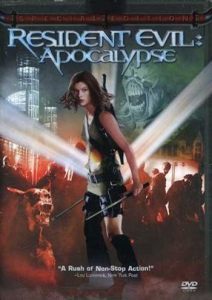 Seventies chop-socky films are another example. You might watch them but you sure as hell can’t defend them from criticism.
  THE WRECK OF A WORLD (1889) – Written by W. Grove. (No other name available) This novel is the sequel to Grove’s A Mexican Mystery, an ahead-of-its-time work about a train engine devised to have artificial intelligence. The machine – called only The Engine in that story – rebelled and took to preying on human beings in horrific fashion. For Balladeer’s Blog’s review of that novel click
 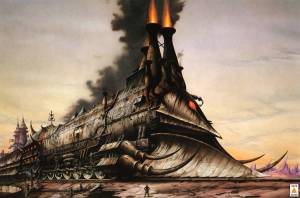 Our story begins in what was to Grove “the far future” of 1949. After a fairly superficial depiction of the world’s political and scientific situation in this imaginary future the meat of the tale begins. All in all the author did not present 1940s technology as being much more advanced than what was available in the 1880s. Grove might have done better to set his tale in 1899 or just into the 1900s to detract from his lack of vision on this particular element.
  THE COMIC (1985) – Virtually every film buff today knows the tale of Sam Raimi, Bruce Campbell and Robert Tapert raising money from doctors, grocers and dentists in Michigan to finance their subsequent horror hit The Evil Dead.
  The Comic takes place “in another place and another time” according to one of the female characters. From appearances it’s a near-future police state in which fairly ambiguous laws are enforced by goose-stepping goons who wear their hair in ponytails. This film seems to be reaching for the heights achieved in cult films like Eraserhead and Café Flesh but falls so far short that it’s more like The Jar.
 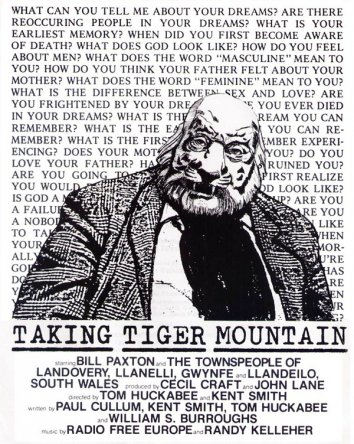 TAKING TIGER MOUNTAIN (1983) – The very memorable actor Bill Paxton passed away recently. I’ve been trying to decide which Paxton film appearance would fit in most with Balladeer’s Blog’s world of weirdness.
  Putting all that aside, Taking Tiger Mountain is an artsy black & white post-apocalypse movie which is more Born of Fire or A Boy and His Dog than Mad Max. In the aftermath of a nuclear war the world is in chaos with diseases running rampant, food riots breaking out regularly and the poles knocked off-kilter.
  Balladeer's Blog