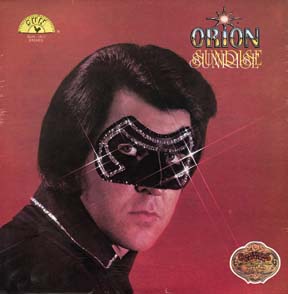
It’s Battle of New Orleans Day AND Elvis Presley’s birthday! In the past I’ve posted my review of Change of Habit, the Elvis movie with him as a doctor, Mary Tyler Moore as a nun and Ed Asner as a cop. I’ve also posted about the musical in which Elvis IS Andrew Jackson – Rock ‘N’ Roll vs the Redcoats. (With an Ann-Margret drag queen as pirate Jean Lafitte. )
This blog post will dredge up the often-neglected Orion business from decades ago. It was a fun bit of nonsense that only the most far-gone Elvis Conspiracy Theorists take seriously. As always I consider conspiracy theories, put-ons, hoaxes and ARG’s to be modern variations of myth and folklore.
Yes, Elvis died in 1977. That’s not the point. The point is the way the whole Orion/ Jimmy Ellis/ Elvis Conspiracy rabbit hole deserves to be studied forever because of the way fiction and reality seemingly influenced each other to the point where they became almost inseparable.
I WANT EL SANTO AND I WANT HIM NOW!
If you’re new to these events get ready for the Elvis Presley equivalent of Orson Welles’ War of the Worlds radio broadcast. And let me make it clear I’m not accusing anyone of anything. I have no idea what anyone’s motives were regarding any aspect of the following.
I’ll present the tale in the style of the fictional Carl Kolchak – as “items” in a list:
ITEM: Elvis Presley died in August of 1977, yet in the years that followed an ever-increasing body of folklore and myth would develop regarding the late rock star supposedly faking his own death. His motives varied according to the theory.
ITEM: For a time Elvis sightings seemed to outnumber sightings of Bigfoot, UFOs and the Loch Ness Monster combined.
ITEM: The novel Orion was published. Conspiracy lovers often cite either 1977, 1978 or 1979 as the year of publication, so you can see how deep some of the rabbit holes run.
ITEM: Orion featured a very Elvis-like young man from the American south who becomes a sensation as a rock singer. In the end the character Orion is so weary of the stresses of stardom that he fakes his own death to get away from it all.
 ITEM: Claims are made that enigmatic power players managed to get the novel removed from bookstores. The claims are sometimes accompanied by insinuations that this was done because the book might have struck too close to reality with its “fake death” ending.
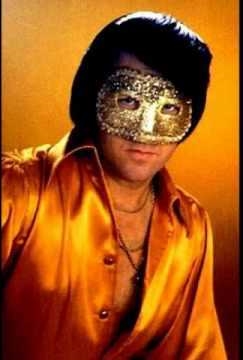
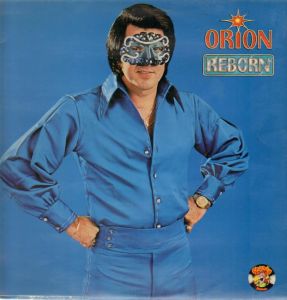
ITEM: A masked singer – who looks like a standard Elvis impersonator except for the mask – appears and calls himself Orion. He begins releasing albums and performing in public. This Orion’s first album, tantalizingly titled Reborn, is released in 1978. Continue reading
 AFTER FERRAU THE MUSLIM HAD BEHEADED THE SLEEPING PRINCE ARGALIA, he once again mounted his horse and rode off eastward through the Forest of Arden, continuing his search for the fleeing Princess Angelica. Roland the Paladin was likewise scouring the forest for this woman who had bewitched so many men back at the court of Charlemagne.
 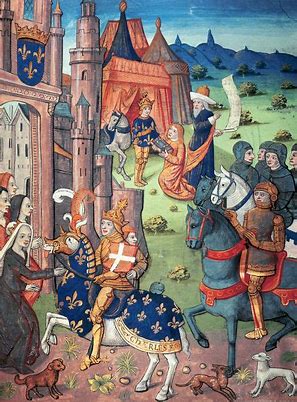 THE NEXT MORNING, the 31 warriors who wanted to joust for the possession of Princess Angelica of Cathay donned their armor and rode together to the Fountain of the Pine. Angelica’s brother Argalia was awaiting them there.
 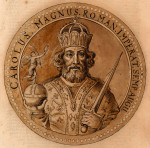 Christmas time through Twelfth Night is the time of year that Balladeer’s Blog covers tales of Charlemagne and his Paladins. These tales are the legends, not the historical accounts of the real Emperor Charlemagne and his court. FOR MY FIRST CHAPTER ON CHARLEMAGNE’S PALADINS CLICK
 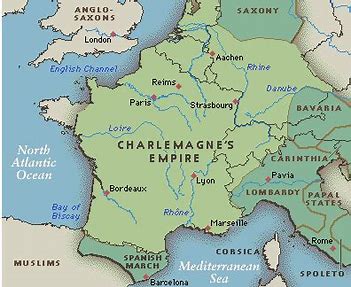 THE PRINCESS OF CATHAY – The previous installment’s reference to a tournament prompted a lot of readers to ask for a full-blown tournament story from the tales of Charlemagne. As always, I listen to you readers, so here we go.
  The woman’s black hair was adorned with jewels and her clothing was of the finest kind. She and her Paladin were permitted to approach Charlemagne’s throne and present themselves. The woman identified herself as Princess Angelica of Cathay. The man in armor was her brother, Prince Umberto.
 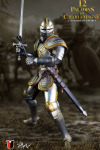 LOTHAIR AND BENES – This story takes place much earlier than most of my previously covered Tales of Charlemagne. Lothair (in real life the grandson of Charlemagne) was, according to legend, the Emperor’s oldest son. Lothair was brave and virtuous, unlike Charlemagne’s scheming and treacherous son Charlot.
  Labor Day weekend is the appropriate time to post this look at neglected working class folk hero Joe Magarac. This figure was the Steel Mill equivalent of Paul Bunyan and John Henry.
  As a lame play on words since this is Labor Day season I’ll present Joe Magarac’s origin and then depict his tales as “Labors” like in The Labors of Hercules.

 PART FORTY-FIVE – Of interest to me in the March of 1911 issue of James Larkin Pearson’s version of the Fool Killer: