
 Over five years ago Balladeer’s Blog began a detailed look at the neglected folklore surrounding the Fool Killer figure. It’s been a while since I left off and I’m about to dive back in. There are so many new readers here that I’m posting a recap of the very first Fool Killer item from the 1850s. Next time I’ll resume where I left off – in 1913.
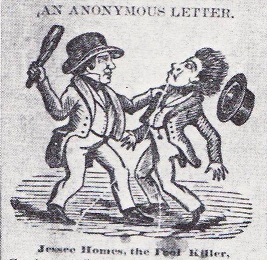 Balladeer’s Blog kicks off a multi-part examination of the neglected 1800s folk figure called the Fool Killer. I will cover the various stories featuring the Fool Killer and the different ways the character was used by the authors. If I ever examine the related character called the Rascal Whaler it will be in a separate series of blog posts.
NOTE: FOOL KILLER LORE IS STRICTLY FOR ADULTS. IT IS NOT FOR THOSE WHO ARE SIMPLE-MINDEDLY OFFENDED BY ANYTHING AND EVERYTHING.
The Fool Killer stories began in 1850s North Carolina. Charles Napoleon Bonaparte Evans, editor of the newspaper called The Milton Chronicle, introduced the character around 1851 (some sources say as early as the late 1840s). If Evans had been a political cartoonist he might have used the Fool Killer as his mascot, like the figure Punch over in England or Puck here in the U.S.
 However, since Evans was all about the written word, he used the Fool Killer as a much more active figure. Evans’ Fool Killer – claiming Jesse Holmes as his real name – roamed North Carolina and Virginia (which at the time still consisted of what would become West Virginia) looking for fools to kill with a club/ walking stick he always carried with him. The character would then send letters to Editor Evans explaining why he had chosen victims, defending his actions with puckish commentary.
I’ve always been struck by the similarity with the way real-life serial killers would correspond with newspapers, explaining and/or defending their deeds. In the case of Charles Evans’ Fool Killer, it was Evans himself writing the letters as if they were pieces of correspondence that “Jesse Holmes” sent to him.
The killings never happened, of course, and were simply Evans’ way of using political commentary in an entertaining way. Instead of high-brow social criticism, the Fool Killer Letters were very dark satire in which the mock author of the letters bashed the life out of corrupt politicians and other malefactors. Continue reading
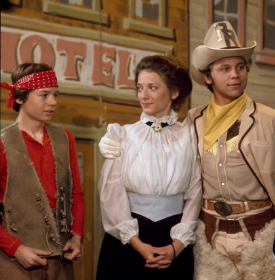 RANGE RYDER AND THE CALGARY KID (1977) – (Also known as The Adventure of the Dinosaur Badlands.) A 14-year-old MIKE MYERS co-starred in this Canadian children’s program that was also aired in the early 1980s on Nickelodeon. (Hey, Nick even showed episodes of The Uncle Floyd Show in its early years.) Myers (in headband) played the Calgary Kid, sidekick to David Ferry’s Range Ryder.
  NATIONAL CHAMPIONSHIP – The final day of the 2024 Flag Football playoffs saw the OTTAWA (KS) UNIVERSITY BRAVES needing a pair of wins to take their 4th straight National Championship. The 1st Game was against the WARNER UNIVERSITY ROYALS. A 7-7 opening Quarter tie remained unchanged at Halftime. The 3rd Quarter ended with the Braves up 14-7, and in the 4th, Ottawa defeated the Royals 21-13. QB Madysen Carrera went 31 of 39 for 271 yards and 3 Touchdowns.
  BATTLE AT BARCLAY’S CENTER – Yesterday the NEW YORK LIBERTY hosted the INDIANA FEVER.
 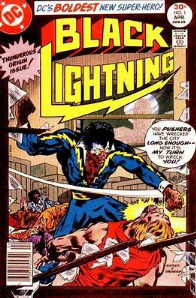 BLACK LIGHTNING Vol 1 #1 (April 1977)
  Jefferson Pierce was a gifted athlete from high school on up and even won medals in the Olympics. Disdaining celebrity, he became a teacher and ultimately moved back to the slums where he grew up and taught at Garfield High.
  TRADER HORN (1927) – This book was the quasi-autobiographical account of Alfred Aloysius Horn (1854-1931), a British trader in Africa during the 1800s. Ethelreda Lewis added pertinent commentary to each chapter.
  NATIONAL CHAMPIONSHIP GAME – The NJCAA’s defending champs of Women’s Flag Football – the FLORIDA GATEWAY COLLEGE TIMBERWOLVES – took on the HESSTON COLLEGE LARKS for the 2024 title.
 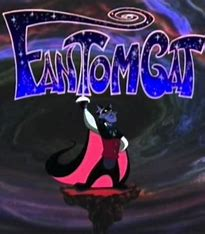 FANTOMCAT (1995) – This animated adventure series is pretty much the overlooked stepchild of Cosgrove Hall’s much more well-known and longer-lasting series Danger Mouse. No spy antics in Fantomcat, however, but anthropomorphic cartoon animals represent all the characters.
  Fantomcat’s archenemy was the sword-wielding sorcerer Baron Hugo von Skelter. On the night of December 31st, 1699, a battle between our hero and von Skelter and his henchmen ended with the villains mystically trapping Fantomcat in a painting on the wall in Fantomcat’s castle.
  ROGER CORMAN (April 5th, 1926 – May 9th, 2024) – Many words have already been said about the passing of this film industry legend and I’m sure many, many more are yet to be said. From the 1950s to the current year – and with projects still in production – Roger William Corman was a Hollywood fixture.
  Roger was never known as someone who lacked talent, he was just in it for the money most of the time, and therefore kept his budgets tight and his schedules tighter. From 50s monster movies to Raging Youth films to whatever horror trends were ascendant to big-screen soap operas that could be more explicit with their content, Roger Corman was there, raking in bucks and working with future giants of the industry.
  BATTLE ROYAL – The WARNER UNIVERSITY ROYALS clashed with the WEBBER INTERNATIONAL UNIVERSITY WARRIORS.
  AND AT THE OTHER EXTREME … – The THOMAS UNIVERSITY NIGHTHAWKS were anti-drama in their game against the REINHARDT UNIVERSITY EAGLES (should be the Rottweilers).
 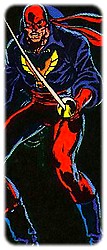 This weekend’s light-hearted and escapist superhero post from Balladeer’s Blog is a Double Feature. The main event is a look at the early adventures of Marvel’s neglected hero El Aguila (the Eagle).
 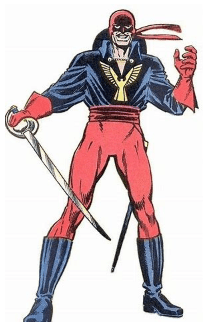 EL AGUILA
  Through trial and error, Alejandro found that long, slender metal objects were the best conductors for his bioelectricity and gave him the most accuracy with his energy blasts. He began using a sword through which to shoot his rays but to conceal his mutant nature publicly pretended his swords contained micro-generators that accounted for the rays he projected.
