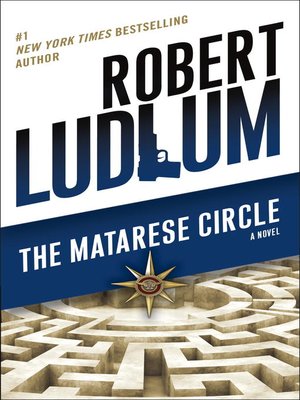
 THE MATARESE CIRCLE (1979)
TIME PERIOD: Late 1970s with investigations into events from before World War One and later.
To me this lengthy, epic espionage novel from Robert Ludlum was his finest work, partly because it nicely encapsulated how – over the course of the 20th Century – the world gradually found itself at the mercy of elaborate “intelligence communities” (LMAO) working in conjunction with international corporate fascists.
There’s something almost poetic about the way that – with the hindsight we have now – the bitter enmity between the novel’s central characters (one a U.S. agent and the other a Soviet agent) is washed away a mere decade before the real-world collapse of the Cold War paradigm.
And with that same hindsight it’s almost eerie how those two rivals come to realize that the real seeds of future totalitarianism lie in the New Feudalism’s ugly motto: Nations are obsolete, so wealth wedded to unchecked political power is the coming thing. Ludlum’s arch-villain Guillaume de Matarese was positively prescient.
LEAD HERO: Brandon Alan Scofield – Codename: Beowulf Agate. Forty-six year old veteran of Consular Operations, Ludlum’s fictional Intelligence Organization specializing in defections from hostile nations – mostly Communist – to the United States.
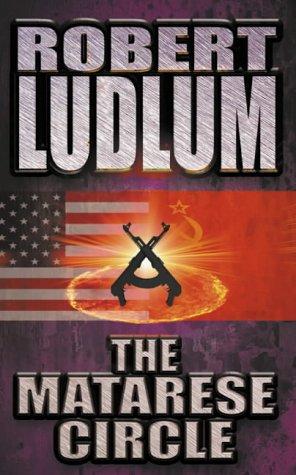 As The Matarese Circle opens in 1979, Scofield has been with Consular Operations for 22 years, almost since its founding. A Harvard grad fluent in multiple languages, Brandon joined the U.S. State Department right out of college. After a couple years in the “real” State Department he gravitated to State’s covert section Consular Operations (or Cons Op for short).
In those early years Cons Op’s activities were not yet totally Top Secret. They were virtually a humanitarian organization which tried to accommodate as many people fleeing the Iron Curtain nations as possible. So many Eastern Europeans began seeking asylum in the Western World that the Soviets realized they had to take steps to cut off the flow of escapees.
Similar to the way they would later construct the Berlin Wall to prevent flight from East Berlin in particular, the Soviets clamped down on potential defections throughout Europe and elsewhere. Soviet intelligence agents – among them Vasili Taleniekov – began shutting down the almost openly- operating Cons Op defection network. Continue reading →

 Richard C Meyer’s fantastic team of mercenary superheroes nicknamed the Jawbreakers are back in action! They’ve been called the new AVENGERS, the new JUSTICE LEAGUE and the new X-MEN, and with good reason.
  JAWBREAKERS: GRAND BIZARRE, the third installment of the superteam’s adventures, features never before revealed secrets regarding the group of mighty mercenaries plus the mind-blowing menace of the Grand Bazaar. Said Bazaar appears on Earth once every 66.5 years and is a more hardcore version of the kind of foes that the Justice League Dark and the 1970s Defenders fought.
  ECLIPSE MONTHLY Vol 1 #10 (July 1984)
  True to his word, the Masked Man (Dick Carstairs) has been at the side of Maggie Brown (his emerging love interest) each step of the way for her therapy. She is still at Frank Capra Memorial Hospital learning to cope with her new blindness following her injuries during our hero’s battle with the Joe Manfredi Gang last time around.
  THE Nth MAN (1920?)
  A MEXICAN MYSTERY (1888)
  THE MONSTER OF LAKE LA METRIE (1899) – This short story was written by Wardon Allan Curtis and was first published in the August of 1899 issue of Pearson’s Magazine.
  The pair of researchers begin to theorize that the lake reaches down to the Earth’s “hollow interior.” (Yes, it’s one of THOSE notions again.) They suspect that plant and animal species long extinct on the surface are still alive deep within the planet and occasionally wash up in the lake’s waters.
  Alexandre Dumas pere is synonymous with swashbuckling historical adventures like The Three Musketeers, The Count of Monte Cristo and The Man in the Iron Mask.
 GEORGES (1843) – Published just one year before The Three Musketeers, this novel is not only a rollicking adventure full of action, romance and double-crosses but it deals with racial issues in such a way that you would have thought it would have been adapted for film four or five decades ago. The title character uses his sword to fight slavery!
 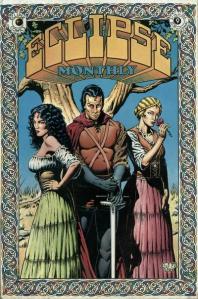 ECLIPSE MONTHLY Vol 1 #9 (June 1984)
 The Masked Man (Dick Carstairs) is on-hand as Editor-In-Chief J Judah Johnson (a pastiche of J Jonah Jameson) assigns our hero’s reporter friend Barney McAllister to scour the city to see if any more members of the Architectural Terrorists are still at large.
  A PLUNGE INTO SPACE (1890) – Written by THE Robert Cromie, later editions of this novel came with a preface by Jules Verne himself. Scientist Henry Barnett, after 20 years of labor, has mastered “the ethereal force which permeates all things,” a combination of electricity and gravity. This mastery will allow for interplanetary space travel.
  In anticipation of encounters with hostile life-forms on other planets, the clique has also manufactured disintegrator weapons, with which they fight off curious parties of indigenous tribes in order to preserve their secret.
  PART THIRTY-NINE – Some of the Fool Killer’s targets in the September of 1910 issue of James Larkin Pearson’s Fool-Killer:
  *** “Republocrats,” as Pearson and his Fool Killer called the corrupt fraternity of career politicians/ career criminals who belonged to the two gangs called Democrats and Republicans. Today the term is spelled “Republicrats.”
 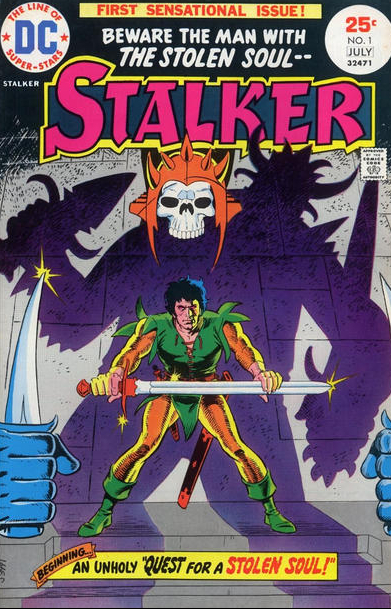 STALKER – With the WITCHER series such a sensation right now, Balladeer’s Blog takes a look at the forgotten 1970s sword, sorcery and fantasy series called Stalker.
 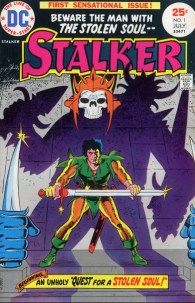 STALKER #1 (July 1975)
