
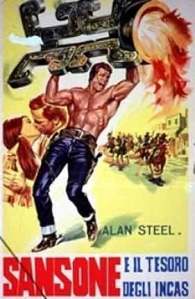
 Balladeer’s Blog takes a look at some neglected westerns. And when it comes to neglected it’s tough to top the tiny sub-genre of what is already a sub-genre: Spaghetti Westerns. I’m talking about Llama Westerns, the microscopic fraction of Italo-Westerns that deals with gunslingers in Peru shooting it out over Inca treasure instead of the usual gold or revenge.
If Indiana Jones used a gun exclusively and thrived on riddling his adversaries with bullets in slow motion while blood squibs burst open THAT would resemble these Llama Westerns.
LOST TREASURE OF THE INCAS (1964) – Alan Steel, best known for Peplums like the Hercules or Maciste movies, plays an often-shirtless gambler/ gunfighter called Samson in this film.
He and his gunslinging pal Alan Fox (Toni Sailer) nip a frame-up job in the bud, then get caught up in a violence-filled race for the untouched treasure of a lost Incan city in the Palladi Mountains of Peru. Continue reading
 MR. A
MR. A  UTOPIA or THE HISTORY OF AN EXTINCT PLANET, PSYCHOMETRICALLY OBTAINED (1884) – Written by Alfred Denton Cridge. An unnamed narrator comes across the remains of a meteor that entered Earth’s atmosphere. This narrator has the gift of psychometry (the author’s uncle was THE William Denton) and after he picks up the tangerine-sized chunk of black rock from another planet he begins getting impressions from it.
  The planet was just 2,500 miles across and was home to a race of roughly 5 1/2 feet tall humanoids, some with yellow skin, some with brown skin and others with gray skin. All the races had long, black hair. Utopia sported Earthlike plains, mountains, lakes and rivers with just one huge ocean.
  BEN VEREEN … COMIN’ AT YA (1975) – As famous and celebrated as the multitalented Ben Vereen is, he’s STILL underrated! At least here in 2026 he is, but in 1975 the stage and television performer was enchanting the U.S. like no other black performer since Sammy Davis Jr.
 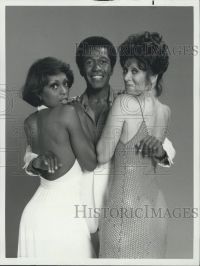 Vereen hosted the program plus sang, danced and starred in comedy sketches with celebrity guest stars. One of the show’s regulars was the one and only Lola Falana, who always got a show-stopping introduction from Ben. (“Lola Fuh-LAW-Naaa, Lola Fuh-LAW-Naaa.”)
  HEART OF AMERICA ATHLETIC CONFERENCE – Only one Upset in the HAAC Tournament Opening Round.
  WAVELENGTH (1983) – This is an unjustly neglected science fiction film that stars Robert Carradine, Cherie Currie and Keenan Wynn in a very unconventional love triangle: both Carradine and Currie are fighting over Wynn. (I’m kidding!)
 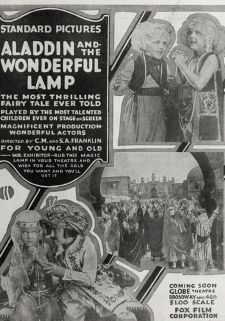 ALADDIN AND THE WONDERFUL LAMP aka Aladdin and His Wonderful Lamp (1917) – Remember how the 1976 movie Bugsy Malone presented a gangster tale with children in all the roles? And how Shirley Temple starred in an entire series of Baby Burlesque shorts with all-child casts in assorted genres? Well, this 80-minute silent film was earlier than all of them.
 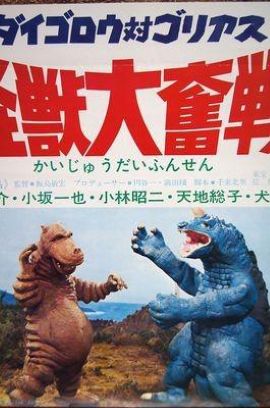 DAIGORO VS GOLIATH (1972) – This neglected kaiju (giant monster) film from Japan is one of the most obscure of them all in America. That’s odd since the movie was a joint project between the creators of Godzilla AND the creators of Ultraman, two very popular characters here in the west.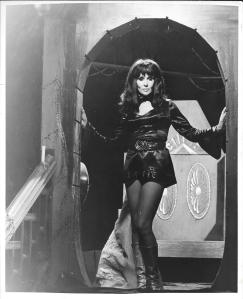
 NUMBER FOUR TAKES A FALL – On Senior Night for the SOUTHEASTERN UNIVERSITY FIRE they welcomed the number 4 team in the nation – the AVE MARIA UNIVERSITY GYRENES. The Fire put AMU on Upset Alert by Halftime with their 39-29 lead, but the Gyrenes forced Overtime with a 71-71 tie. In the extra session Southeastern U. won 83-80. Anthony Kangah led the victors with 21 points while teammate Nathan Mikkelson got a Double Double of 19 points and 13 rebounds.
 CENTURY CLUB – Teams scoring 100 or more points in Regulation: The ST. MARY-OF-THE-WOODS COLLEGE POMEROYS beat the visiting INDIANA UNIVERSITY AT COLUMBUS CRIMSON PRIDE 101-70 ### Meanwhile, the UNIVERSITY OF RIO GRANDE (OH) RED STORM downed the KENTUCKY CHRISTIAN UNIVERSITY KNIGHTS 114-79 ### And the GOVERNORS STATE JAGUARS won 107-55 at the JUDSON UNIVERSITY EAGLES.
