
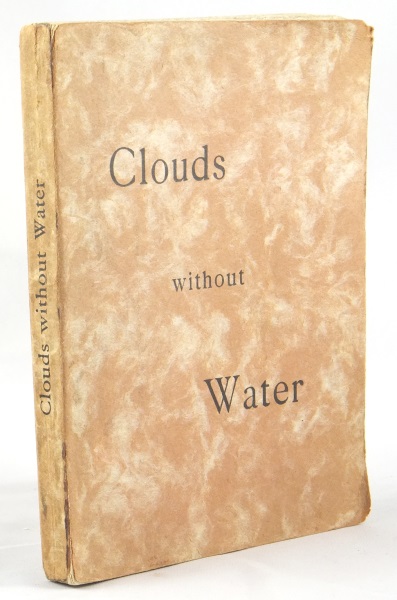
 What better way to mark April Fool’s Day than by commemorating one of the wittiest and most daring of practical jokes, one perpetrated by Aleister Crowley in those brilliant years before drugs and/or self-delusion fogged his mind. Decades before the pathetic “Peekaboo Crowley” of much renown Aleister was still churning out some very enjoyable poetry – some of it brilliant. The Sword of Song and Konx Om Pax are my favorite volumes of verse by “the Laird of Boleskine” … AFTER Clouds Without Water, that is.
Clouds Without Water was not Crowley’s only literary practical joke, of course, but the humor of it resonates to this very day, thanks mainly to the never-changing air of pious self-righteousness that afflicts most of the world’s clergy-members. And not just pious self-righteousness but a habit of condemning in the strongest language works of art which their self-limited minds clearly don’t understand.
THE JOKE: Clouds Without Water was published under one of Crowley’s pseudonyms – Reverend Charles Verey. It was circulated to various ministries and teaching colleges allegedly as a condemnation of “the type of atheism and socialism” that the young and the bohemian were embracing. Crowley – writing as Reverend Verey – wrote a foreward and a closing prayer for the volume of poetry as well as (when you know the full story) HILARIOUS footnotes expressing the kind of simplistic moral outrage that only the most narrow-minded of holy-rollers can spout. Continue reading
 Balladeer’s Blog continues its examination of the grand and exciting Hawaiian epic about the goddesses Pele and Hi’iaka.
 FORSETI – The god of the laws for men and gods alike who acted as the judge and moderator for disputes among the deities of the Teutono-Norse pantheon. His powers of arbitration and unquestioned fairness were necessary for settling conflicts involving his hot-blooded and temperamental fellow divinities. It is unknown, but doubtful, if Forseti’s rulings were at all binding on Odin. He was the son of the god Baldur through his wife Nanna and lived in a

 Spring is the time of year that always puts me in mind of the many dead and resurrected deities who were featured in various seasonal myths around the world. This is a look at Inanna, but if you want more dead and resurrected gods and goddesses click


 Balladeer’s Blog continues its examination of the grand and exciting Hawaiian epic about the goddesses Pele and Hi’iaka.


