Category Archives: Mythology

FOOL KILLER THIRTY-THREE: FEBRUARY OF 1910

Balladeer’s Blog continues its examination of the many facets of Fool Killer lore. FOR PART ONE, INCLUDING THE HISTORICAL CONTEXT, CLICK HERE 

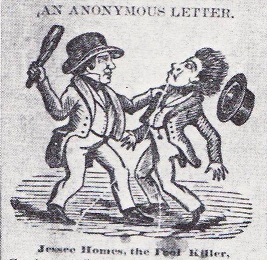
Fool Killer timelessPART THIRTY-THREE: This latest look at the Fool Killer centers on the February of 1910 issue of James Larkin Pearson’s Fool-Killer. That month’s targets of the Fool Killer (I prefer no hyphen) included:

*** Crooked businessman Charles Wyman Morse, infamous for assorted financial crimes including fraud and corrupt business practices. The previous month Morse had begun his prison term in the Atlanta penitentiary, where one of his fellow prisoners was THE Charles Ponzi, originator of Ponzi Schemes.

*** Three fools in Swain County, NC who used a radiator in the courthouse building to “thaw” a stick of dynamite for blast-fishing. The dynamite “thawed” so well it exploded, destroying the courthouse.

*** News outlets in the pockets of the wealthy, who used those outlets to downplay their plutocratic abuses. (Some things never change.) 

*** People who were pushing locations in Pennsylvania, Virginia and North Carolina as “the official birth-place of Daniel Boone.”

*** The people involved in high-stakes card games in Saint Louis. Continue reading

6 Comments

Filed under Mythology, Neglected History

ANGUTA: INUIT DEITY

Detailed entry on the father of the sea goddess Sedna. For more entries on the gods and goddesses of Inuit mythology click here: https://glitternight.com/inuit-myth/

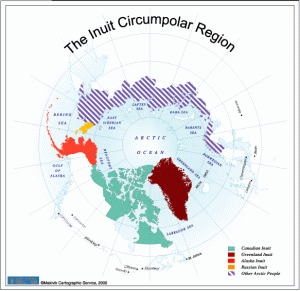
Inuit regionANGUTA – This father of the sea goddess Sedna was originally the god who ruled over Pugtulik Island. He was responsible for inflicting punishments on deserving souls when they reached Sedna’s subaquatic realm of the dead.
At the dawn of time, after his unruly daughter devoured both of her mother’s arms and had consumed one of Anguta’s own, he took her out in a canoe to abandon her at sea in the apotheotic event that saw Sedna’s ascension to sea goddess. Continue reading

4 Comments

Filed under Mythology

FOOL KILLER PART THIRTY-TWO: JANUARY OF 1910

Fool Killer 1910-1929Balladeer’s Blog continues its examination of the many facets of Fool Killer lore. FOR PART ONE, INCLUDING THE HISTORICAL CONTEXT, CLICK HERE 
Balladeer’s Blog’s readers have been asking me to back up a bit and cover the 1910-1917 run of James Larkin Pearson’s Fool-Killer publication before following it any further into the Roaring Twenties. As always, I aim to please the readers, so here we go:

Fool Killer timelessPART THIRTY-TWO: The targets of Pearson’s Fool Killer (I prefer no hyphen) in this debut issue from January of 1910:

*** A flim-flam artist called Grammar who was selling bogus “eternal youth” treatments via his book Perpetual Life, or Living in the Body Forever.

*** Frederick Cook, who, the previous December, had seen his claim to have reached the North Pole ruled invalid and possibly fraudulent by the University of Copenhagen. (The Fool Killer was unable to locate Cook, however.)

*** The “Idle Rich” who had never worked a day in their gilded lives. One memorable line: “A good deal of ‘the cream of society’ ought to be churned.”

*** A Professor Pickering who wanted to raise 10 million dollars to send a message to the planet Mars. Continue reading

8 Comments

Filed under Mythology

TWENTY BUNYORO DEITIES: AFRICAN MYTHOLOGY

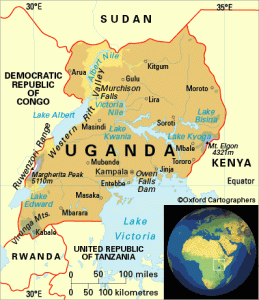
The year 2020 will see plenty of Top Twenty lists here at Balladeer’s Blog. Here’s a look at 20 Bunyoro Gods. Bunyoro was located in and around present-day Uganda. The people had an elaborate pantheon of deities. For the top gods of the Nyanga people instead, click HERE

UgandaRUHANGAThe supreme god of the Bunyoro pantheon. The creator and initiator of the world after he separated the Earth from the sky and adorned the sky with stars. Ruhanga stayed remote and, though omnipotent, was seldom invoked or prayed to. He provided the Banyoro people (Bunyoro for the place, Banyoro for the people) with children, animals and the harvest, but also was the author of disease, sickness and death.  

On the freshly-created Earth Ruhanga put three seeds into the ground and in 1 day 3 calabashes had grown. all on one stem. He took a man/woman couple out of the first 2 calabashes but found just a lone man in the third.  Ruhanga named the men KAKAMA, KAHIMA and KAIRU.  

After subjecting the men to tests to determine their worth, Kakama was judged the most worthy and Ruhanga decreed his descendants would be the ruling class. He further decreed that Kahima’s descendants would be the cattlemen class and Kairu’s descendants would be the farmer class. (No the myth doesn’t say who Kairu has the children with.) Continue reading

20 Comments

Filed under Mythology

FOOL KILLER PART THIRTY-ONE: JULY OF 1921

Balladeer’s Blog continues its examination of the many facets of Fool Killer lore. FOR PART ONE, INCLUDING THE HISTORICAL CONTEXT, CLICK HERE 

Fool Killer picPART THIRTY-ONE: Moving on to the July 1921 issue of James Larkin Pearson’s monthly Fool-Killer publication. The Fool Killer’s (I prefer no hyphen) targets this time around were: 

*** Politicians and pundits who were still pushing the notion that the World War which ended in November of 1918 really was “The War to End All War” and that the world was poised for an era of peace and tranquility with no more bloodshed.

*** Nations which were still trying to develop ever-deadlier chemical weapons, despite the uproar over the long-term consequences of such weapons in the war from 1914-1918.

*** In particular the Fool Killer targeted jingoistic U.S. War Department scientists and /or officials who spoke of a deadly gas that our country had just developed – a gas which could supposedly “depopulate a whole city in a few minutes.” 

              Mascot new lookPearson and his Fool Killer wondered if, despite official claims that the government was trying to prevent other nations from getting hold of the formula, the U.S. might wind up using the gas ourselves at some future time and therefore become “the Huns” of a new war. 

              Here in 2020 we are accustomed to the notion that our own elected officials – from both parties – may be as totalitarian and destructive as any others. That realization came after decades of real-life scandals plus fictional espionage and science fiction stories using (eventually overusing) the “Are we are own worst enemy? theme. 

              I find it incredibly intriguing to see a contemporary 1921 example of that justifiable suspicion. The image of the Fool Killer – homicidal vigilante though he’s always been – taking down scientists, military men or politicians gambling with such poisonous gasses is wildly ahead of its time.  

*** In a REALLY prescient bit, he targeted people who felt that Germany should be forced harder and harder to try to pay war reparations no matter what damage it did to that nation’s economy. We all know where that wound up taking the world. Continue reading

16 Comments

Filed under Mythology, Neglected History

GODS OF BELLONA AND RENNELL ISLANDS

bellona-and-rennellIn the style of Balladeer’s Blog’s separate examinations of Hawaiian and Samoan myths as a subset of Polynesian Mythology comes this look at the deities worshipped on the Polynesian outliers Bellona Island and Rennell Island. Despite its much smaller size Bellona had a larger population for much of their history.

NGE’OBIONGO – The goddess of the stone ovens used by the people of Rennell and Bellona. The ovens were shown such reverence that it was forbidden to eat near them or to scatter firewood or even to speak in raised voices in their vicinity. Nge’obiongo would punish anyone who violated those taboos, just as she punished women who were bad or lazy cooks or who prepared meals without first properly cleaning their hands.

Undercooking the food would also invite this deity’s wrath. On rare occassions some of the prepared food would be left in the ovens as an offering to Nge’obiongo.

bellona-and-rennell-world-heritageMAHUIKE – The earthquake god of Bellona and Rennell Islands (henceforth Bel-Ren). Like his counterparts in Hawaii and Samoa, Mahuike lived far underground and caused earthquakes by pushing at the earth with both of his arms.

Once, after a particularly destructive earthquake, the god Tehu’aingabenga fought Mahuike for injuring his worshippers and broke off one of the earthquake god’s arms. Continue reading

26 Comments

Filed under Mythology

CHARLEMAGNE: REINOLD, MAUGRIS THE MAGICIAN AND BAYARD

Here’s a bonus Charlemagne post in honor of Twelfth Night. FOR THE FIRST CHAPTER ON CHARLEMAGNE’S PALADINS CLICK HERE

Reinold and BayardREINOLD, MAUGRIS THE MAGICIAN AND THE ENCHANTED HORSE BAYARD – Reinold was another of Charlemagne’s nephews, like the Paladin Roland. Reinold, also called Rinaldo, was the son of the Emperor’s sister Aya and her husband, Duke Aymon of Ardennes. Reinold’s sister Bradamante, covered previously at Balladeer’s Blog, was the white-armored Paladin in Charlemagne’s court, making her literally a “white knight.”

Reinold, like his three older brothers and his sister distinguished himself in battle and was knighted by the Emperor. Reinold, already showing the maverick streak that he would become famous for, declined a sword at the knighting ceremony, vowing that as one of Charlemagne’s Paladins he would carry a sword taken from the next adversary he bested in combat.

MaugrisOnce, while riding outside Paris, Reinold was presented with a magnificent suit of armor by Maugris the magician, the younger, more active counterpart to Merlin from Arthurian lore. (In some versions Maugris – aka Malagigi – also gives Reinold a horse, but since this tale centers around Reinold’s taming of the mount Bayard I’m omitting that to keep the story stream-lined.)

Not long after, Maugris the enchanter again appeared before Reinold, this time in the forest of Arden. Maugris told the young Paladin that a mightier steed than the one he currently rode was on the loose in the forest, killing everyone who tried to tame him.

Maugris went on to explain to Reinold that the horse, named Bayard, once belonged to Amadis of Gaul. After Amadis’ death, Maugris had cast a spell on the horse that granted it supernatural powers, making it impossible for the beast to be subdued by anyone except another Paladin as brave and capable as Amadis himself.

All the other Paladins that Maugris had sent to try taming Bayard had been killed by the horse. Reinold was undeterred by that knowledge and rode off toward the cavern lair of Bayard.  Continue reading

6 Comments

Filed under Mythology

CHARLEMAGNE: OGIER AND THE CROWN OF DENMARK

FOR THE FIRST CHAPTER ON CHARLEMAGNE’S PALADINS CLICK HERE Ogier

OGIER AND THE CROWN OF DENMARK – King Geoffrey of Denmark saw his lands invaded by pagan Vikings from the north. The ferocity and numbers of the invaders proved too much for Geoffrey and his men so the king sent messengers to Emperor Charlemagne asking for help.

Charlemagne nobly set aside the lingering hostility he felt for Geoffrey from the time when that King of the Danes refused him tribute and the Emperor had led his armies to defeat Geoffrey. Charlemagne decided to send troops to assist Denmark but also to test the character of his Paladin, Ogier the Dane … Geoffrey’s son.

The Emperor wanted to see how Ogier would conduct himself in such a situation, facing superior odds in the field AND having to contain his resentment toward his father Geoffrey for having sent him as a hostage to Charlemagne’s court after his military defeat long years earlier.

Charlemagne placed Ogier at the head of an army consisting of a thousand Paladins and thousands more common Frank soldiers. Wielding his enchanted sword Cortana, the Dane led his men north. Continue reading

13 Comments

Filed under Mythology

CHARLEMAGNE: TWO ADVENTURES OF ROLAND

FOR THE FIRST CHAPTER ON CHARLEMAGNE’S PALADINS CLICK HERE 

RolandI. A 14 ft tall giant named Ferragus was preying upon Charlemagne’s subjects, carrying them away at will and devouring them in his cave. When the Emperor was made aware of this situation by the inhabitants of the affected region he called for a volunteer from among his Paladins to kill the giant.

Roland was the first and loudest volunteer and so Charlemagne, despite being worried over his nephew’s safety, permitted him to ride off to battle Ferragus.

A few days later Roland had ridden to the site of the giant’s mountain cave. The monster emerged to battle the armored adventurer and the two clashed. Hours went by with Ferragus unable to slay Roland and with Roland’s enchanted sword Durindana failing to penetrate the giant’s thick skin. Continue reading

15 Comments

Filed under Mythology

BEST OF SEPTEMBER 2019

Balladeer’s Blog’s end of year retrospective continues with this look at September’s best:

classical greecePOLEIS (CITIES) 422-419 B.C. – A look at the ancient Greek political comedy written by Eupolis. CLICK HERE

TRANSGRESS WITH ME: SEPTEMBER 23rd – Are you brave enough to share some more transgressive thoughts? CLICK HERE

Babylon ElectrifiedANCIENT SCIENCE FICTION – Messages From Mars (1892)  HERE , The Queen of Appalachia (1901) HERE , Babylon Electrified (1888) HERE , Looking Forward (1899) HERE , The Automatic Maid (1893) HERE

HEROIC WOMEN FIGHTING OPPRESSION IN THE MUSLIM WORLD – The title says it all. CLICK HERE

WOI EPIC – A Liberian epic myth about gods and demons. CLICK HERE

Isaiah WashingtonISAIAH WASHINGTON – And yet another Martin Luther King Person of Courage to profile – CLICK HERE Continue reading

5 Comments

Filed under Ancient Greek Comedy, Bad and weird movies, humor, LIBERALS AND CONSERVATIVES, Mythology, Neglected History, opinion