
 THE WRECK OF A WORLD (1889) – Written by W. Grove. (No other name available) This novel is the sequel to Grove’s A Mexican Mystery, an ahead-of-its-time work about a train engine devised to have artificial intelligence. The machine – called only The Engine in that story – rebelled and took to preying on human beings in horrific fashion. For Balladeer’s Blog’s review of that novel click HERE
The Wreck of a World is not a direct sequel to A Mexican Mystery but does use one of that novel’s elements as its springboard: the deliciously frightening notion that the Engine’s artificial intelligence might have included the capacity to design and build others of its kind. Though A Mexican Mystery never explored that concept, Grove deals with it in much more detail in this second novel.
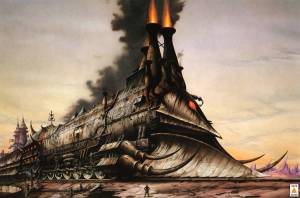 Our story begins in what was to Grove “the far future” of 1949. After a fairly superficial depiction of the world’s political and scientific situation in this imaginary future the meat of the tale begins. All in all the author did not present 1940s technology as being much more advanced than what was available in the 1880s. Grove might have done better to set his tale in 1899 or just into the 1900s to detract from his lack of vision on this particular element.
The revolt of the machines begins with train engines, presumably as a nod to the memorably malevolent Engine from Grove’s previous novel. The engines begin constructing others of their kind with the same robotic arms and with each new edition flaunting deadlier and deadlier weaponry to boot.
The engines soon modify themselves beyond the need for train tracks and become more like tanks, so kudos to this neglected author for nicely predicting the advent of such mobile death-machines. Continue reading
 A FANTASTICAL EXCURSION INTO THE PLANETS (1839) – By an unknown author. An advanced alien life form makes contact with the novel’s anonymous narrator and takes him on a guided tour of other planets in our solar system. Among other things he encounters angelic creatures on Mercury, warlike males and females on Mars, enormous humanoids on Jupiter and a pack of Lovecraftian horrors on Saturn. For my full review click
 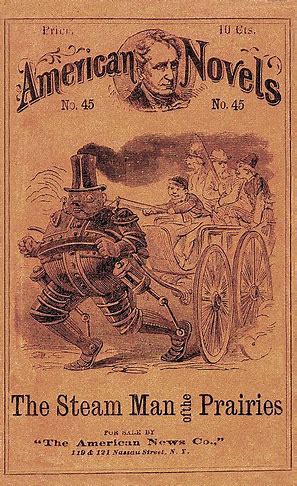 THE STEAM MAN OF THE PRAIRIES (1868) – Written by Edward Sylvester Ellis. Before the Frank Reade stories came this work that is often hailed as the first Dime Novel with a science fiction theme.
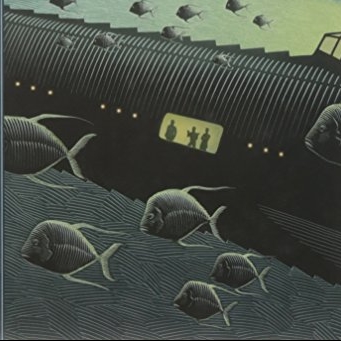
  THE LOG OF THE FLYING FISH: A STORY OF AERIAL AND SUBMARINE PERIL AND ADVENTURE (1887) – Written by Harry Collingwood (William J.C. Lancaster).
  THE WAR UNDER THE SEA (1892) – Written by Georges Le Faure. This sci-fi work was intended as an escapist societal salve to a French public still smarting from their loss to Germanic forces during the Franco-Prussian War just over two decades earlier.
  Interestingly enough, despite this threat the Germans are not depicted as being any more bloodthirsty than the alleged “heroes” of this story as we will see. Though the Count and his allies prove equally callous about large-scale killing (and worse) their attitude is romanticized and approved of by the narrative since Andre and the others are fighting France’s traditional Continental foes the Germans. Instead of Film Noir think of this novel’s approach as callous enough to be called World Noir. Or at least Politics Noir.
  Balladeer’s Blog concludes its examination of Garrett P Serviss’ odd sequel to Fighters From Mars, his blatant imitation of War of the Worlds.
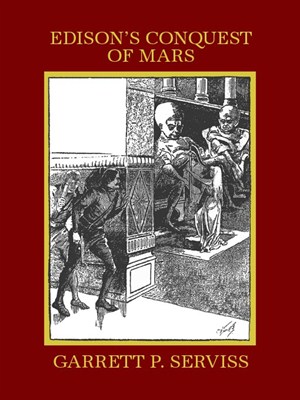 Balladeer’s Blog continues its examination of Garrett P Serviss’ odd sequel to Fighters From Mars, his blatant imitation of War of the Worlds.
  Balladeer’s Blog continues its examination of Garrett P Serviss’ odd sequel to Fighters From Mars, his blatant imitation of War of the Worlds.
  Balladeer's Blog