
Balladeer’s Blog’s periodic look at silent movies and silent film stars continues with a sampling of Rudolph Valentino’s movies, from both before and after he became the Latin Lover sensation of his era.
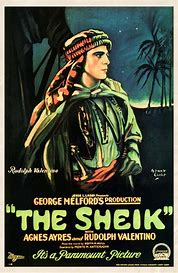 THE SHEIK (1921) – Edith Maude Hull’s 1919 novel came to the big screen to cement Rudolph Valentino’s rising star. He shone as Sheik Ahmed Ben Hassan with Agnes Ayers as Lady Diane Mayo.
Diane is an adventuress who has spurned all marriage proposals thus far and her latest escapade is a tour of the desert led by Arab guides. In a ritzy casino the night before her expedition departs, she dresses as a dancing girl to sneak into an exclusive event being held by Ahmed.
The Sheik is charmed and aroused by this wild and haughty Western woman who listens to no man, not even male relatives like her brother. Ahmed and his troops surreptitiously follow Diane’s caravan and when the time is right, the Sheik abducts her and carries her off to his elaborate tent-mansion deep in the desert.
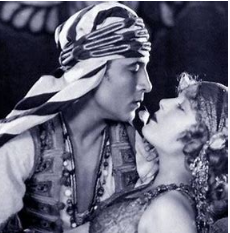 A lot of Gothic Romance Novel antics follow in this film that has not aged well. Valentino’s wide eyes and flaring nostrils were masterfully parodied by Peter Sellers in a comedy bit decades later.
It’s impossible to take his performance seriously through modern eyes, which is just as well since he is basically guilty of kidnapping and taking advantage of the young woman.
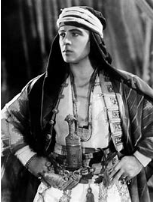 As their battle of wills goes on, Diane is seized by caravan robbers and taken to their leader’s lair. Sheik Ahmed leads his men to the rescue, and, with Stockholm Syndrome well and truly in charge, Lady Diane “realizes” how much she has fallen in love with her abductor.
The most laughable aspects of silent film histrionics make immersion in this 86-minute movie impossible. Luckily, it’s so ridiculous that you can never forget you’re watching a movie, and that Diane is never really in any danger from Valentino or anyone else.
Continue reading
 RIN TIN TIN (1918-1932) – Here at Balladeer’s Blog, I’m even fonder of dogs than I am of silent movies, so this post will combine the two topics. Sadly, most silent films have become so little remembered that few people even realize that there actually WAS a real Rin Tin Tin, adopted by American soldiers during World War One.
 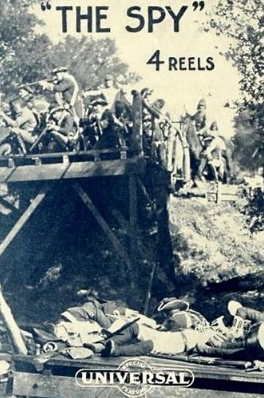 THE SPY (1914) – This four-reel movie was based on the 1821 novel of the same name by THE James Fenimore Cooper. The story is set largely at a home in Scarsdale, New York as American Rebel families share feuds, intrigues and romances with British Loyalists.
 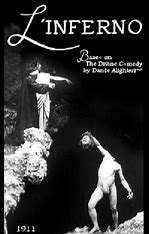 L’INFERNO (1911) – This 71-minute movie was an adaptation of Dante’s epic poem Inferno, one-third of his Divine Comedy along with Purgatorio and Paradiso. It was also Italy’s first feature-length film, beating Cabiria to theaters by three years.
 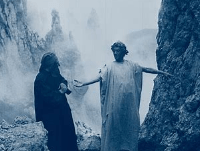 Second, L’Inferno has a certain grandeur from being filmed in Italy itself, the home of Dante Alighieri and his guide through Hell, Virgil. And third, nearly all of the footage set in the realm of the damned was filmed amid extinct and semi-extinct volcanoes in Italy, adding immeasurably to the infernal atmosphere.
 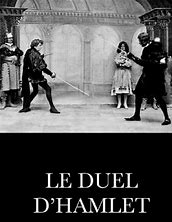 LE DUEL D’HAMLET (1900) – In this roughly 2-minute short, the 56-year-old Bernhardt gave cinema a gender-flipped Hamlet as she fenced with Pierre Magnier as Laertes in the climactic duel.
 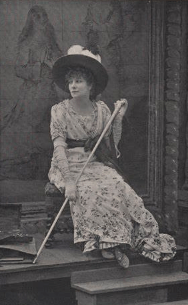 TOSCA (1908, 1912) – Bernhardt portrayed Floria Tosca in this adaptation of the Puccini opera. (Yes, it’s a silent movie version of an opera.) The entire story was condensed into just 40 minutes and Sarah was so appalled with the production that she insisted that it not be released and, in fact, wanted it destroyed!
 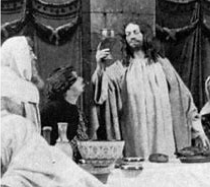 HAPPY EASTER, LADIES AND GENTLEMEN! The good response to my blog post about
 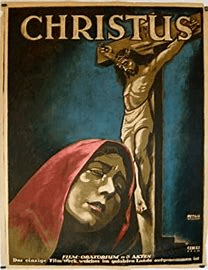 CHRISTUS (1916) – Directed by Giulio Cesare Antamoro, this is a fascinating look at Jesus, from the Angel visiting Mary through his Resurrection and subsequent visit with his Apostles. Christus runs 88 minutes and features some inventive variations on Biblical tableaux. The Star of Bethlehem is depicted as a comet; when Mary finds young Jesus preaching to his teachers His shadow appears as a cross; and Judas gets three visions of the Devil – first urging him on to betray Jesus, then taunting him when he regrets that betrayal, and finally welcoming him into Hell, which opens up under Judas’ swinging corpse.
 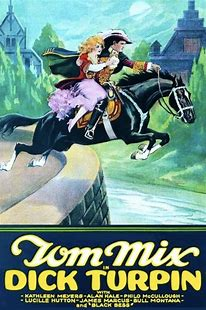 DICK TURPIN (1925) – Western star Tom Mix took a break from his Wild West movies by starring in this highly romanticized film about the real-life English thief and highway robber Dick Turpin. John G. Blystone directed the movie for Fox Film Corporation. Tom swapped his six-guns and rifles for a sword and pistols in this flick.
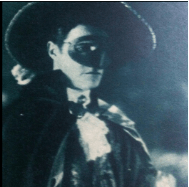 The main villain of the film is Lord Churlton (Philo McCullough), who not only resents having been robbed by Turpin, but abuses his power and influence by menacingly trying to force Lady Alice Brookfield (Kathleen Myers) to marry him.
 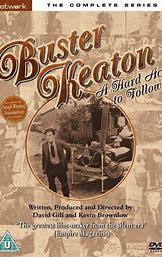 Reactions to Balladeer’s Blog’s reviews of silent movies have been positive enough that I’d like to offer a quick take on a few multi-part documentary series on the subject. Both were from British Film Historian Kevin Brownlow, who did a better job of depicting the Age of Silent Movies than any Americans ever did.
 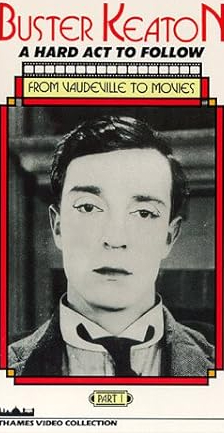 PART ONE – From Vaudeville to Movies: Brownlow and his colleagues scoured the best available footage remaining from Buster Keaton’s silent comedies. (For newbies to silent film history I’ll mention that countless movies from that period are lost forever due to decomposition prior to efforts to preserve them.)
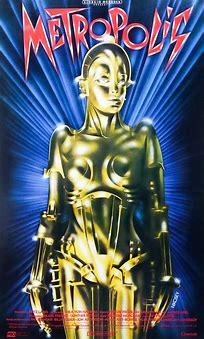 METROPOLIS – Volumes have been written about Fritz Lang’s 1927 silent movie sci-fi masterpiece. I love the film myself but rather than write the 9,899,974th glowing review of the 1927 original I will instead take a look at the 1984 re-issue, produced by Giorgio Moroder, who also did soundtracks for movies like Scarface, Midnight Express, and later Top Gun.
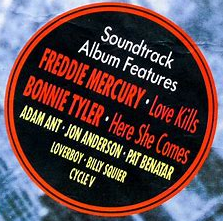 Rather than have the usual classical or similar music play as accompaniment to a silent movie, composer Giorgio Moroder wrote a rock and pop music score to attract a generation of filmgoers who might otherwise have never sat through a silent movie in their lives. Freddie Mercury, Pat Benatar, Adam Ant and Billy Squier were among those performing Moroder’s score.
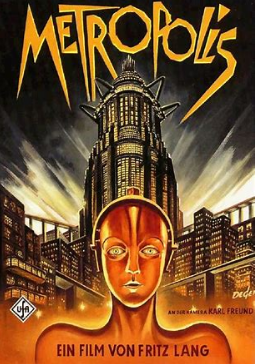 Not only 1984 audiences but all subsequent generations of viewers which were drawn to silent movies in general thanks to airings of Metropolis (1984) may never have brought the new blood and passion to the early cinematic artform if not for Moroder.
 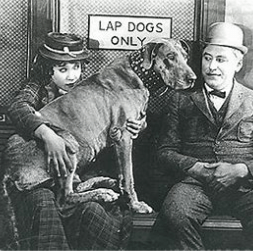 Balladeer’s Blog takes another look at the films of a silent movie star. This time I’m reviewing some of the films featuring trained animal star Teddy the Great Dane aka Teddy the Dog aka Keystone Teddy. From 1915 to 1924 Teddy starred or otherwise appeared in silent shorts as well as feature-length movies.
 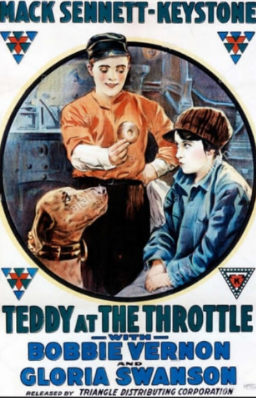 TEDDY AT THE THROTTLE (1917) – This Mack Sennett short at Keystone Studios was one of two films in which Teddy actually got his name in the title. In this light-hearted affair the Great Dane plays the pet of THE Gloria Swanson.
 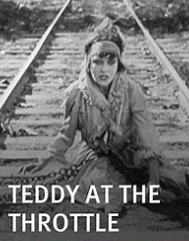 Beery’s villain character is embezzling money from the romantic leads Gloria Swanson and Bobby Vernon. Teddy, the REAL star, is cute and lively, plus he bravely saves Gloria’s life in the end when Beery ties her to railroad tracks after his villainy is exposed.
