
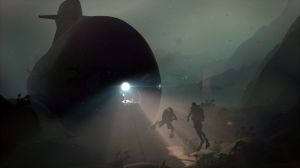
 THE WAR UNDER THE SEA (1892) – Written by Georges Le Faure. This sci-fi work was intended as an escapist societal salve to a French public still smarting from their loss to Germanic forces during the Franco-Prussian War just over two decades earlier.
One of the main characters in The War Under The Sea is Count Andre Petersen, a French military man who saw service in the Franco-Prussian War. The Count was appalled at France’s humiliation and since then has been running a secret intelligence organization to ensure that his homeland will be much better prepared the next time they must face Germans in war. And that’s not the only outrageous science fiction concept put forth in this novel. (I’m kidding.)
Unfortunately for Count Andre the Germans have been outmaneuvering his organization at the arts of spycraft and know the names of every member of his secret organization – even the Danish, Austrian and Alsation operatives. Unless the Count agrees to a political marriage to the daughter of a German Consul followed by the disbanding of his spy network the Germans will kill every one of his agents.
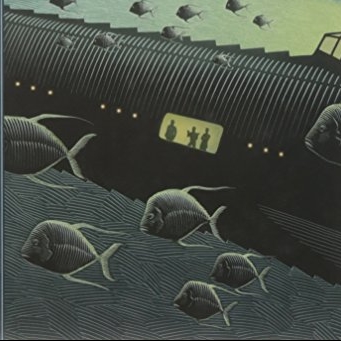 Interestingly enough, despite this threat the Germans are not depicted as being any more bloodthirsty than the alleged “heroes” of this story as we will see. Though the Count and his allies prove equally callous about large-scale killing (and worse) their attitude is romanticized and approved of by the narrative since Andre and the others are fighting France’s traditional Continental foes the Germans. Instead of Film Noir think of this novel’s approach as callous enough to be called World Noir. Or at least Politics Noir.
The Count is rescued from his dilemma by Jacobus Delborg, a Dutch scientist who has created an incredibly advanced submarine and has been running an anti-German spy network of his own. Continue reading
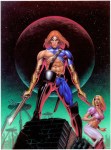
 KILLRAVEN GRAPHIC NOVEL (1983)
 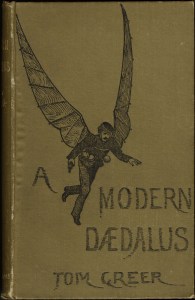 A MODERN DAEDALUS (1887) – By Tom Greer. No, the title’s not referring to James Joyce’s character Stephen Dedalus (sic) but this tale IS about Ireland. The main character is a young man named Jack O’Halloran, a recent college graduate who returns to his native Ireland.
  THE SPIDER OF GUYANA (1860) – Written by the team of Emile Erckmann and Alexandre Chatrian. Balladeer’s Blog’s previous looks at ancient works of science fiction have established how far back the “big bug” trope goes. Creature Feature movies were far from the first appearance of oversized insects and arachnids. And atomic radiation wasn’t needed to justify such outrageous mutations.
  Balladeer’s Blog is all about responding to reader questions and requests. Some of you have mentioned that you’d like to see me write about what revisions I’d have made to the Star Wars sequels in the same way I write about revisions I’d have made to old Killraven stories or how I’d have handled the unfinished Harry Flashman novels.
 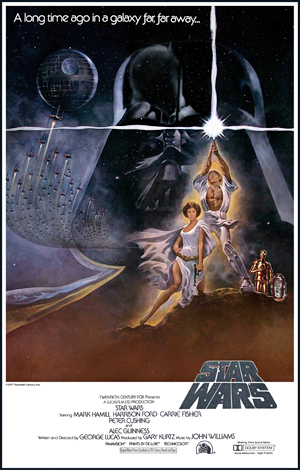 The original 1977 Star Wars is about as close to perfection as you can get in terms of a movie succeeding at what it was intended to be: in this case a fun, uncomplicated valentine to the days of simpler storytelling as a nice antidote to the glut of self-consciously “deep” movies by that point in the 70s.
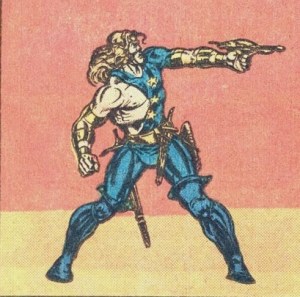
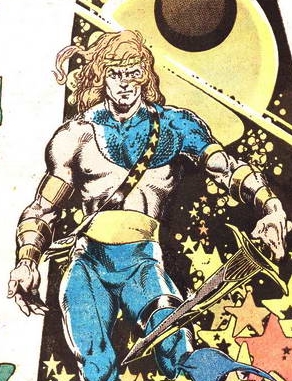 KILLRAVEN: THE GRAPHIC NOVEL (1983) – Killraven and his Freemen continued their guerilla war against Earth’s alien conquerors. In the 7th of its official line of graphic novels, Marvel Comics let writer Don McGregor and artist Craig Russell wrap up some of the storylines left dangling by the cancellation of the 1973-1976 series of Killraven stories. In the previous post I detailed how McGregor had, in the meantime, transferred many of the Killraven story elements and time period to his
 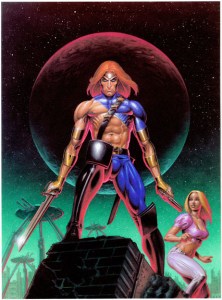 *** First, through no fault of Don McGregor or the original Killraven artists, Darth Vader became a huge pop culture figure in 1977. KR’s main alien villain, the High Overlord (introduced in 1974), had worn full-body armor and a Japanese feudal helmet like the kind Darth Vader went on to wear in Star Wars. Obviously, Star Wars was so much better known than the canceled Killraven series that this 1983 graphic novel dropped the helmet for the High Overlord to avoid looking like their villain was a rip-off of Vader, despite the fact that the High Overlord predated Star Wars.
 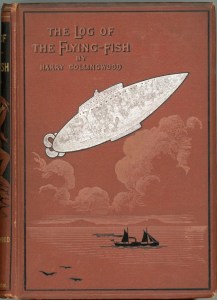 THE LOG OF THE FLYING FISH: A STORY OF AERIAL AND SUBMARINE PERIL AND ADVENTURE (1887) – Written by Harry Collingwood (William J.C. Lancaster).
 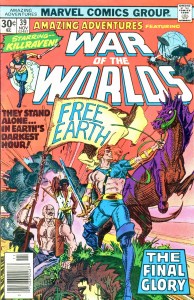 AMAZING ADVENTURES Vol 2 #39 (November 1976)
  It is now January 2020, but we can just call it “44 years from now” as it would have been to 1976 readers. The setting is the Okefenokee Swamp, an unknown number of days after the previous issue’s New Year’s Eve celebration between Killraven and his Freemen and Brother Axe and his military-uniformed rebel colony.
 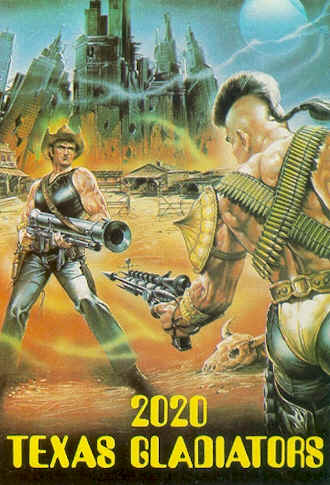 2020 TEXAS GLADIATORS (1982) – HAPPY NEW YEAR! Balladeer’s Blog’s Weirdness at the End of the World welcomes in the year 2020 with a look at what Texas will be like in a few months. There are changes coming your way, Texans!
  Their black wigs with built-in headbands are one thing, their less than authentic vests are another thing, their Tonto way of speaking still another, but the POST-APOCALYPSE TEEPEES they live in will bring a smile to the lips of any true fan of really bad exploitation movies.
 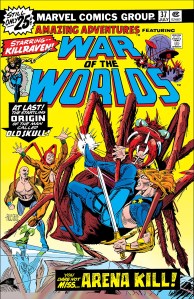 AMAZING ADVENTURES Vol 2 #37 (July 1976)
  The cause of the conflict soon becomes clear – Brother Axe is skeptical that Killraven really is THE Killraven, the world-famous scourge of Earth’s alien conquerors. He suspects KR and his band may be fakers trying to bamboozle him or – even worse – undercover human quislings trying to pinpoint the location of Brother Axe’s rebel band so they can betray the band to their alien masters.
