
Balladeer’s Blog continues its examination of the many facets of Fool Killer lore. FOR PART ONE, INCLUDING THE HISTORICAL CONTEXT, CLICK HERE
 PART EIGHTEEN: In this issue the Fool Killer stated his mission in his newest incarnation (Or “regeneration” we could say with tongue in cheek.) was “the general overturning of all established institutions of every kind.” … “The Hour of Doom has struck for many of this old world’s pet institutions.” Quite a long way from his 1830s mission of driving the Devil out of the Tennessee Hills and killing fools who tried stealing the “hidden” gold of the Melungeons!
A look at the “fools” targeted by the Fool Killer in the September, 1919 issue of James Larkin Pearson’s publication The Fool-Killer:
*** Astronomers claiming that an alignment of planets on December 17th, 1919 would cause a solar explosion visible from Earth, resulting in catastrophic storms and a devastating winter here. A nice touch of cultural kitsch is the way that, with the proposed League of Nations a topic of interest, the astronomers were calling the alignment “The League of Planets.”
*** Democrat President Woodrow Wilson and his operatives who had tried to keep the Bullitt Report out of the public record. This situation came to light when William C Bullitt, Jr was testifying to the Senate Foreign Relations Committee about his mission to the Soviet Union in February and March of 1919. Senator Henry Cabot Lodge allowed Bullitt to enter his suppressed report into the Senate record.
Pearson’s Fool Killer obviously shared his creator’s suspicion that the Wilson Administration wanted Bullitt’s findings suppressed because those findings put Lenin and the Bolshevik Government in Moscow in a better light than Wilson wanted. Continue reading
 PART FIFTEEN: Last time around I examined Joel Chandler Harris’ 1902 story Flingin’ Jim And His Fool-Killer, set in Georgia in October of 1872, plus Ridgway Hill’s Facts For The Fool-Killer, set in and around Buffalo, NY in 1909.
 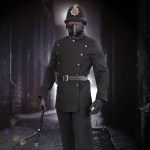 PART FOURTEEN: FACTS FOR THE FOOL-KILLER (1909) by Ridgway Hill.
 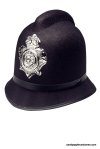 Facts For The Fool-Killer finds the fictional character operating from Buffalo, NY and vicinity. The Fool Killer now wears the blue uniform and tall helmet of a turn-of-the-century policeman and wields a police officer’s billy-club in lieu of his usual club/ walking stick/ cudgel.
  PART THIRTEEN: FABLES IN SLANG (1899)
 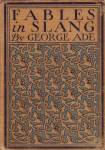 “The written word equivalent of political cartoons” might be another way of describing the fables. In any event Ade did accompany the fables with assorted illustrations.
  PART TWELVE
 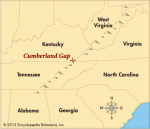 Now we’re in the 1880s and 1890s. The Fool Killer lore of the Melungeon people was absorbing traces of Mormon influence from the wider culture. The Melungeons were NOT Mormons but their Fool Killer tales took on pseudo-religious elements from Mormon lore, like the notion that the Melungeons may be even older than the previously held legends about pre-Columbian Portuguese explorers or ancient Phoenicians.
  PART TEN: MELUNGEON VARIATIONS
 If he had, one possible source would be the Fool Killer figure from Melungeon folklore in East Tennessee and other Appalachian areas. Or, since we have no way of checking exact dates, Evans’ darkly satirical tales may have influenced the existing Melungeon lore since Melungeons at the time were scattered from Tennessee to North Carolina, Kentucky and Virginia.
 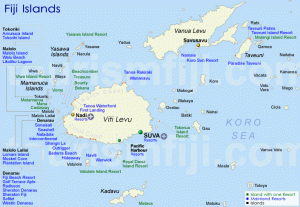 ROKOMAUTU – A son of the supreme deity Ndengei by his sister. This deity was born from his mother’s elbow as another example of birthing oddities in world mythology. Rokomautu was so headstrong he tried to force even his own parents to worship him.
  Labor Day weekend seemed like the appropriate time to post my long-delayed look at neglected working class folk hero Joe Magarac. This figure was the Steel Mill equivalent of Paul Bunyan and John Henry.
  As a lame play on words since this is Labor Day season I’ll present Joe Magarac’s origin and then depict his tales as “Labors” like in The Labors of Hercules.
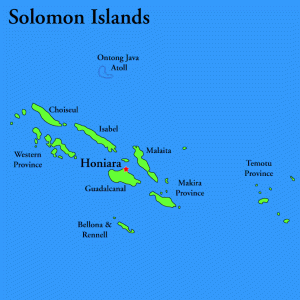 Balladeer’s Blog’s look at the gods and myths of Bellona and Rennell Islands has proven very popular. (CLICK
