
Balladeer’s Blog’s periodic look at silent movies and silent film stars continues with a sampling of Rudolph Valentino’s movies, from both before and after he became the Latin Lover sensation of his era.
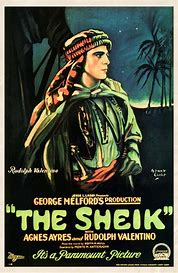 THE SHEIK (1921) – Edith Maude Hull’s 1919 novel came to the big screen to cement Rudolph Valentino’s rising star. He shone as Sheik Ahmed Ben Hassan with Agnes Ayers as Lady Diane Mayo.
Diane is an adventuress who has spurned all marriage proposals thus far and her latest escapade is a tour of the desert led by Arab guides. In a ritzy casino the night before her expedition departs, she dresses as a dancing girl to sneak into an exclusive event being held by Ahmed.
The Sheik is charmed and aroused by this wild and haughty Western woman who listens to no man, not even male relatives like her brother. Ahmed and his troops surreptitiously follow Diane’s caravan and when the time is right, the Sheik abducts her and carries her off to his elaborate tent-mansion deep in the desert.
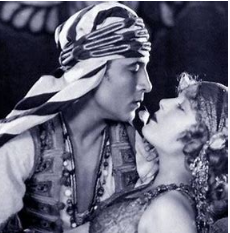 A lot of Gothic Romance Novel antics follow in this film that has not aged well. Valentino’s wide eyes and flaring nostrils were masterfully parodied by Peter Sellers in a comedy bit decades later.
It’s impossible to take his performance seriously through modern eyes, which is just as well since he is basically guilty of kidnapping and taking advantage of the young woman.
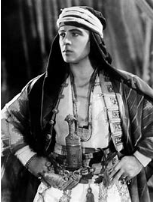 As their battle of wills goes on, Diane is seized by caravan robbers and taken to their leader’s lair. Sheik Ahmed leads his men to the rescue, and, with Stockholm Syndrome well and truly in charge, Lady Diane “realizes” how much she has fallen in love with her abductor.
The most laughable aspects of silent film histrionics make immersion in this 86-minute movie impossible. Luckily, it’s so ridiculous that you can never forget you’re watching a movie, and that Diane is never really in any danger from Valentino or anyone else.
Continue reading
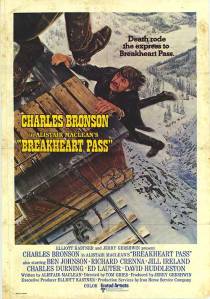 BREAKHEART PASS (1975) – (Frontierado is coming up August 2nd and, as always, it’s about the myth of the Old West, not the grinding reality.) Alistair MacLean may be more closely associated with espionage and crime thrillers like When Eight Bells Toll, The Eagle Has Landed and Puppet on a Chain but his lone Western, Breakheart Pass, is a very solid story which transfers MacLean’s usual themes to the American West.
 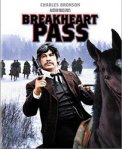 Some critics bash this above-average film because they apparently thought Alistair MacLean’s name on the script meant it would be an over-the-top Western Spy actioner along the lines of Robert Conrad’s old Wild Wild West television series crossed with Where Eagles Dare. Instead, Breakheart Pass comes closer to grittiness than slickness and is all the more enjoyable for that.
  THE FRONTIERADO HOLIDAY IS COMING UP ON FRIDAY, AUGUST 2nd!
 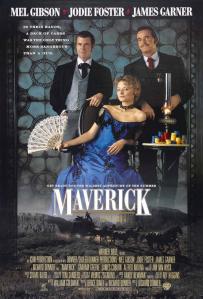 MAVERICK (1994) – Richard Donner directed and Mel Gibson starred in this excellent tribute to the 1950s and 1980s Maverick television series. The original series starred James Garner as slick-talking gambler/ gunslinger Bret Maverick AND, in old-age makeup, as “Pappy” Beauregard Maverick, the gambler and con-man patriarch of that family of rogues. (No relation to the real-life Maverick family of Texas, for whom “maverick” cattle were named.)
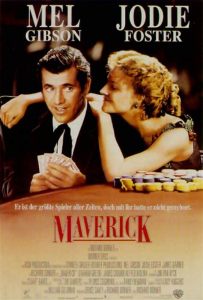 Mel Gibson portrays Bret Maverick since by 1994 James Garner was too old for the role. Jodie Foster co-stars as rival gambler Annabelle Bransford and the iconic James Garner provides memorable support as a lawman.
  RIN TIN TIN (1918-1932) – Here at Balladeer’s Blog, I’m even fonder of dogs than I am of silent movies, so this post will combine the two topics. Sadly, most silent films have become so little remembered that few people even realize that there actually WAS a real Rin Tin Tin, adopted by American soldiers during World War One.
 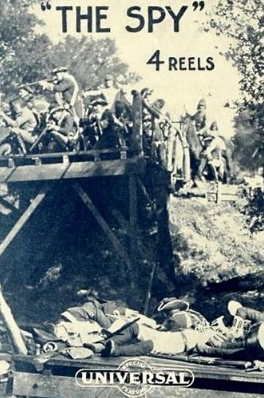 THE SPY (1914) – This four-reel movie was based on the 1821 novel of the same name by THE James Fenimore Cooper. The story is set largely at a home in Scarsdale, New York as American Rebel families share feuds, intrigues and romances with British Loyalists.
 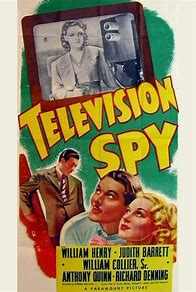 TELEVISION SPY (1939) – I’ve been reminiscing recently, what with Balladeer’s Blog’s 14th Anniversary just having passed a few days ago. I was reflecting on my long-ago review of the hilariously bad 1935 movie Murder by Television, which starred Bela Lugosi in a dual role.
 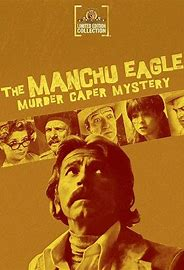 THE MANCHU EAGLE MURDER CAPER MYSTERY (1973, 1975) – This film was made in 1973 but not released until 1975. Where to begin with this bizarre detective “comedy” that starred Gabriel Dell long after his days with the Dead-End Kids/ Bowery Boys/ Little Tough Guys. For starters, fans of that series of films that ran from the 1930s onward will enjoy the fact that Dell gets to share a few scenes with his fellow veteran of those movies – Huntz Hall.
 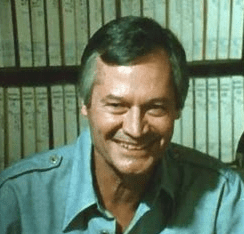 ROGER CORMAN (April 5th, 1926 – May 9th, 2024) – Many words have already been said about the passing of this film industry legend and I’m sure many, many more are yet to be said. From the 1950s to the current year – and with projects still in production – Roger William Corman was a Hollywood fixture.
  Roger was never known as someone who lacked talent, he was just in it for the money most of the time, and therefore kept his budgets tight and his schedules tighter. From 50s monster movies to Raging Youth films to whatever horror trends were ascendant to big-screen soap operas that could be more explicit with their content, Roger Corman was there, raking in bucks and working with future giants of the industry.
 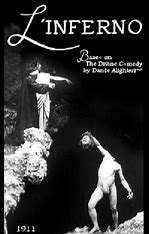 L’INFERNO (1911) – This 71-minute movie was an adaptation of Dante’s epic poem Inferno, one-third of his Divine Comedy along with Purgatorio and Paradiso. It was also Italy’s first feature-length film, beating Cabiria to theaters by three years.
 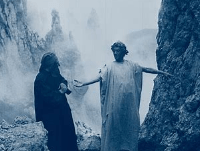 Second, L’Inferno has a certain grandeur from being filmed in Italy itself, the home of Dante Alighieri and his guide through Hell, Virgil. And third, nearly all of the footage set in the realm of the damned was filmed amid extinct and semi-extinct volcanoes in Italy, adding immeasurably to the infernal atmosphere.
 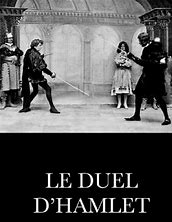 LE DUEL D’HAMLET (1900) – In this roughly 2-minute short, the 56-year-old Bernhardt gave cinema a gender-flipped Hamlet as she fenced with Pierre Magnier as Laertes in the climactic duel.
 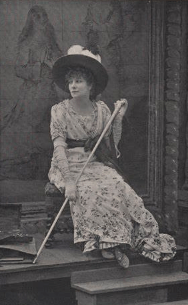 TOSCA (1908, 1912) – Bernhardt portrayed Floria Tosca in this adaptation of the Puccini opera. (Yes, it’s a silent movie version of an opera.) The entire story was condensed into just 40 minutes and Sarah was so appalled with the production that she insisted that it not be released and, in fact, wanted it destroyed!
  Balladeer's Blog